
Science
Scientists Reveal Evidence of Massive Ancient Ocean on Mars

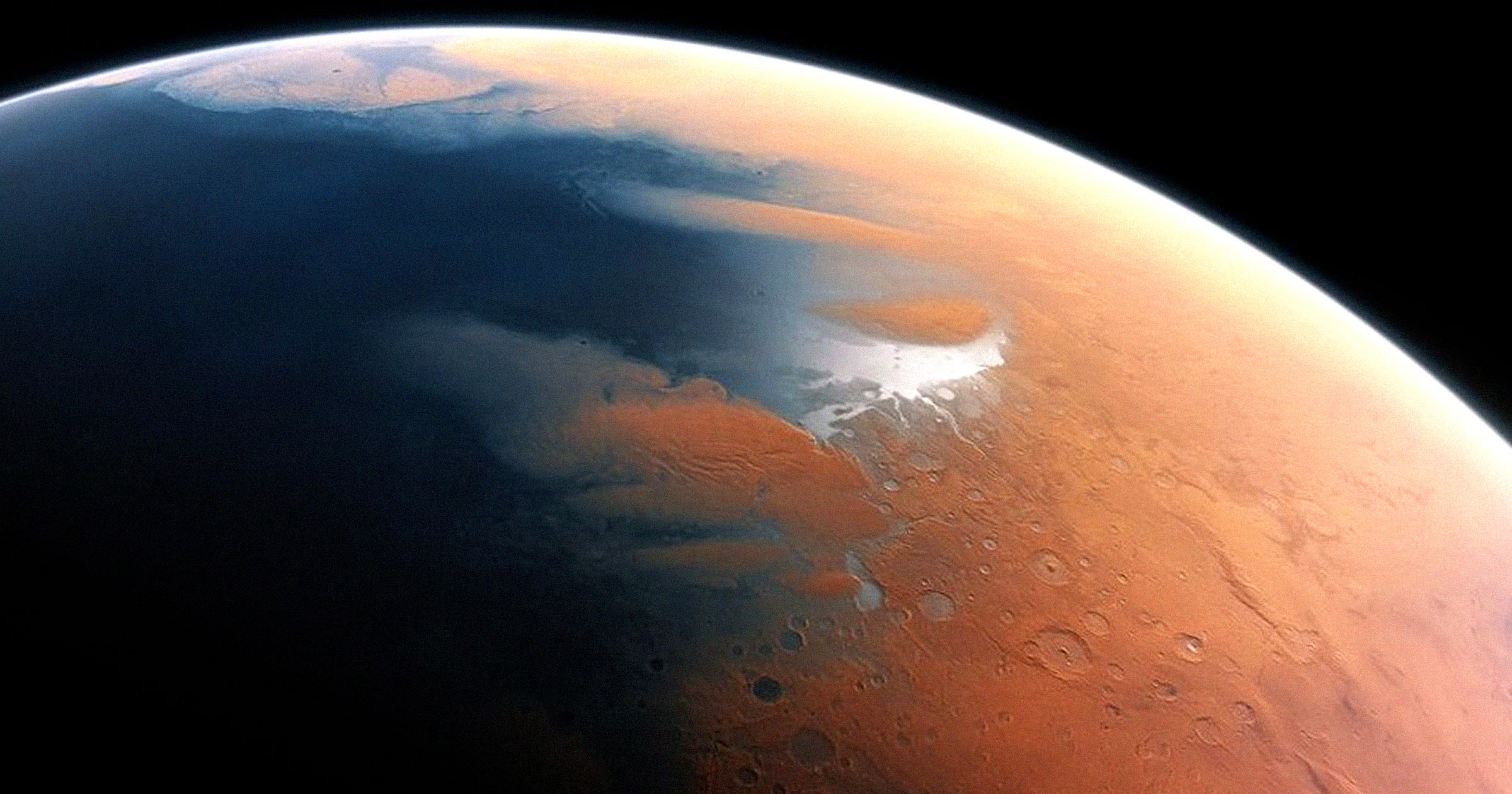
Researchers have uncovered compelling evidence suggesting that Mars once hosted a vast ocean capable of supporting life. An international team, utilizing advanced satellite data, simulated sea levels in the **Coprates Chasma**, a significant feature of the **Valles Marineris**, the largest canyon in the solar system. Their findings, published in the journal **NPJ Space Exploration**, indicate that ancient river deltas on Mars resemble those found on Earth, reinforcing the idea that the planet was once a “blue planet” approximately **three billion years ago**.
The team analyzed satellite imagery from the **European Space Agency’s ExoMars Trace Gas Orbiter**, **Mars Express**, and **NASA’s Mars Reconnaissance Orbiter**. They observed geomorphologic structures in the Valles Marineris that closely mimic the mouths of rivers flowing into oceans on Earth. This led them to infer a historical sea level, indicating the period when the planet had its highest availability of surface water.
Ignatius Argadestya, a PhD student from the **University of Bern**, expressed his excitement over the findings, stating, “The unique high-resolution satellite images of Mars have enabled us to study the Martian landscape in great detail by surveying and mapping.” He highlighted the remarkable similarities between Martian features and Earth’s mountainous landscapes. “I was particularly impressed by the deltas that I discovered at the edge of one of the mountains,” he added.
As the team compared Martian “fan deltas” with those on Earth, they found striking correspondences. According to coauthor and geology professor **Fritz Schlunegger**, the evidence suggests that these structures represent the mouths of rivers flowing into a substantial ocean. They estimated that the ocean could have been at least the size of the **Arctic Ocean**.
While Schlunegger acknowledged that previous research has posited the existence of such an ocean, their study provides new insights based on high-resolution imagery and detailed reconstruction of ancient coastlines. Argadestya noted, “With our study, we were able to provide evidence for the deepest and largest former ocean on Mars to date — an ocean that stretched across the northern hemisphere of the planet.”
The implications of these findings for the search for ancient life on Mars are still being explored. Nonetheless, they offer an intriguing perspective on the planet’s history, suggesting a time when it was a vibrant, water-rich environment.
As scientists continue to analyze the Martian landscape, this research presents a tantalizing glimpse into the potential for ancient life on a planet that is now a stark desert, far removed from its once-thriving past.






Revolutionary Photonic Ski-Jump Could Miniaturize LiDAR Systems

Couples Detox from Plastics in New Netflix Doc: Can It Boost Fertility?

Aventon Launches Affordable Full-Suspension Electric Mountain Bike

Discover Eight Must-Try Restaurants This Spring Season

UC Irvine Team Unveils Innovative Ion Pump for Water Treatment

One-Third of Americans Trim Daily Expenses for Healthcare Needs

Apple Secures First Oscar in Three Years with F1: The Movie

Fourth Graders Celebrate St. Patrick’s Day with Creative Weather Drawings

Kim Kardashian Dazzles at Vanity Fair Oscars Party 2026

Nostradamus’ 2026 Predictions: Star Death and Dark Events Loom

Breakthroughs and Challenges Await Science in 2026

Electric Moto Influencer Surronster Arrested in Tijuana

OpenAI to Implement Age Verification for ChatGPT by December 2025

Discover the Top 10 Calorie Counting Apps of 2025

Bella Hadid Shares Health Update After Treatment for Lyme Disease

Analysts Project Stronger Growth for Apple’s iPhone 17 Lineup

Japanese Study Finds Rose Oil Can Increase Brain Gray Matter

Top 10 Penny Stocks to Watch in 2026 for Strong Returns
-
 Science4 months ago
Nostradamus’ 2026 Predictions: Star Death and Dark Events Loom
-
 Science4 months ago
Breakthroughs and Challenges Await Science in 2026
-
 Technology7 months ago
Electric Moto Influencer Surronster Arrested in Tijuana
-
 Technology4 months ago
OpenAI to Implement Age Verification for ChatGPT by December 2025
-
 Technology9 months ago
Discover the Top 10 Calorie Counting Apps of 2025
-
 Health7 months ago
Bella Hadid Shares Health Update After Treatment for Lyme Disease
-
 Health7 months ago
Analysts Project Stronger Growth for Apple’s iPhone 17 Lineup
-
 Health7 months ago
Japanese Study Finds Rose Oil Can Increase Brain Gray Matter
-
 Technology4 months ago
Top 10 Penny Stocks to Watch in 2026 for Strong Returns
-

 Science6 months ago
Starship V3 Set for 2026 Launch After Successful Final Test of Version 2
-

 Technology1 month ago
Nvidia GTC 2026: Major Announcements Expected for AI and Hardware
-

 Education7 months ago
Harvard Secures Court Victory Over Federal Funding Cuts