
Science
NASA Gears Up for Crewed Moon Mission with Cleveland Expertise

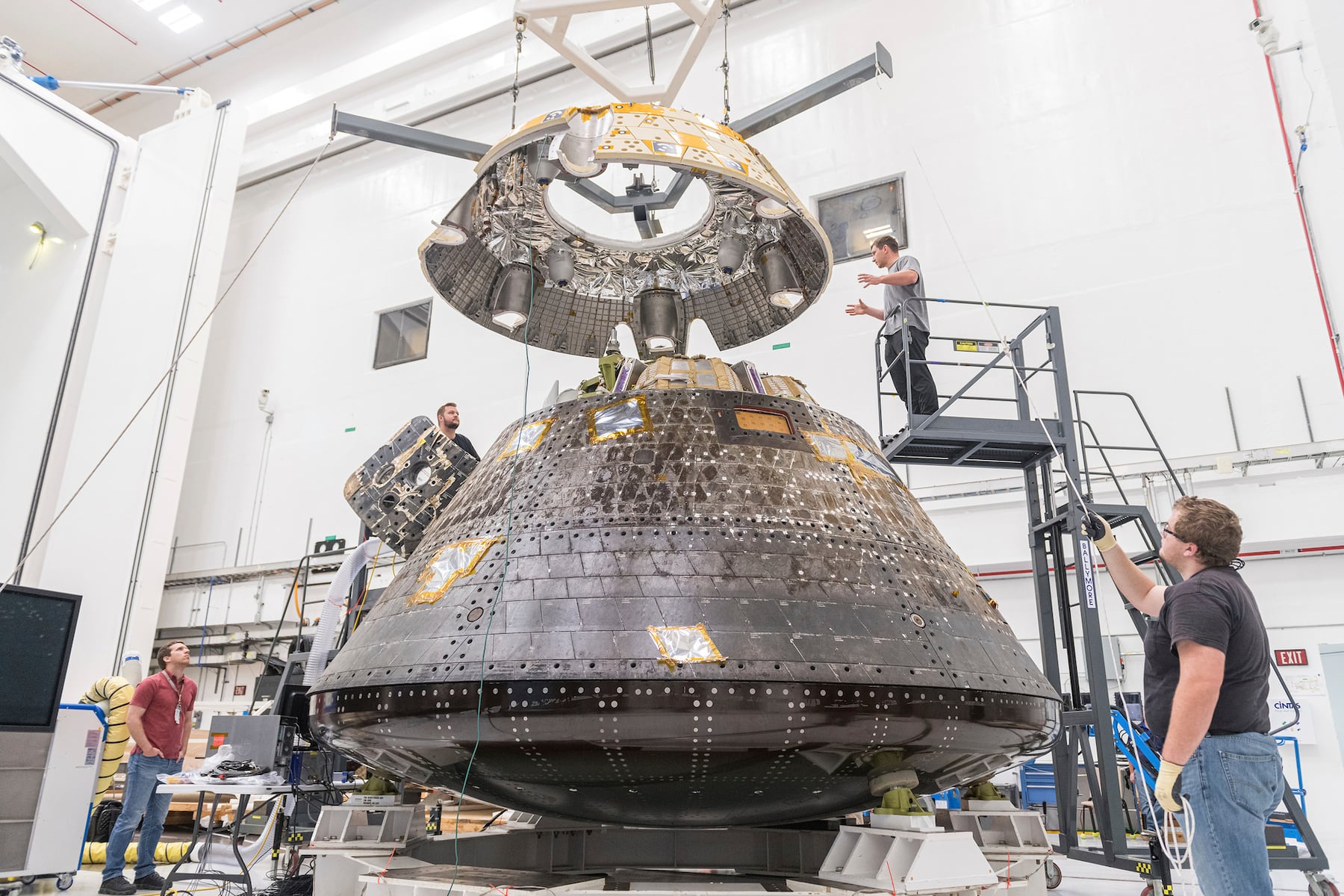
NASA is on the brink of another historic lunar journey, marking the first crewed mission to orbit the moon in over 50 years. Scheduled for launch on April 1, 2024, from Cape Canaveral, Florida, the Artemis II mission will carry four astronauts, including three Americans and a Canadian, on a ten-day adventure into deep space.
This mission is significant in NASA’s broader plan to establish a permanent lunar base and explore further into the solar system. The agency’s efforts are bolstered by the expertise of the NASA Glenn Research Center in Cleveland, where more than 80 engineers are playing crucial roles in the mission’s preparations.
Collaboration and Integration Efforts
A key focus for the Cleveland engineers has been ensuring the seamless integration of the service module, developed by the European Space Agency and its prime contractor, Airbus, with the Orion spacecraft. The Orion vehicle, which includes both a crew module and an attached service module, is designed to supply astronauts with essential resources like power, propulsion, air, and water during their flight.
Steve Barsi, deputy manager of the European Service Module Integration Office at NASA Glenn, highlighted the major differences between Artemis II and its predecessor, Artemis I, which was an uncrewed mission in 2022. “The addition of life-support systems is a significant advancement,” Barsi explained. This includes systems that will pump oxygen and nitrogen into the crew cabin, ensuring that astronauts can breathe easily during their journey.
NASA Glenn engineers have been proactive in their approach, visiting suppliers to observe testing and traveling to Germany, where the service module components were assembled.
Innovations and Challenges Ahead
The crew module itself is larger than those used by the Apollo astronauts decades ago but still presents challenges in terms of space. Rob Ahlman, a systems engineer at NASA Glenn, noted the tight quarters, stating, “I’ve been in the full-size mockup and it’s not roomy.” Despite the constraints, the module has undergone extensive testing at NASA Glenn’s Neil Armstrong Test Facility to ensure it can withstand the intense forces of launch and reentry.
Among the critical components is the launch abort system, which is designed to propel the crew module away from the launch vehicle in case of an emergency. Ahlman’s work has focused on ensuring this system is ready for any eventuality, even though it is hoped that it will never be needed.
Delays have been part of the Artemis II timeline, initially set for 2024. Evaluations of the heat shield, which protects the crew during reentry, revealed some areas that needed further assessment after its successful performance in Artemis I. Launch windows initially scheduled for early February and March faced setbacks due to technical issues, leading to the current planned launch on April 1.
Following the launch, Orion will be propelled into space atop the Space Launch System, which includes a main rocket and two boosters. Mission Control at the Johnson Space Center in Houston will oversee the mission, with Barsi among the nine managers responsible for monitoring data and addressing any anomalies.
NASA’s ambitions extend beyond Artemis II, with plans for Artemis III in 2027, aiming to return astronauts to low-Earth orbit, and Artemis IV set for a lunar landing in 2028. The Artemis II astronauts will play a vital role in assessing lunar geology to identify potential landing sites for future missions, examining features like impact craters and ancient lava flows.
As the launch date approaches, excitement within the NASA Glenn team is palpable. Ahlman plans to attend the launch at the Kennedy Space Center with his family, reflecting on how far he has come since his childhood days building model rockets. “This is a really exciting time,” he remarked. “It’s not just for Glenn, it’s for NASA, the U.S., and humanity. It’s truly an exciting moment.”
NASA’s long-term vision includes future missions to Mars, potentially utilizing advanced technologies being developed at NASA Glenn that could make interplanetary travel feasible. As Barsi noted, “In the long run, sustaining life outside of our planet is crucial for our species.” The Artemis II mission stands as a testament to human ingenuity and determination, setting the stage for a new era of space exploration.









Revolutionary Photonic Ski-Jump Could Miniaturize LiDAR Systems

Couples Detox from Plastics in New Netflix Doc: Can It Boost Fertility?

Aventon Launches Affordable Full-Suspension Electric Mountain Bike

Discover Eight Must-Try Restaurants This Spring Season

UC Irvine Team Unveils Innovative Ion Pump for Water Treatment

One-Third of Americans Trim Daily Expenses for Healthcare Needs

Apple Secures First Oscar in Three Years with F1: The Movie

Fourth Graders Celebrate St. Patrick’s Day with Creative Weather Drawings

Kim Kardashian Dazzles at Vanity Fair Oscars Party 2026

Nostradamus’ 2026 Predictions: Star Death and Dark Events Loom

Breakthroughs and Challenges Await Science in 2026

Electric Moto Influencer Surronster Arrested in Tijuana

OpenAI to Implement Age Verification for ChatGPT by December 2025

Discover the Top 10 Calorie Counting Apps of 2025

Recovering a Suspended TikTok Account: A Step-by-Step Guide

Bella Hadid Shares Health Update After Treatment for Lyme Disease

Backpack Drives Equip Students with Supplies for New School Year

Analysts Project Stronger Growth for Apple’s iPhone 17 Lineup
-
 Science8 months ago
Nostradamus’ 2026 Predictions: Star Death and Dark Events Loom
-
 Science8 months ago
Breakthroughs and Challenges Await Science in 2026
-
 Technology11 months ago
Electric Moto Influencer Surronster Arrested in Tijuana
-
 Technology9 months ago
OpenAI to Implement Age Verification for ChatGPT by December 2025
-
 Technology1 year ago
Discover the Top 10 Calorie Counting Apps of 2025
-
 Technology1 year ago
Recovering a Suspended TikTok Account: A Step-by-Step Guide
-
 Health11 months ago
Bella Hadid Shares Health Update After Treatment for Lyme Disease
-
 Education1 year ago
Backpack Drives Equip Students with Supplies for New School Year
-
 Health11 months ago
Analysts Project Stronger Growth for Apple’s iPhone 17 Lineup
-

 Health12 months ago
Japanese Study Finds Rose Oil Can Increase Brain Gray Matter
-

 Technology8 months ago
Top 10 Penny Stocks to Watch in 2026 for Strong Returns
-

 Science10 months ago
Starship V3 Set for 2026 Launch After Successful Final Test of Version 2