
Top Stories
Revolutionary Photonic Ski-Jump Could Miniaturize LiDAR Systems

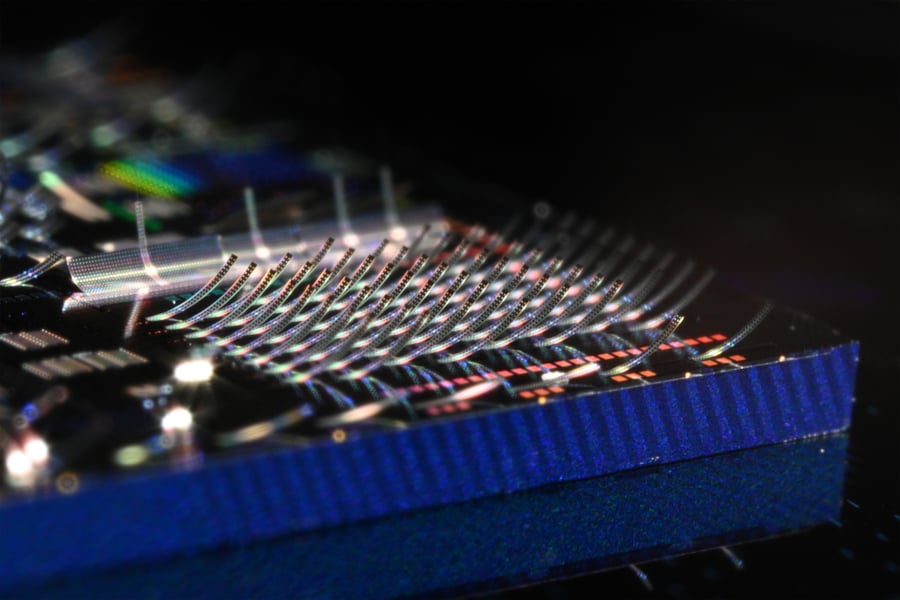
A groundbreaking development in photonics could significantly reduce the size and power requirements of LiDAR systems used in spacecraft. Researchers from the Massachusetts Institute of Technology (MIT), MITRE, and Sandia National Laboratories have introduced a new technology, termed the “photonic ski-jump,” which has the potential to transform how spacecraft communicate and navigate.
This innovation addresses a long-standing challenge in the aerospace sector: the weight and power demands of optical and communication hardware. Traditionally, LiDAR systems, essential for distance measurement and spatial awareness, have relied on bulky mechanical mirrors that are heavy and energy-intensive. The recent paper published in the journal Nature outlines how the photonic ski-jump can overcome these limitations.
At its core, the photonic ski-jump is a nanoscale optical waveguide integrated onto a piezoelectrically controlled microcantilever. This design resembles a series of miniature ski jumps extending from the surface of a chip. By utilizing thermal forces created during the cooling of different chip layers, the cantilever bends at a 90-degree angle. When alternating voltages are applied, the ski-jump’s tip can oscillate rapidly, producing thousands of precisely controlled laser beams in a very small area, less than 0.1 mm squared. This capability enables the creation of images equivalent to a 30,000 pixel display in a space no larger than half a grain of salt.
The potential applications for this technology are vast. Initially developed to address challenges in quantum computing, where control over millions of qubits requires highly accurate laser systems, the ski-jump technology is now poised to also benefit augmented reality. Researchers envision it could enable devices to render high-resolution images in real-time, enhancing user interaction with their environments.
In testing, the researchers successfully projected stable, full-color images into free space, effectively creating a high-resolution 2D hologram. Additionally, they demonstrated the system’s capabilities within a cryostat to detect the state of a single silicon vacancy on a quantum chip, marking a significant advancement in quantum technology.
While the immediate commercial focus may lean towards augmented reality glasses due to their broad market appeal, the implications for LiDAR technology are profound. Currently, LiDAR systems are prominent in autonomous vehicles and are also utilized in aerospace, where spacecraft often need to navigate closely around other objects during operations such as landing or docking. Traditional LiDAR units are characterized by their bulkiness, fragility, and high power consumption. The new ski-jump photonics system could potentially eliminate these issues, making future LiDAR systems lighter, more durable, and more efficient.
Yet, it is important to note that this technology is still in its early development stages. Real-world applications in space exploration may take time to materialize, as the system must be rigorously tested for its ability to withstand the harsh conditions of launch and cosmic radiation.
As researchers continue to refine this technology, it heralds a promising future for both LiDAR and quantum computing. The advancements made with the photonic ski-jump could redefine how spacecraft navigate and interact within their environments, paving the way for more efficient space exploration and communication.








Revolutionary Photonic Ski-Jump Could Miniaturize LiDAR Systems

Couples Detox from Plastics in New Netflix Doc: Can It Boost Fertility?

Aventon Launches Affordable Full-Suspension Electric Mountain Bike

Discover Eight Must-Try Restaurants This Spring Season

UC Irvine Team Unveils Innovative Ion Pump for Water Treatment

One-Third of Americans Trim Daily Expenses for Healthcare Needs

Apple Secures First Oscar in Three Years with F1: The Movie

Fourth Graders Celebrate St. Patrick’s Day with Creative Weather Drawings

Kim Kardashian Dazzles at Vanity Fair Oscars Party 2026

Nostradamus’ 2026 Predictions: Star Death and Dark Events Loom

Breakthroughs and Challenges Await Science in 2026

Electric Moto Influencer Surronster Arrested in Tijuana

OpenAI to Implement Age Verification for ChatGPT by December 2025

Discover the Top 10 Calorie Counting Apps of 2025

Recovering a Suspended TikTok Account: A Step-by-Step Guide

Bella Hadid Shares Health Update After Treatment for Lyme Disease

Backpack Drives Equip Students with Supplies for New School Year

Analysts Project Stronger Growth for Apple’s iPhone 17 Lineup
-
 Science8 months ago
Nostradamus’ 2026 Predictions: Star Death and Dark Events Loom
-
 Science8 months ago
Breakthroughs and Challenges Await Science in 2026
-
 Technology11 months ago
Electric Moto Influencer Surronster Arrested in Tijuana
-
 Technology9 months ago
OpenAI to Implement Age Verification for ChatGPT by December 2025
-
 Technology1 year ago
Discover the Top 10 Calorie Counting Apps of 2025
-
 Technology1 year ago
Recovering a Suspended TikTok Account: A Step-by-Step Guide
-
 Health11 months ago
Bella Hadid Shares Health Update After Treatment for Lyme Disease
-
 Education1 year ago
Backpack Drives Equip Students with Supplies for New School Year
-
 Health12 months ago
Analysts Project Stronger Growth for Apple’s iPhone 17 Lineup
-

 Health12 months ago
Japanese Study Finds Rose Oil Can Increase Brain Gray Matter
-

 Technology8 months ago
Top 10 Penny Stocks to Watch in 2026 for Strong Returns
-

 Science10 months ago
Starship V3 Set for 2026 Launch After Successful Final Test of Version 2