
Science
New Research Reveals Thickness of Europa’s Ice Shell, Impacts Habitability

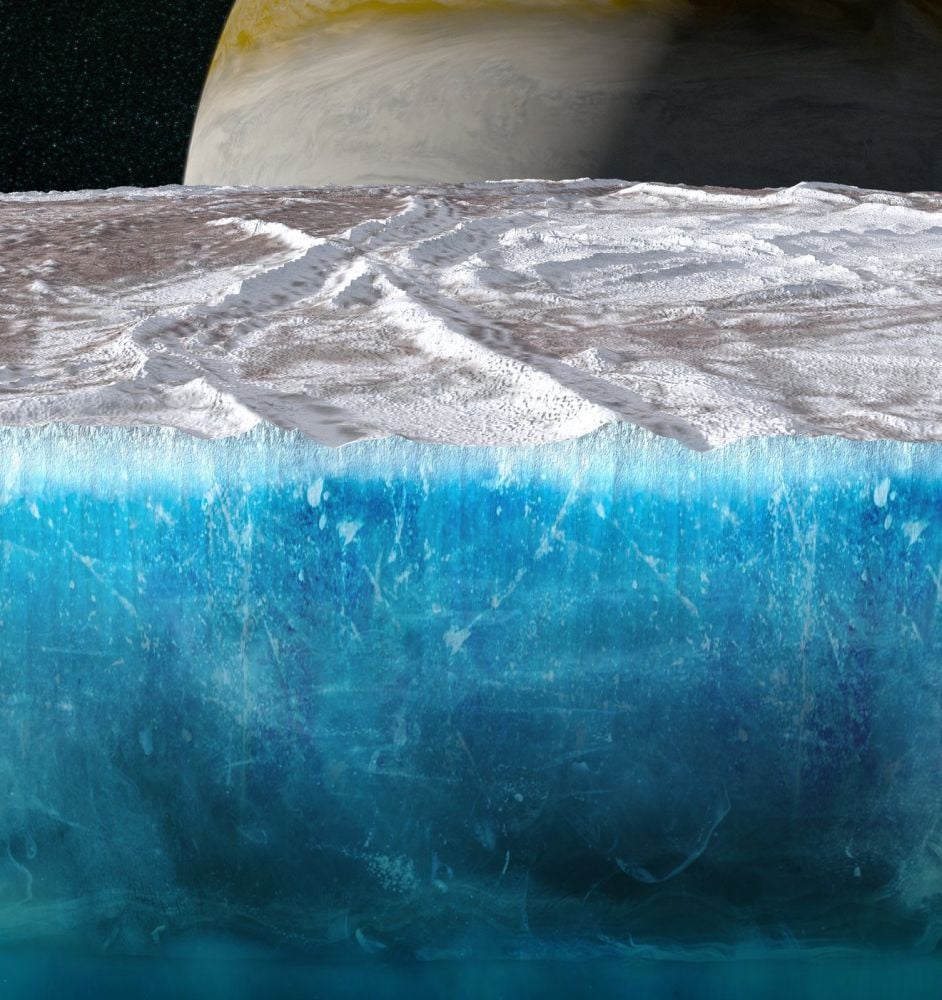
Recent observations have provided new insights into the thickness of Europa’s icy shell, which could significantly influence the moon’s potential for habitability. A study published in Nature Astronomy reveals that Europa, one of Jupiter’s moons, has an ice shell estimated to be between 3 km and 30 km thick, complicating theories about the existence of life beneath its frozen surface.
The findings stem from data collected by NASA’s Juno spacecraft, which has been monitoring the Jovian system since 2016. Europa has long captured scientific interest due to its underlying warm ocean, which is believed to be rich in chemical elements necessary for life. This ocean may provide essential ingredients for biological processes, prompting missions like NASA’s Europa Clipper and the European Space Agency’s JUICE to explore the moon in greater detail.
The idea that Europa might harbor a subsurface ocean dates back to the early Voyager missions, which revealed a cracked icy surface. Subsequent evidence from the Galileo mission and Hubble Space Telescope observations of erupting plumes further supported this hypothesis. Yet, critical questions about the thickness of the ice shell and its composition remain unanswered.
Scientists, led by Steve Levin, Juno project scientist at NASA’s Jet Propulsion Laboratory, utilized Juno’s Microwave Radiometer (MWR) to gather these measurements. The MWR can penetrate the thick atmosphere of Jupiter and measure temperature variations across different depths of Europa’s ice. This capability allowed researchers to estimate the ice shell’s thickness and analyze its structural characteristics.
According to the study, “Jupiter’s moon Europa is thought to harbour a saltwater ocean beneath a variously disrupted ice shell, and it is, thus, one of the highest priority astrobiology targets in the Solar System.” The results indicate that while the ice shell is indeed thick, its potential to allow chemical interactions between the surface and the ocean may be limited.
The findings suggest that if Europa’s ice shell is around 29 ± 10 km thick, as modeled assuming pure water ice, the presence of cracks or pores extending only a few hundred meters beneath the surface may not provide sufficient pathways for nutrients to reach the ocean. The implications of this limitation could dampen enthusiasm regarding the moon’s habitability.
Levin noted, “The 18-mile estimate relates to the cold, rigid, conductive outer layer of a pure water ice shell. If an inner, slightly warmer convective layer also exists, the total ice shell thickness would be even greater.” This presents a more complex picture regarding the ice’s capacity to support life, as thicker ice serves as a more effective barrier against chemical exchange.
Additionally, the study raises questions about the observed plumes. Previous assumptions that these geysers originate from the subsurface ocean may need reevaluation, as they could instead be emanating from pockets of water trapped within the ice.
The implications of these findings are twofold. While they cast doubt on the direct chemical pathways that would support life, they do not entirely eliminate the possibility of life existing in Europa’s ocean. Tidal heating and hydrothermal vents could still play crucial roles in sustaining potential biological activity.
The researchers also acknowledged limitations in their study, noting that their measurements are restricted to specific terrain observed by Juno. They emphasized the need for further mapping of Europa’s surface, which may reveal variations in ice shell thickness or other structural characteristics that could enhance our understanding of its habitability.
The upcoming missions, particularly the Europa Clipper set to arrive in 2030, are expected to provide more comprehensive data. The Clipper will conduct nearly 50 close flybys of Europa, employing ice-penetrating radar to map the boundary between the ocean and ice more thoroughly. Meanwhile, JUICE will perform limited flybys and study multiple moons, including Europa.
As scientists await the results from these missions, the complexities surrounding Europa’s ice shell and its potential for supporting life continue to evolve. The ongoing exploration of this intriguing moon promises to yield critical insights into the broader questions of habitability within our solar system.







Revolutionary Photonic Ski-Jump Could Miniaturize LiDAR Systems

Couples Detox from Plastics in New Netflix Doc: Can It Boost Fertility?

Aventon Launches Affordable Full-Suspension Electric Mountain Bike

Discover Eight Must-Try Restaurants This Spring Season

UC Irvine Team Unveils Innovative Ion Pump for Water Treatment

One-Third of Americans Trim Daily Expenses for Healthcare Needs

Apple Secures First Oscar in Three Years with F1: The Movie

Fourth Graders Celebrate St. Patrick’s Day with Creative Weather Drawings

Kim Kardashian Dazzles at Vanity Fair Oscars Party 2026

Nostradamus’ 2026 Predictions: Star Death and Dark Events Loom

Breakthroughs and Challenges Await Science in 2026

Electric Moto Influencer Surronster Arrested in Tijuana

OpenAI to Implement Age Verification for ChatGPT by December 2025

Discover the Top 10 Calorie Counting Apps of 2025

Recovering a Suspended TikTok Account: A Step-by-Step Guide

Bella Hadid Shares Health Update After Treatment for Lyme Disease

Backpack Drives Equip Students with Supplies for New School Year

Analysts Project Stronger Growth for Apple’s iPhone 17 Lineup
-
 Science8 months ago
Nostradamus’ 2026 Predictions: Star Death and Dark Events Loom
-
 Science8 months ago
Breakthroughs and Challenges Await Science in 2026
-
 Technology11 months ago
Electric Moto Influencer Surronster Arrested in Tijuana
-
 Technology9 months ago
OpenAI to Implement Age Verification for ChatGPT by December 2025
-
 Technology1 year ago
Discover the Top 10 Calorie Counting Apps of 2025
-
 Technology1 year ago
Recovering a Suspended TikTok Account: A Step-by-Step Guide
-
 Health11 months ago
Bella Hadid Shares Health Update After Treatment for Lyme Disease
-
 Education1 year ago
Backpack Drives Equip Students with Supplies for New School Year
-
 Health12 months ago
Analysts Project Stronger Growth for Apple’s iPhone 17 Lineup
-

 Health12 months ago
Japanese Study Finds Rose Oil Can Increase Brain Gray Matter
-

 Technology8 months ago
Top 10 Penny Stocks to Watch in 2026 for Strong Returns
-

 Science10 months ago
Starship V3 Set for 2026 Launch After Successful Final Test of Version 2