
Science
New Insights on 1977 Wow! Signal Linked to Mysterious Comet

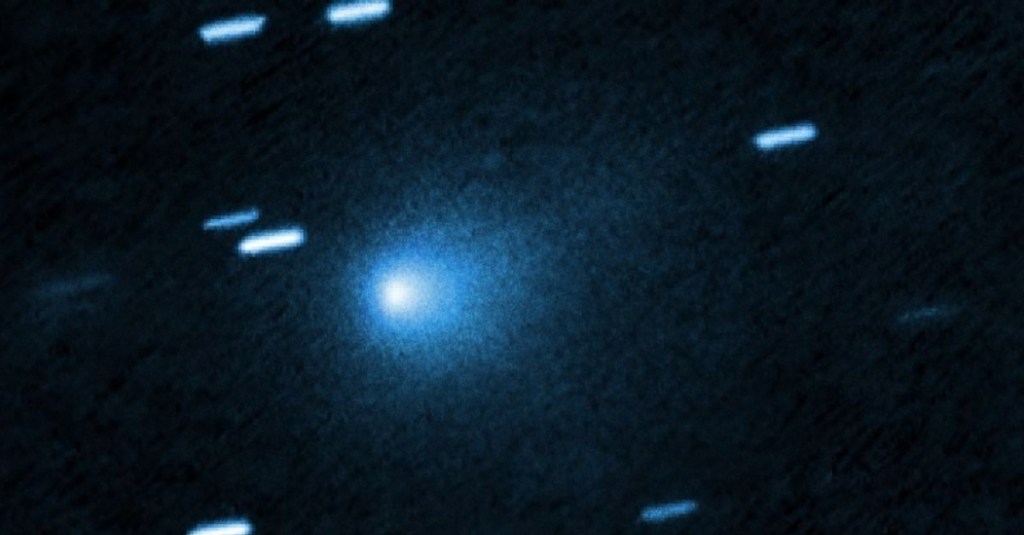
In a remarkable turn of events, recent analysis suggests that the enigmatic “Wow!” signal, which was detected in 1977, could be linked to a newly discovered comet, known as 3I/ATLAS. This signal, a 72-second burst of radio waves captured by a telescope at Ohio State University, has puzzled scientists for decades as it remains the only one of its kind ever recorded.
The “Wow!” signal was identified by astronomer Jerry Ehman, who famously circled the printout with a red pen and annotated it with the word “wow!” Since then, the search for an explanation has led to numerous theories. The latest comes from Avi Loeb, a Harvard astronomer known for his provocative views on extraterrestrial life. Loeb suggests that the signal may have originated from 3I/ATLAS, a comet discovered in 2023, which is only the third known object to visit our solar system from interstellar space.
Loeb’s hypothesis is built on the observation that both the comet and the “Wow!” signal seem to originate from similar directions in space. He calculates the probability of this alignment being random at around 0.6 percent, a figure he considers notably low. This correlation raises intriguing questions about the nature of both phenomena.
Despite Loeb’s enthusiasm, there are significant challenges to his theory. In 1977, the comet would have been approximately 600 astronomical units from Earth, translating to roughly 55 billion miles. For the signal to reach Earth from such a distance, it would require a powerful transmitter, potentially equivalent to the output of a nuclear reactor.
Moreover, no current telescopes have detected any transmissions from 3I/ATLAS, casting further doubt on the idea that it could be the source of the “Wow!” signal. In light of these challenges, Loeb is advocating for a comprehensive observational campaign. He proposes a constant surveillance effort of 3I/ATLAS, hoping to capture any signals that might confirm its origins or reveal it as a technologically advanced artifact from a distant civilization.
This proposal reflects a growing interest in the intersection of astronomy and the search for extraterrestrial intelligence. While NASA scientists remain cautious, attributing the comet’s unusual behavior to natural phenomena, Loeb’s perspective adds an engaging dimension to ongoing discussions about the possibilities of life beyond Earth.
As the scientific community continues to explore the mysteries of space, the connection between the “Wow!” signal and 3I/ATLAS serves as a reminder of the enduring allure of the unknown. Further research and observations may soon provide new insights into one of the most enduring questions in astronomy.










Revolutionary Photonic Ski-Jump Could Miniaturize LiDAR Systems

Couples Detox from Plastics in New Netflix Doc: Can It Boost Fertility?

Aventon Launches Affordable Full-Suspension Electric Mountain Bike

Discover Eight Must-Try Restaurants This Spring Season

UC Irvine Team Unveils Innovative Ion Pump for Water Treatment

One-Third of Americans Trim Daily Expenses for Healthcare Needs

Apple Secures First Oscar in Three Years with F1: The Movie

Fourth Graders Celebrate St. Patrick’s Day with Creative Weather Drawings

Kim Kardashian Dazzles at Vanity Fair Oscars Party 2026

Nostradamus’ 2026 Predictions: Star Death and Dark Events Loom

Breakthroughs and Challenges Await Science in 2026

Electric Moto Influencer Surronster Arrested in Tijuana

OpenAI to Implement Age Verification for ChatGPT by December 2025

Discover the Top 10 Calorie Counting Apps of 2025

Bella Hadid Shares Health Update After Treatment for Lyme Disease

Analysts Project Stronger Growth for Apple’s iPhone 17 Lineup

Japanese Study Finds Rose Oil Can Increase Brain Gray Matter

Top 10 Penny Stocks to Watch in 2026 for Strong Returns
-
 Science6 months ago
Nostradamus’ 2026 Predictions: Star Death and Dark Events Loom
-
 Science7 months ago
Breakthroughs and Challenges Await Science in 2026
-
 Technology10 months ago
Electric Moto Influencer Surronster Arrested in Tijuana
-
 Technology7 months ago
OpenAI to Implement Age Verification for ChatGPT by December 2025
-
 Technology12 months ago
Discover the Top 10 Calorie Counting Apps of 2025
-
 Health10 months ago
Bella Hadid Shares Health Update After Treatment for Lyme Disease
-
 Health10 months ago
Analysts Project Stronger Growth for Apple’s iPhone 17 Lineup
-
 Health10 months ago
Japanese Study Finds Rose Oil Can Increase Brain Gray Matter
-
 Technology7 months ago
Top 10 Penny Stocks to Watch in 2026 for Strong Returns
-

 Science9 months ago
Starship V3 Set for 2026 Launch After Successful Final Test of Version 2
-

 Technology9 months ago
InMotion Unveils P6 Electric Unicycle with 93 MPH Top Speed
-

 Technology4 months ago
Nvidia GTC 2026: Major Announcements Expected for AI and Hardware