
Science
MIT Researchers Explore Ionic Liquids as Alternative Biological Solvents

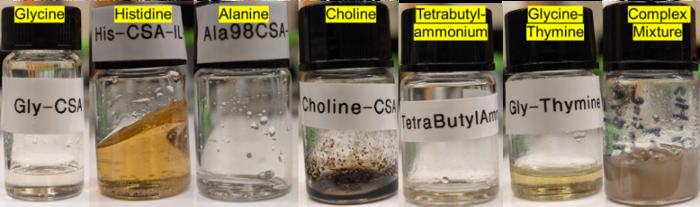
A recent study by researchers at the Massachusetts Institute of Technology (MIT) suggests that ionic liquids could serve as viable biological solvents in environments previously thought inhospitable for life. This groundbreaking work, which includes insights from ongoing missions to investigate life on Venus, indicates that these liquids might form naturally under extreme conditions found on certain exoplanets.
Ionic liquids, essentially salts that are liquid at around room temperature, consist solely of either negatively or positively charged ions. Their unique properties make them particularly interesting as potential solvents for life. Unlike water, ionic liquids possess a “polar” nature that allows them to dissolve other polar molecules, including vital biomolecules such as enzymes. This characteristic is critical for any solvent that supports life’s biochemical processes. Additionally, ionic liquids remain stable at much higher temperatures than liquid water, and they exhibit low vapor pressure, making them resistant to evaporation even in minimal atmospheric conditions.
The research emerged from a challenge faced by scientists attempting to isolate organic compounds in Venus’s atmosphere, rich in sulfuric acid. As they worked to remove sulfuric acid by evaporation, they discovered persistent residues, leading them to conclude that reactions were occurring between glycine, an organic compound, and sulfuric acid, resulting in the formation of ionic liquids. Such liquids are rarely found naturally on Earth, with one notable exception being the mixing of venoms from competing ant species.
Recognizing the abundance of organic compounds throughout the solar system, the researchers explored the potential for ionic liquids to form on other planets. They set up experiments on slabs of basalt, simulating planetary surfaces, and introduced varying temperatures and pressures to a mix of sulfuric acid and glycine. The results confirmed that ionic liquids could indeed be created and maintained under these conditions.
While the actual environments in space are likely harsher than those simulated in the lab, the researchers believe that excess sulfuric acid could be absorbed into rock pores, mitigating its effects. Furthermore, the organic molecules and salts would need to withstand intense radiation, but they could find protection from magnetic fields or the very rocks that help eliminate sulfuric acid.
This research marks a significant advance in our understanding of potential forms of life beyond Earth. Although it does not provide definitive proof of extraterrestrial life, it opens new avenues for astrobiologists in their quest to explore the universe’s diverse environments. The implications of this study could inspire future research efforts and reframe the criteria for habitability beyond the reliance on liquid water.
In conclusion, the findings from MIT underline the versatility of life’s potential solvents and broaden the scope of environments that could support biological processes. As scientists continue to investigate these possibilities, the search for life on distant planets gains new momentum, guided by innovative insights into the chemical foundations of life.







Revolutionary Photonic Ski-Jump Could Miniaturize LiDAR Systems

Couples Detox from Plastics in New Netflix Doc: Can It Boost Fertility?

Aventon Launches Affordable Full-Suspension Electric Mountain Bike

Discover Eight Must-Try Restaurants This Spring Season

UC Irvine Team Unveils Innovative Ion Pump for Water Treatment

One-Third of Americans Trim Daily Expenses for Healthcare Needs

Apple Secures First Oscar in Three Years with F1: The Movie

Fourth Graders Celebrate St. Patrick’s Day with Creative Weather Drawings

Kim Kardashian Dazzles at Vanity Fair Oscars Party 2026

Nostradamus’ 2026 Predictions: Star Death and Dark Events Loom

Breakthroughs and Challenges Await Science in 2026

Electric Moto Influencer Surronster Arrested in Tijuana

OpenAI to Implement Age Verification for ChatGPT by December 2025

Discover the Top 10 Calorie Counting Apps of 2025

Recovering a Suspended TikTok Account: A Step-by-Step Guide

Bella Hadid Shares Health Update After Treatment for Lyme Disease

Backpack Drives Equip Students with Supplies for New School Year

Analysts Project Stronger Growth for Apple’s iPhone 17 Lineup
-
 Science7 months ago
Nostradamus’ 2026 Predictions: Star Death and Dark Events Loom
-
 Science7 months ago
Breakthroughs and Challenges Await Science in 2026
-
 Technology10 months ago
Electric Moto Influencer Surronster Arrested in Tijuana
-
 Technology8 months ago
OpenAI to Implement Age Verification for ChatGPT by December 2025
-
 Technology1 year ago
Discover the Top 10 Calorie Counting Apps of 2025
-
 Technology1 year ago
Recovering a Suspended TikTok Account: A Step-by-Step Guide
-
 Health10 months ago
Bella Hadid Shares Health Update After Treatment for Lyme Disease
-
 Education1 year ago
Backpack Drives Equip Students with Supplies for New School Year
-
 Health11 months ago
Analysts Project Stronger Growth for Apple’s iPhone 17 Lineup
-

 Technology7 months ago
Top 10 Penny Stocks to Watch in 2026 for Strong Returns
-

 Health11 months ago
Japanese Study Finds Rose Oil Can Increase Brain Gray Matter
-

 Science9 months ago
Starship V3 Set for 2026 Launch After Successful Final Test of Version 2