
Science
JWST and Ariel Set to Collaborate on Exoplanet Research

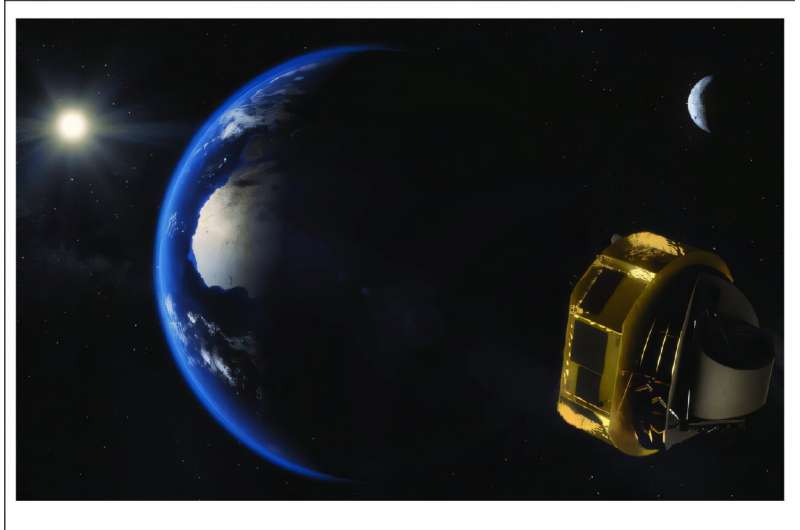
Astronomers are poised for a groundbreaking collaboration between the James Webb Space Telescope (JWST) and the upcoming Atmospheric Remote-sensing Infrared Exoplanet Large-survey (Ariel) mission, set to enhance our understanding of exoplanet atmospheres. A new paper from the Ariel-JWST Synergy Working Group outlines how these two powerful instruments can work together once both are operational in the early 2030s.
The JWST, launched in December 2021, has become the most advanced space-based observatory, offering exceptional resolution for a wide array of cosmic phenomena. Its capabilities range from studying distant black holes to examining comets in our solar system. However, the telescope is often over-scheduled, limiting its ability to observe certain exoplanets in detail. Additionally, its sensitivity can hinder observations of exoplanets orbiting exceptionally bright stars, as these stars can saturate JWST’s detectors, rendering them ineffective for tracking.
In contrast, Ariel is designed specifically for large-scale surveys of exoplanet atmospheres. Though it lacks the resolution of JWST, Ariel employs a “dragnet” observational strategy, monitoring thousands of stars over extended periods. Its single detection instrument can capture a broad spectrum of wavelengths simultaneously, a feature that allows it to efficiently survey the cosmos without the high-resolution demands placed on JWST.
Synergistic Observations and Data Sharing
The collaboration between the two telescopes will be facilitated by their shared location at the L2 Earth-Sun Lagrange point, providing a common reference frame that is not available to most other observatories. The JWST can be likened to a “sniper,” targeting individual exoplanet systems, while Ariel functions as a broad surveyor, continuously scanning wide areas of the sky.
The paper highlights several strategies for data sharing that will capitalize on the strengths of each telescope. For instance, JWST can conduct detailed analyses of specific exoplanet atmospheres and relay this information to Ariel, which can then assess the findings in the context of thousands of other planets. Conversely, if Ariel identifies an anomaly in its survey of 1,000 planets, it can alert JWST to focus on that outlier for further investigation, leveraging its superior resolution.
Both telescopes excel in different areas. Ariel is better equipped to analyze bright stars that might overwhelm JWST’s detectors, while JWST can detect fainter targets that Ariel may miss due to its lower resolution. Their complementary capabilities will allow for a richer understanding of exoplanet atmospheres than either could achieve alone.
Looking to the Future
Ariel is scheduled to launch in 2029, with full scientific operations expected to commence in 2030 and a planned operational window of four years. Although JWST’s primary mission is set to conclude in July 2027, it possesses sufficient fuel to maintain its orbit until the 2040s. Barring unforeseen complications, this collaboration between the JWST and Ariel could yield a decade of significant advancements in exoplanetary science.
As the scientific community eagerly anticipates these missions, the partnership promises to deepen our understanding of distant worlds and their atmospheres, providing invaluable insights into the nature of the universe. The findings from this collaboration are expected to revolutionize our approach to exoplanet research and broaden our knowledge of potential habitable environments beyond our solar system.









Revolutionary Photonic Ski-Jump Could Miniaturize LiDAR Systems

Couples Detox from Plastics in New Netflix Doc: Can It Boost Fertility?

Aventon Launches Affordable Full-Suspension Electric Mountain Bike

Discover Eight Must-Try Restaurants This Spring Season

UC Irvine Team Unveils Innovative Ion Pump for Water Treatment

One-Third of Americans Trim Daily Expenses for Healthcare Needs

Apple Secures First Oscar in Three Years with F1: The Movie

Fourth Graders Celebrate St. Patrick’s Day with Creative Weather Drawings

Kim Kardashian Dazzles at Vanity Fair Oscars Party 2026

Nostradamus’ 2026 Predictions: Star Death and Dark Events Loom

Breakthroughs and Challenges Await Science in 2026

Electric Moto Influencer Surronster Arrested in Tijuana

OpenAI to Implement Age Verification for ChatGPT by December 2025

Discover the Top 10 Calorie Counting Apps of 2025

Recovering a Suspended TikTok Account: A Step-by-Step Guide

Bella Hadid Shares Health Update After Treatment for Lyme Disease

Backpack Drives Equip Students with Supplies for New School Year

Analysts Project Stronger Growth for Apple’s iPhone 17 Lineup
-
 Science8 months ago
Nostradamus’ 2026 Predictions: Star Death and Dark Events Loom
-
 Science8 months ago
Breakthroughs and Challenges Await Science in 2026
-
 Technology11 months ago
Electric Moto Influencer Surronster Arrested in Tijuana
-
 Technology9 months ago
OpenAI to Implement Age Verification for ChatGPT by December 2025
-
 Technology1 year ago
Discover the Top 10 Calorie Counting Apps of 2025
-
 Technology1 year ago
Recovering a Suspended TikTok Account: A Step-by-Step Guide
-
 Health11 months ago
Bella Hadid Shares Health Update After Treatment for Lyme Disease
-
 Education1 year ago
Backpack Drives Equip Students with Supplies for New School Year
-
 Health11 months ago
Analysts Project Stronger Growth for Apple’s iPhone 17 Lineup
-

 Health12 months ago
Japanese Study Finds Rose Oil Can Increase Brain Gray Matter
-

 Technology8 months ago
Top 10 Penny Stocks to Watch in 2026 for Strong Returns
-

 Science10 months ago
Starship V3 Set for 2026 Launch After Successful Final Test of Version 2