
Science
James Webb Space Telescope Unveils Earliest Galaxy Cluster Yet

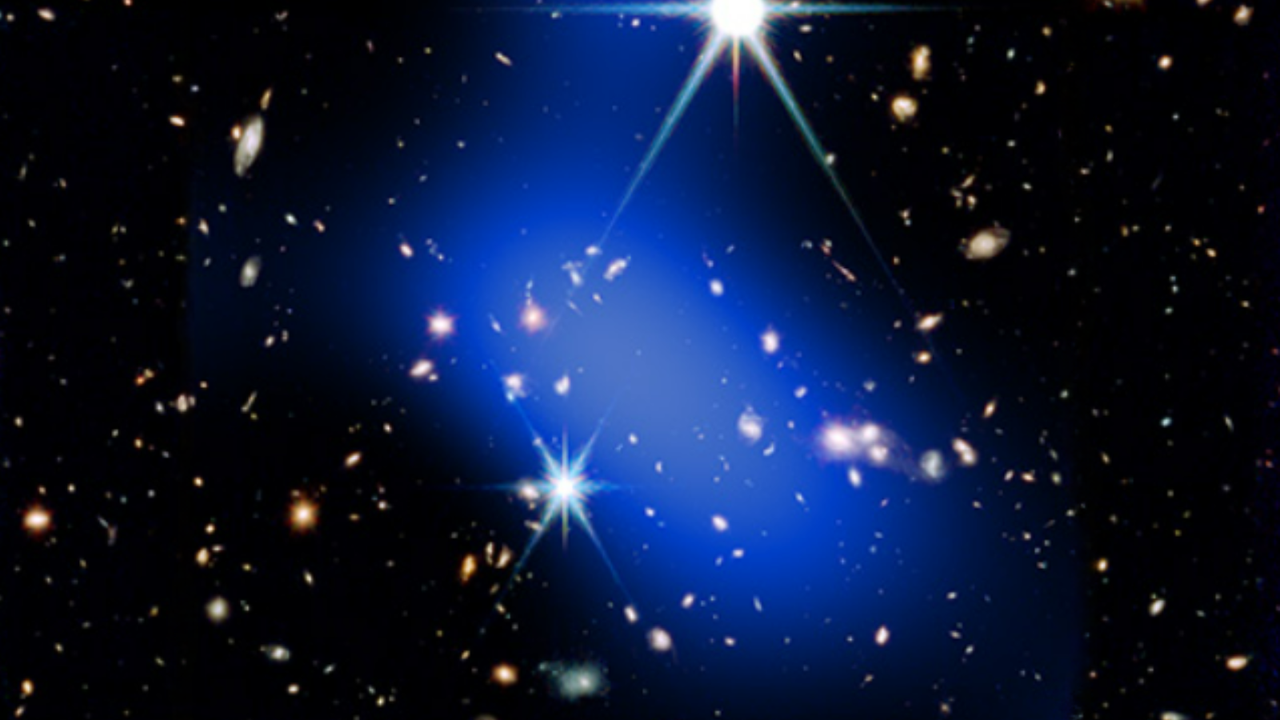
Scientists have made a groundbreaking discovery using the James Webb Space Telescope and NASA’s Chandra X-ray Observatory. They have observed the most distant galaxy cluster ever identified, forming just 1 billion years after the Big Bang. This infant cluster, known as JADES-ID1, provides new insights into the early universe and challenges existing theories about the formation of galaxy clusters.
The light from JADES-ID1 has traveled 12.7 billion years to reach Earth, revealing a phase of formation that occurs much earlier than previously anticipated. Researchers are now confronted with a significant question: How did such large structures grow so rapidly in the early cosmos? Team leader Akos Bogdan from the Center for Astrophysics | Harvard & Smithsonian remarked, “This may be the most distant confirmed protocluster ever seen. JADES-ID1 is giving us new evidence that the universe was in a huge hurry to grow up.”
Understanding Galaxy Clusters and Their Formation
Galaxy clusters consist of thousands of galaxies, vast clouds of hot gas, and an extensive framework of dark matter. These clusters are crucial for understanding the overall composition of the universe and can help astronomers refine calculations regarding its expansion rate. Team member Gerrit Schellenberger stated, “It’s very important to actually see when and how galaxy clusters grow. It’s like watching an assembly line make a car, rather than just trying to figure out how a car works by looking at the finished product.”
The findings related to JADES-ID1 were made possible through the collaboration of the two telescopes. The James Webb Space Telescope identified multiple galaxies bound by gravity, while the Chandra X-ray Observatory detected a significant surrounding cloud of hot gas through its X-ray emissions. As this gas falls into the protocluster, it heats up and produces X-rays, marking JADES-ID1 as a protocluster.
Existing models of galaxy cluster formation suggested that the density of galaxies observed in JADES-ID1 would not occur until approximately 3 billion years after the universe’s origin. The discovery of this protocluster only 1 billion years after the Big Bang reshapes our understanding of cosmic evolution.
Implications for Cosmology and Future Research
The implications of these findings are profound. The rapid growth of galaxy clusters challenges previous notions about the timeline of cosmic development. Team member Qiong Li from the University of Manchester emphasized, “We thought we’d find a protocluster like this two or three billion years after the Big Bang—not just one billion. Before, astronomers found surprisingly large galaxies and black holes not long after the Big Bang, and now we’re finding that clusters of galaxies can also grow rapidly.”
The team’s research was published in the journal Nature on January 28, 2024. As further studies continue, scientists hope to unravel more mysteries surrounding the formation of galaxy clusters and the early expansion of the universe, offering a clearer picture of our cosmic history. This discovery not only expands our knowledge but also sets the stage for future explorations into the depths of space and time.







Revolutionary Photonic Ski-Jump Could Miniaturize LiDAR Systems

Couples Detox from Plastics in New Netflix Doc: Can It Boost Fertility?

Aventon Launches Affordable Full-Suspension Electric Mountain Bike

Discover Eight Must-Try Restaurants This Spring Season

UC Irvine Team Unveils Innovative Ion Pump for Water Treatment

One-Third of Americans Trim Daily Expenses for Healthcare Needs

Apple Secures First Oscar in Three Years with F1: The Movie

Fourth Graders Celebrate St. Patrick’s Day with Creative Weather Drawings

Kim Kardashian Dazzles at Vanity Fair Oscars Party 2026

Nostradamus’ 2026 Predictions: Star Death and Dark Events Loom

Breakthroughs and Challenges Await Science in 2026

Electric Moto Influencer Surronster Arrested in Tijuana

OpenAI to Implement Age Verification for ChatGPT by December 2025

Discover the Top 10 Calorie Counting Apps of 2025

Recovering a Suspended TikTok Account: A Step-by-Step Guide

Bella Hadid Shares Health Update After Treatment for Lyme Disease

Backpack Drives Equip Students with Supplies for New School Year

Analysts Project Stronger Growth for Apple’s iPhone 17 Lineup
-
 Science8 months ago
Nostradamus’ 2026 Predictions: Star Death and Dark Events Loom
-
 Science8 months ago
Breakthroughs and Challenges Await Science in 2026
-
 Technology11 months ago
Electric Moto Influencer Surronster Arrested in Tijuana
-
 Technology9 months ago
OpenAI to Implement Age Verification for ChatGPT by December 2025
-
 Technology1 year ago
Discover the Top 10 Calorie Counting Apps of 2025
-
 Technology1 year ago
Recovering a Suspended TikTok Account: A Step-by-Step Guide
-
 Health11 months ago
Bella Hadid Shares Health Update After Treatment for Lyme Disease
-
 Education1 year ago
Backpack Drives Equip Students with Supplies for New School Year
-
 Health11 months ago
Analysts Project Stronger Growth for Apple’s iPhone 17 Lineup
-

 Health12 months ago
Japanese Study Finds Rose Oil Can Increase Brain Gray Matter
-

 Technology8 months ago
Top 10 Penny Stocks to Watch in 2026 for Strong Returns
-

 Science10 months ago
Starship V3 Set for 2026 Launch After Successful Final Test of Version 2