
Top Stories
Astronomers Discover Unusual Star System Defying Planet Formation

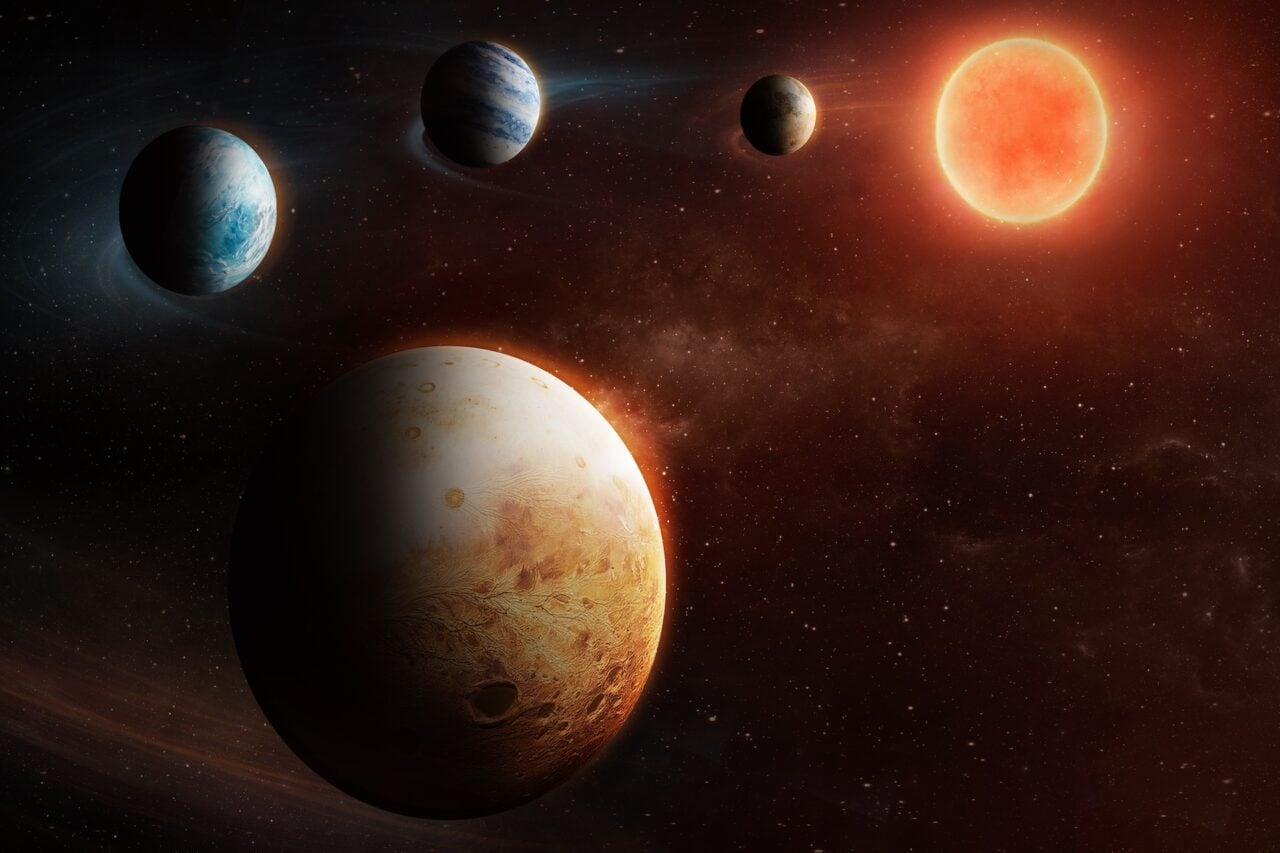
A team of astronomers has identified a remarkable star system that challenges existing theories of planet formation. The system, known as LHS 1903, features a rocky planet located far from its host star, contradicting the established pattern where gas giants typically occupy the outer regions. This discovery raises significant questions about how planets develop in different environments across the universe.
The inner planets of our solar system, which include Mercury, Venus, Earth, and Mars, are composed primarily of rock, whereas the outer solar system is home to gas giants like Jupiter and Saturn. Other star systems in the Milky Way generally follow this pattern, with rocky planets forming closer to their stars and gas planets forming at greater distances. However, the situation at LHS 1903 diverges from this norm.
Unexpected Findings Around LHS 1903
LHS 1903 is classified as a small red M-dwarf star, cooler and less luminous than the Sun. Researchers, led by Thomas Wilson from the University of Warwick, utilized data from various space telescopes to identify three initial planets orbiting the star. The breakthrough came when observations from the European Space Agency’s CHEOPS space telescope revealed a fourth planet, which turned out to be rocky and situated in the outermost position of the system.
“This strange disorder makes it a unique inside-out system,” Wilson explained. The typical expectation is that rocky planets are found closer to their host stars, while gas giants occupy the farther regions. The rocky planet’s placement contradicts established theories of planet formation. According to these theories, radiation from a star typically strips gas from planets that are closer, resulting in rocky compositions, while cooler conditions further out allow gas to accumulate.
The new rocky planet could either have lost its gaseous atmosphere or may never have formed one in the first place.
Challenging Established Theories
The research team sought to unravel the mystery behind this disordered star system. They conducted simulations to explore various scenarios, including whether the planets might have exchanged positions or if the rocky planet had suffered an impact severe enough to strip it of its atmosphere. However, these hypotheses did not hold up under scrutiny.
Instead, the evidence pointed towards the possibility that the planets formed sequentially rather than simultaneously. Typically, planets emerge from protoplanetary discs of gas and dust surrounding a star, arriving in clusters. In the case of LHS 1903, it appears that the planets may have formed one after another, rather than all at once.
“By the time this final outer planet formed, the system may have already run out of gas, which is considered vital for planet formation,” Wilson noted. The existence of this small, rocky world raises the possibility of a new understanding of planetary development.
This discovery could either represent an anomaly in our understanding of planet formation or hint at a broader trend across the cosmos. “Historically, our planet formation theories are based on what we see and know about our solar system,” said Isabel Rebollido, a research fellow at ESA. “As we are seeing more and more different exoplanet systems, we are starting to revisit these theories.”
The findings from LHS 1903 highlight the complexity and diversity of planetary systems beyond our own, suggesting that there is still much to learn about how planets form and evolve in various stellar environments. As astronomers continue to investigate these unusual systems, they may uncover new insights that reshape our understanding of the universe.








Revolutionary Photonic Ski-Jump Could Miniaturize LiDAR Systems

Couples Detox from Plastics in New Netflix Doc: Can It Boost Fertility?

Aventon Launches Affordable Full-Suspension Electric Mountain Bike

Discover Eight Must-Try Restaurants This Spring Season

UC Irvine Team Unveils Innovative Ion Pump for Water Treatment

One-Third of Americans Trim Daily Expenses for Healthcare Needs

Apple Secures First Oscar in Three Years with F1: The Movie

Fourth Graders Celebrate St. Patrick’s Day with Creative Weather Drawings

Kim Kardashian Dazzles at Vanity Fair Oscars Party 2026

Nostradamus’ 2026 Predictions: Star Death and Dark Events Loom

Breakthroughs and Challenges Await Science in 2026

Electric Moto Influencer Surronster Arrested in Tijuana

OpenAI to Implement Age Verification for ChatGPT by December 2025

Discover the Top 10 Calorie Counting Apps of 2025

Bella Hadid Shares Health Update After Treatment for Lyme Disease

Analysts Project Stronger Growth for Apple’s iPhone 17 Lineup

Japanese Study Finds Rose Oil Can Increase Brain Gray Matter

Top 10 Penny Stocks to Watch in 2026 for Strong Returns
-
 Science4 months ago
Nostradamus’ 2026 Predictions: Star Death and Dark Events Loom
-
 Science4 months ago
Breakthroughs and Challenges Await Science in 2026
-
 Technology7 months ago
Electric Moto Influencer Surronster Arrested in Tijuana
-
 Technology4 months ago
OpenAI to Implement Age Verification for ChatGPT by December 2025
-
 Technology9 months ago
Discover the Top 10 Calorie Counting Apps of 2025
-
 Health7 months ago
Bella Hadid Shares Health Update After Treatment for Lyme Disease
-
 Health7 months ago
Analysts Project Stronger Growth for Apple’s iPhone 17 Lineup
-
 Health7 months ago
Japanese Study Finds Rose Oil Can Increase Brain Gray Matter
-
 Technology4 months ago
Top 10 Penny Stocks to Watch in 2026 for Strong Returns
-

 Science6 months ago
Starship V3 Set for 2026 Launch After Successful Final Test of Version 2
-

 Technology1 month ago
Nvidia GTC 2026: Major Announcements Expected for AI and Hardware
-

 Education7 months ago
Harvard Secures Court Victory Over Federal Funding Cuts