
Science
Researchers Develop Method to Detect Exomoons via Lunar Eclipses

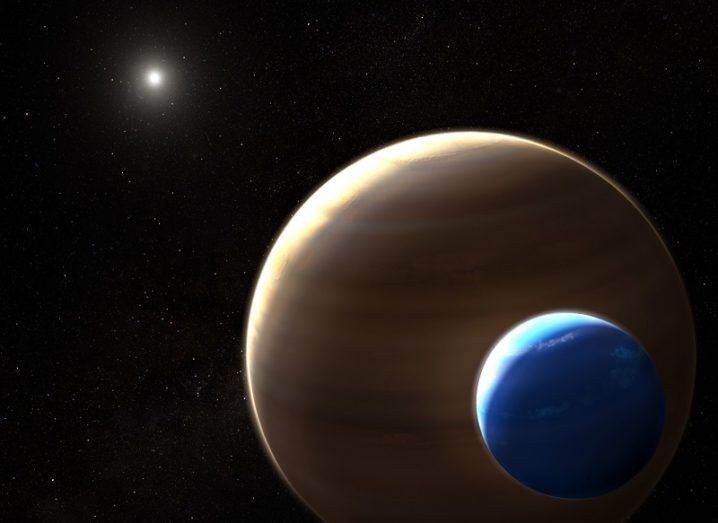
A collaborative team of researchers from the United States and the United Kingdom has proposed a novel method for detecting exomoons, which are moons orbiting exoplanets. This innovative technique could enhance the capabilities of NASA’s future Habitable Worlds Observatory (HWO) by identifying exomoons that may support life. Their study was recently accepted for publication in The Astrophysical Journal.
The research team utilized computer simulations to model how Earth-like exomoons could be detected as they pass behind gas giant exoplanets. During this process, the light reflected from the exoplanet could also illuminate the atmosphere of the exomoon, making it detectable from Earth. The study suggests that HWO could observe an Earth-sized exomoon located at a distance of 1 astronomical unit (AU) from a Jupiter-sized exoplanet, potentially as far away as 12 parsecs (39 light-years).
Innovative Detection Methodology
The researchers argue that HWO should consider exomoons in its search for habitability, emphasizing the need for a strategic approach. They recommend that mission planners keep stars with habitable-zone giant planets on their target list, devise a search strategy for habitable exomoons, and explore methods for characterizing any candidates discovered. The study highlights that while lunar eclipses are a sensitive method for detection, they may not be the most efficient for a broad search. Instead, focused monitoring of large gas giants during lunar eclipses could yield significant scientific insights.
Given the rich diversity of moons in our solar system, the discovery of exomoons could illuminate the complexities of exoplanetary systems. Although only a limited number of moons are considered potentially habitable, the research suggests that exomoons orbiting gas giants might also possess conditions suitable for life. Despite the confirmation of over 6,000 exoplanets, scientists have yet to verify the existence of any exomoons.
Identified Exomoon Candidates
Currently, several candidates are under investigation, including Kepler-1625b I, Kepler-1708b I, Kepler-90g, Kepler-80g, and WASP-49b. Four of these candidates are believed to orbit gas giants, while the Kepler-80g moon candidate is thought to orbit a planet slightly larger than Earth. The existence of Kepler-1625b I and Kepler-1708b I has been the subject of debate, with a 2023 study in Nature Astronomy questioning their status, while a 2025 study left their existence open for further discussion.
The HWO mission, slated for launch in 2041, aims to search for Earth-sized habitable exoplanets and conduct studies on galaxy formation, elemental evolution, and solar system objects. As the scientific community prepares for this mission, discussions continue about the potential for discovering habitable exomoons.
The research conducted by this team opens new avenues for understanding the universe. As scientists explore the various dimensions of exoplanetary systems, the possibility of uncovering exomoons that could harbor life remains an exciting frontier in astronomy.












Revolutionary Photonic Ski-Jump Could Miniaturize LiDAR Systems

Couples Detox from Plastics in New Netflix Doc: Can It Boost Fertility?

Aventon Launches Affordable Full-Suspension Electric Mountain Bike

Discover Eight Must-Try Restaurants This Spring Season

UC Irvine Team Unveils Innovative Ion Pump for Water Treatment

One-Third of Americans Trim Daily Expenses for Healthcare Needs

Apple Secures First Oscar in Three Years with F1: The Movie

Fourth Graders Celebrate St. Patrick’s Day with Creative Weather Drawings

Kim Kardashian Dazzles at Vanity Fair Oscars Party 2026

Nostradamus’ 2026 Predictions: Star Death and Dark Events Loom

Breakthroughs and Challenges Await Science in 2026

Electric Moto Influencer Surronster Arrested in Tijuana

OpenAI to Implement Age Verification for ChatGPT by December 2025

Discover the Top 10 Calorie Counting Apps of 2025

Recovering a Suspended TikTok Account: A Step-by-Step Guide

Bella Hadid Shares Health Update After Treatment for Lyme Disease

Backpack Drives Equip Students with Supplies for New School Year

Analysts Project Stronger Growth for Apple’s iPhone 17 Lineup
-
 Science8 months ago
Nostradamus’ 2026 Predictions: Star Death and Dark Events Loom
-
 Science8 months ago
Breakthroughs and Challenges Await Science in 2026
-
 Technology11 months ago
Electric Moto Influencer Surronster Arrested in Tijuana
-
 Technology9 months ago
OpenAI to Implement Age Verification for ChatGPT by December 2025
-
 Technology1 year ago
Discover the Top 10 Calorie Counting Apps of 2025
-
 Technology1 year ago
Recovering a Suspended TikTok Account: A Step-by-Step Guide
-
 Health11 months ago
Bella Hadid Shares Health Update After Treatment for Lyme Disease
-
 Education1 year ago
Backpack Drives Equip Students with Supplies for New School Year
-
 Health12 months ago
Analysts Project Stronger Growth for Apple’s iPhone 17 Lineup
-

 Health12 months ago
Japanese Study Finds Rose Oil Can Increase Brain Gray Matter
-

 Technology8 months ago
Top 10 Penny Stocks to Watch in 2026 for Strong Returns
-

 Science10 months ago
Starship V3 Set for 2026 Launch After Successful Final Test of Version 2