
Science
Research Reveals How Birds Use Hidden Feathers to Enhance Colors

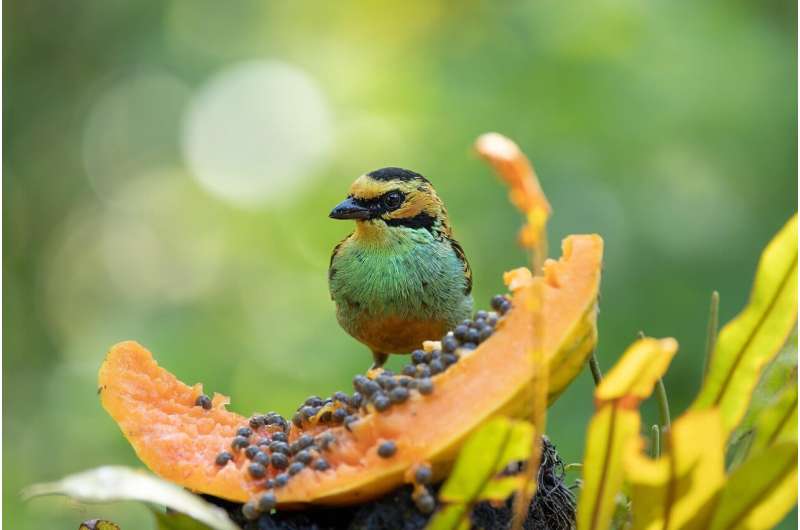
Birds have long been celebrated for their vibrant colors, but new research from Princeton University uncovers a fascinating mechanism that enhances these hues. A study published in Science Advances on July 26, 2025, led by researcher Rosalyn M. Price-Waldman, reveals that certain birds utilize hidden black and white feathers to amplify their plumage’s vibrancy.
This innovative approach involves layering colored feathers over either black or white underlying feathers, which significantly alters how light interacts with the colors. The research highlights that male birds, often more colorful than their female counterparts, benefit from this technique to attract mates. The study’s findings indicate that the differences in coloration between males and females may not solely be due to the pigments in their feathers but rather the amount of black or white underneath.
Enhancing Brightness Through Layering
The process relies on the principles of sexual selection, a concept first articulated by Charles Darwin. Males with more vivid colors are likely to attract mates, thereby increasing their reproductive success. By placing a black layer beneath bright blue feathers, males can create a striking contrast that enhances the perception of color. The black layer absorbs light that passes through the top feathers, allowing only the blue wavelengths to reflect, resulting in a more intense hue.
In contrast, the study found that yellow feathers, which contain carotenoid pigments, become brighter when layered over a white under-layer. This white layer reflects light that enhances the brightness of the yellow, making these patches stand out even more.
A Widespread Adaptation in Birds
The researchers primarily focused on tanagers, a group of colorful fruit-eating birds native to Central and South America. Their findings prompted an investigation into other bird families, revealing that this clever use of underlying feathers is prevalent among various species, including the Australian fairy wrens, known for their vivid blue plumage.
The implications of this research extend beyond avian beauty. Understanding how birds have developed such intricate signaling mechanisms could influence color production in fields like architecture, art, and fashion. The findings suggest that this method of enhancing color has been utilized by birds for tens of millions of years, highlighting an evolutionary strategy that spans diverse species.
The study not only enriches the understanding of bird coloration but also opens avenues for exploring how complex traits evolve in nature. As researchers continue to uncover the secrets of avian beauty, the interplay between biology and aesthetics may yield insights applicable to human creativity and design.
For further details, refer to the study by Rosalyn M. Price-Waldman et al in Science Advances, DOI: 10.1126/sciadv.adw5857.












Revolutionary Photonic Ski-Jump Could Miniaturize LiDAR Systems

Couples Detox from Plastics in New Netflix Doc: Can It Boost Fertility?

Aventon Launches Affordable Full-Suspension Electric Mountain Bike

Discover Eight Must-Try Restaurants This Spring Season

UC Irvine Team Unveils Innovative Ion Pump for Water Treatment

One-Third of Americans Trim Daily Expenses for Healthcare Needs

Apple Secures First Oscar in Three Years with F1: The Movie

Fourth Graders Celebrate St. Patrick’s Day with Creative Weather Drawings

Kim Kardashian Dazzles at Vanity Fair Oscars Party 2026

Nostradamus’ 2026 Predictions: Star Death and Dark Events Loom

Breakthroughs and Challenges Await Science in 2026

Electric Moto Influencer Surronster Arrested in Tijuana

OpenAI to Implement Age Verification for ChatGPT by December 2025

Discover the Top 10 Calorie Counting Apps of 2025

Recovering a Suspended TikTok Account: A Step-by-Step Guide

Bella Hadid Shares Health Update After Treatment for Lyme Disease

Backpack Drives Equip Students with Supplies for New School Year

Analysts Project Stronger Growth for Apple’s iPhone 17 Lineup
-
 Science8 months ago
Nostradamus’ 2026 Predictions: Star Death and Dark Events Loom
-
 Science8 months ago
Breakthroughs and Challenges Await Science in 2026
-
 Technology11 months ago
Electric Moto Influencer Surronster Arrested in Tijuana
-
 Technology9 months ago
OpenAI to Implement Age Verification for ChatGPT by December 2025
-
 Technology1 year ago
Discover the Top 10 Calorie Counting Apps of 2025
-
 Technology1 year ago
Recovering a Suspended TikTok Account: A Step-by-Step Guide
-
 Health11 months ago
Bella Hadid Shares Health Update After Treatment for Lyme Disease
-
 Education1 year ago
Backpack Drives Equip Students with Supplies for New School Year
-
 Health12 months ago
Analysts Project Stronger Growth for Apple’s iPhone 17 Lineup
-

 Health12 months ago
Japanese Study Finds Rose Oil Can Increase Brain Gray Matter
-

 Technology8 months ago
Top 10 Penny Stocks to Watch in 2026 for Strong Returns
-

 Science10 months ago
Starship V3 Set for 2026 Launch After Successful Final Test of Version 2