
Top Stories
Princeton Honors Four Graduate Students with Jacobus Fellowships

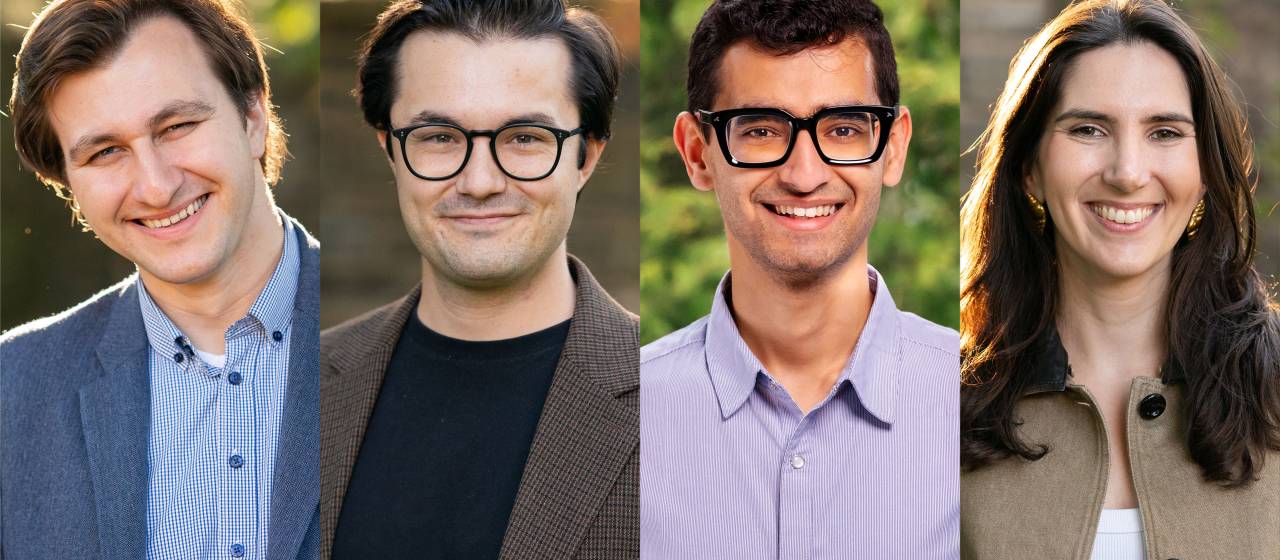
Four exceptional graduate students from Princeton University have been awarded the prestigious Porter Ogden Jacobus Fellowship, the institution’s highest distinction for graduate scholars. The recipients are historian Philip Decker, mathematician Victor Geadah, computer scientist Sayash Kapoor, and literary scholar Eliana Rozinov. They will be honored during Alumni Day ceremonies on February 21, 2024.
Established in 1905, the Jacobus Fellowship is awarded to one Ph.D. student in each of the four academic divisions: humanities, social sciences, natural sciences, and engineering. This fellowship supports students in their final year of study at Princeton and recognizes those whose research exemplifies the highest standards of scholarly excellence.
Rodney Priestley, dean of the Graduate School, remarked on the significance of the award, stating, “Throughout this 125th anniversary year of the Princeton Graduate School, we have been reflecting on the transformational impact of Princeton graduate education on our students, the University, and the world. This year’s Jacobus Fellows exemplify that legacy.” He noted that their research spans critical topics, from the development of accountable artificial intelligence to the intricacies of decision-making in the brain, illustrating a commitment to impactful scholarship.
Research Contributions of the Jacobus Fellows
Philip Decker, a sixth-year doctoral student in history, focuses his dissertation on “The Molotov-Ribbentrop Pact: A Cultural and Diplomatic History.” His work investigates Nazi-Soviet relations surrounding the infamous nonaggression treaty signed on August 23, 1939. Decker challenges conventional narratives that emphasize military power, arguing for a deeper understanding of cultural exchanges between Germany and the Soviet Union. His adviser, Yair Mintzker, praised Decker’s archival skills, highlighting the extensive research he undertook, including sifting through thousands of documents across various European archives.
In contrast, Victor Geadah, a fifth-year Ph.D. student in applied and computational mathematics, examines the workings of the brain in his dissertation titled “Statistical Inference of Normative Processes in Neuroscientific Data.” Geadah’s research introduces statistical methods that yield insights into individual behaviors and neural processes. His adviser, Jonathan Pillow, emphasizes Geadah’s unique ability to bridge theoretical and practical applications in neuroscience.
Computer scientist Sayash Kapoor, also a fifth-year Ph.D. candidate, centers his dissertation on “AI’s Impact on Science and Society.” Kapoor critiques the current evaluation methods for artificial intelligence, noting that many researchers unknowingly misuse AI tools, leading to significant errors in scientific papers. His work aims to establish rigorous standards for AI evaluations, thereby influencing public policy and scientific consensus. His adviser, Arvind Narayanan, underscored Kapoor’s role as a leading figure in improving AI assessment practices.
Lastly, Eliana Rozinov, a sixth-year doctoral student in English and Gender and Sexuality Studies, explores feminist interpretations of Freud in her dissertation titled “Riddles of Women: Mythical, Modernist, Freudian.” Rozinov argues that women play a crucial role in understanding the psychological enigmas Freud posited. Her work engages with literary texts from modernist authors, emphasizing how these narratives can reframe contemporary discussions around gender and identity.
Significance of the Jacobus Fellowship
The Jacobus Fellowship not only honors individual academic achievements but also reflects Princeton’s commitment to fostering groundbreaking research. Each fellow’s projects contribute to a broader understanding of their respective fields, addressing complex issues with innovative perspectives. As they prepare to share their findings at Alumni Day, these scholars exemplify the spirit of inquiry and excellence that defines Princeton University.
The recognition of these four graduate students serves as a reminder of the vital role that research plays in shaping our understanding of the world. As they continue their academic journeys, their work promises to illuminate important questions and spark discussions well beyond the walls of Princeton.













Revolutionary Photonic Ski-Jump Could Miniaturize LiDAR Systems

Couples Detox from Plastics in New Netflix Doc: Can It Boost Fertility?

Aventon Launches Affordable Full-Suspension Electric Mountain Bike

Discover Eight Must-Try Restaurants This Spring Season

UC Irvine Team Unveils Innovative Ion Pump for Water Treatment

One-Third of Americans Trim Daily Expenses for Healthcare Needs

Apple Secures First Oscar in Three Years with F1: The Movie

Fourth Graders Celebrate St. Patrick’s Day with Creative Weather Drawings

Kim Kardashian Dazzles at Vanity Fair Oscars Party 2026

Nostradamus’ 2026 Predictions: Star Death and Dark Events Loom

Breakthroughs and Challenges Await Science in 2026

Electric Moto Influencer Surronster Arrested in Tijuana

OpenAI to Implement Age Verification for ChatGPT by December 2025

Discover the Top 10 Calorie Counting Apps of 2025

Recovering a Suspended TikTok Account: A Step-by-Step Guide

Bella Hadid Shares Health Update After Treatment for Lyme Disease

Backpack Drives Equip Students with Supplies for New School Year

Analysts Project Stronger Growth for Apple’s iPhone 17 Lineup
-
 Science7 months ago
Nostradamus’ 2026 Predictions: Star Death and Dark Events Loom
-
 Science7 months ago
Breakthroughs and Challenges Await Science in 2026
-
 Technology10 months ago
Electric Moto Influencer Surronster Arrested in Tijuana
-
 Technology8 months ago
OpenAI to Implement Age Verification for ChatGPT by December 2025
-
 Technology1 year ago
Discover the Top 10 Calorie Counting Apps of 2025
-
 Technology1 year ago
Recovering a Suspended TikTok Account: A Step-by-Step Guide
-
 Health10 months ago
Bella Hadid Shares Health Update After Treatment for Lyme Disease
-
 Education12 months ago
Backpack Drives Equip Students with Supplies for New School Year
-
 Health10 months ago
Analysts Project Stronger Growth for Apple’s iPhone 17 Lineup
-

 Technology7 months ago
Top 10 Penny Stocks to Watch in 2026 for Strong Returns
-

 Health11 months ago
Japanese Study Finds Rose Oil Can Increase Brain Gray Matter
-

 Science9 months ago
Starship V3 Set for 2026 Launch After Successful Final Test of Version 2