
Science
Physicist Proposes Ganymede as a Major Dark Matter Detector

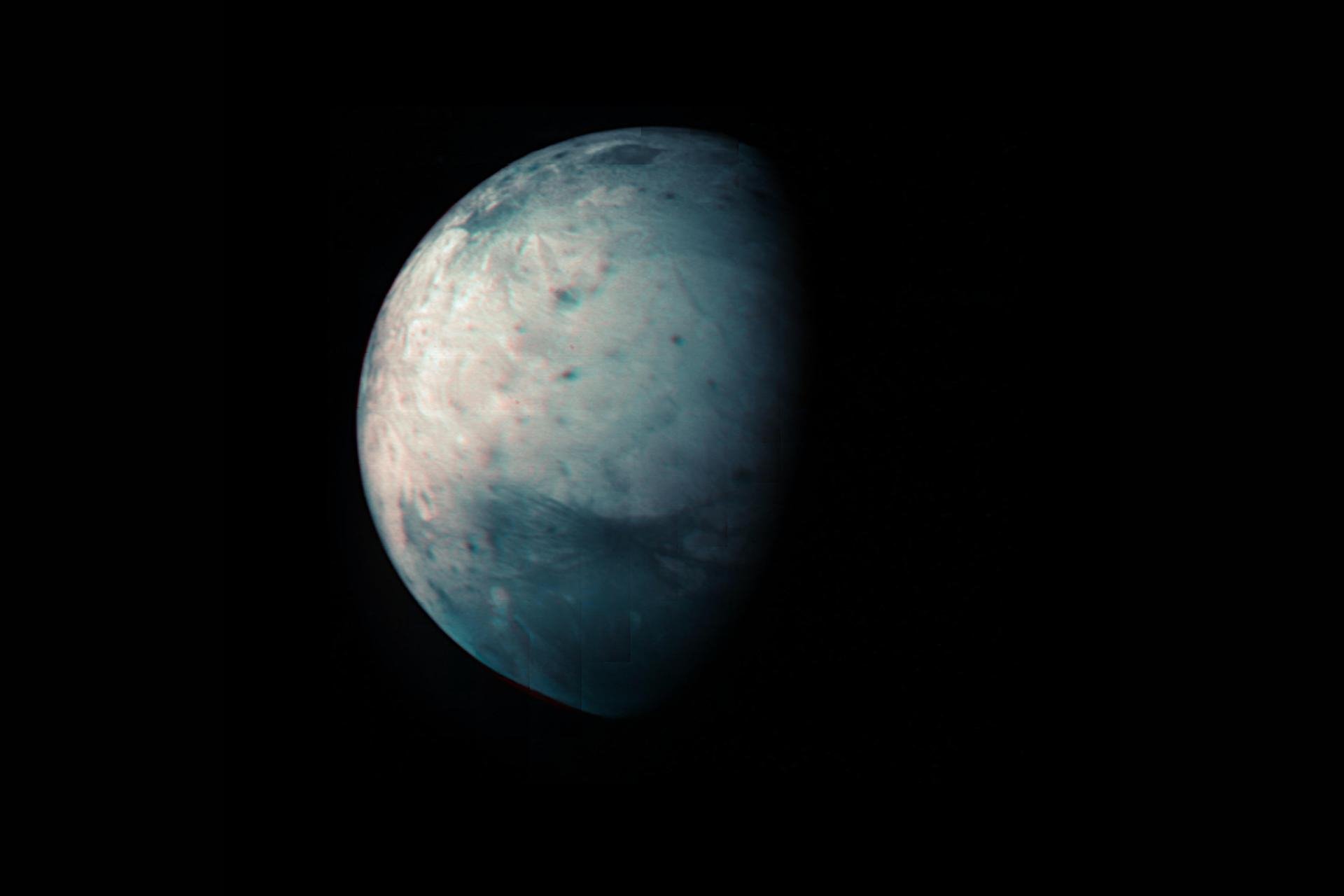
A physicist has proposed an innovative plan to utilize Ganymede, Jupiter’s largest moon, as a colossal detector for dark matter. This ambitious project aims to enhance the search for the elusive substance that is believed to make up approximately 85% of the universe. Dark matter is termed “dark” because it does not emit light and interacts very weakly with regular matter, making it incredibly difficult to observe.
William DeRocco, a physicist at the University of Maryland, submitted a preprint to arXiv outlining his vision of using Ganymede’s craters to potentially capture evidence of dark matter particles. According to DeRocco’s proposal, spacecraft like NASA’s Europa Clipper and ESA’s JUICE could investigate these craters during their upcoming missions.
The paper suggests that large dark matter particles may have impacted Ganymede’s thick icy crust, causing significant surface disruptions. Unlike the smaller dark matter candidates typically detected on Earth, these larger particles could have created “dark matter craters,” which would manifest as unique surface features where deep-seated minerals from Ganymede’s oceans are exposed.
In an interview with New Scientist, DeRocco elaborated on his hypothesis: “If you used something like ground-penetrating radar, you might be able to see this column of melted ice going all the way down through the ice.” This technique could reveal critical insights into the composition and behavior of dark matter.
The prospect of studying Ganymede’s surface through this lens has garnered interest in the scientific community. Bradley Kavanaugh, an astrophysicist at the University of Cantabria in Spain, acknowledged the potential of the proposal, despite the absence of definitive evidence for such massive dark matter particles. He emphasized that exploring unconventional ideas is often essential in physics, particularly when addressing profound mysteries.
While the scientific community remains cautious, DeRocco’s approach invites a fresh perspective on the search for dark matter. His bold proposal encourages a reconsideration of how scientists might detect this enigmatic substance, even if it challenges conventional methods.
The scientific community will be watching closely to see if NASA or ESA decide to incorporate DeRocco’s idea into their mission plans. Whether or not Ganymede indeed bears the marks of dark matter craters remains an open question, but the exploration of this possibility marks a significant step in the ongoing quest to understand the universe’s fundamental components.






Revolutionary Photonic Ski-Jump Could Miniaturize LiDAR Systems

Couples Detox from Plastics in New Netflix Doc: Can It Boost Fertility?

Aventon Launches Affordable Full-Suspension Electric Mountain Bike

Discover Eight Must-Try Restaurants This Spring Season

UC Irvine Team Unveils Innovative Ion Pump for Water Treatment

One-Third of Americans Trim Daily Expenses for Healthcare Needs

Apple Secures First Oscar in Three Years with F1: The Movie

Fourth Graders Celebrate St. Patrick’s Day with Creative Weather Drawings

Kim Kardashian Dazzles at Vanity Fair Oscars Party 2026

Nostradamus’ 2026 Predictions: Star Death and Dark Events Loom

Breakthroughs and Challenges Await Science in 2026

Electric Moto Influencer Surronster Arrested in Tijuana

OpenAI to Implement Age Verification for ChatGPT by December 2025

Discover the Top 10 Calorie Counting Apps of 2025

Recovering a Suspended TikTok Account: A Step-by-Step Guide

Bella Hadid Shares Health Update After Treatment for Lyme Disease

Backpack Drives Equip Students with Supplies for New School Year

Analysts Project Stronger Growth for Apple’s iPhone 17 Lineup
-
 Science8 months ago
Nostradamus’ 2026 Predictions: Star Death and Dark Events Loom
-
 Science8 months ago
Breakthroughs and Challenges Await Science in 2026
-
 Technology11 months ago
Electric Moto Influencer Surronster Arrested in Tijuana
-
 Technology9 months ago
OpenAI to Implement Age Verification for ChatGPT by December 2025
-
 Technology1 year ago
Discover the Top 10 Calorie Counting Apps of 2025
-
 Technology1 year ago
Recovering a Suspended TikTok Account: A Step-by-Step Guide
-
 Health11 months ago
Bella Hadid Shares Health Update After Treatment for Lyme Disease
-
 Education1 year ago
Backpack Drives Equip Students with Supplies for New School Year
-
 Health11 months ago
Analysts Project Stronger Growth for Apple’s iPhone 17 Lineup
-

 Health12 months ago
Japanese Study Finds Rose Oil Can Increase Brain Gray Matter
-

 Technology8 months ago
Top 10 Penny Stocks to Watch in 2026 for Strong Returns
-

 Science10 months ago
Starship V3 Set for 2026 Launch After Successful Final Test of Version 2