
Science
Japanese Pufferfish Craft Stunning Underwater Circles for Mating

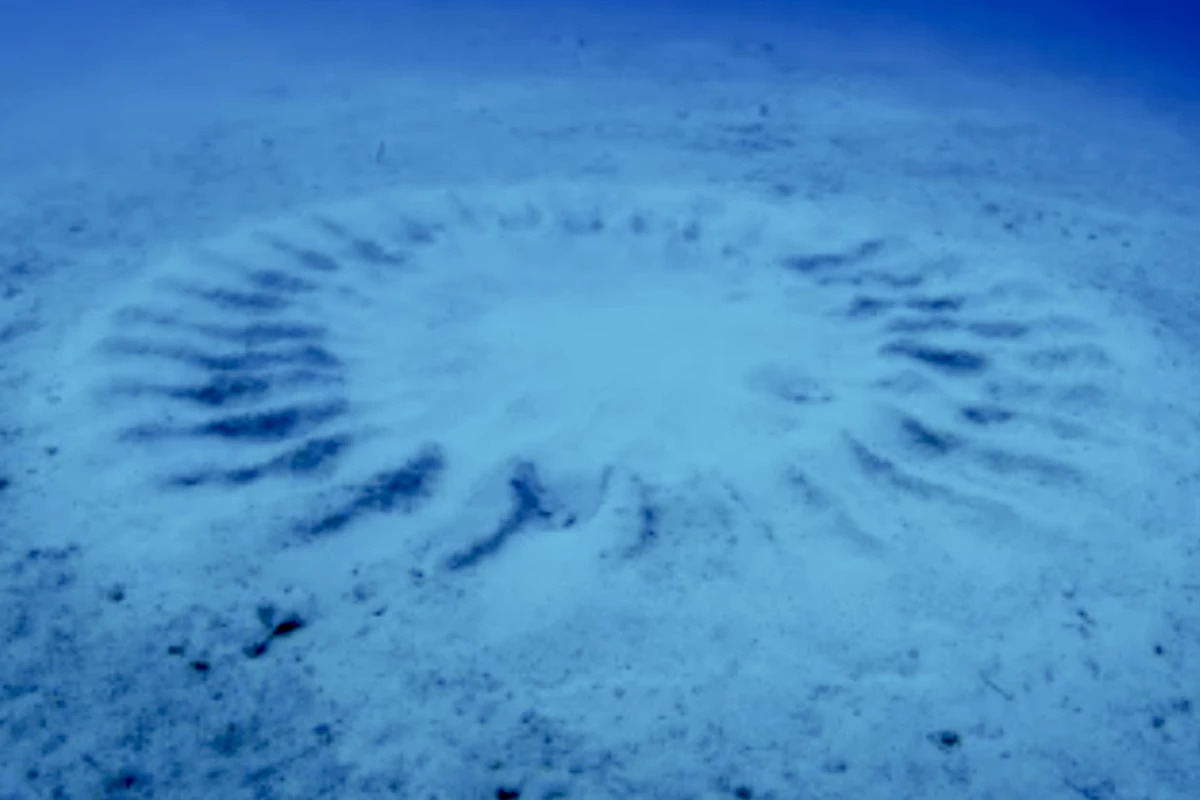
In a remarkable discovery, scientists have identified the creators of intricate underwater structures resembling “crop circles” off the coast of Amami Oshima Island in Japan. Since their first observation by divers in 1995, these geometrically precise formations, constructed annually, have fascinated marine researchers. The findings reveal that the stunning creations are the work of the male white-spotted pufferfish, scientifically known as Torquigener albomaculosus.
These circular structures can measure up to two metres (6.6 feet) in diameter and are meticulously crafted on the sandy seabed, which is typically devoid of features. The circles are not mere mounds of sand; they consist of ridges and grooves that radiate out from a central area, resembling the spokes of a wheel. For years, their existence was classified as one of the ocean’s mysteries until recent studies unveiled their fascinating purpose.
The male pufferfish engages in a laborious process to attract a mate and create a safe environment for its eggs. Sir David Attenborough has praised this fish’s artistry, describing it as “probably nature’s greatest artist.” According to a study published in Nature: Scientific Reports, the circle’s structure comprises deep ditches arranged radially in the outer ring, paired with shallow, maze-like ditches in the center.
To create these nests, the male pufferfish first uses its belly to flatten a central area in the sand. It then excavates the substrate with its fins and body, leaving behind numerous marks. This meticulous digging begins at lower points and progresses outward, forming a distinct circle shape. Once the outer ring is established, the fish returns to the center to refine the surface into a more complex design. These structures are visible from the water’s surface, even at depths ranging from 10 m (33 ft) to 30 m (66 ft).
The intricate design of these nests plays a crucial role in reproduction. After the male completes the structure, females inspect various circles before selecting the most appealing for spawning. Notably, females prefer nests with fine sand, which is the first material to degrade in the circle. This means that the male will have to construct a new nest for each mating event, as the previous one will not be reused. The entire construction process takes between seven to nine days, during which the male maintains the geometry of the circle by swimming along the sand and fanning its fins.
In subsequent studies, researchers have documented the specific details of the circle-building process. Initially, the male creates irregular depressions that evolve into a primitive circular form within the first two days. Over the next week, the number of ridges and valleys increases until the structure is complete. The final design is not the result of complex cognition, but rather the repetition of simple actions, a phenomenon known as “emergent complexity.”
Interestingly, these underwater nests are not designed to trap the eggs laid by females. Instead, they facilitate the retention of fine sand grains in the central area, creating a calmer zone where eggs can develop safely. As water currents pass over the structure, the peaks and valleys redirect flow, ensuring that the center remains oxygenated while minimizing disturbances.
After spawning, males typically remain in the circle for approximately six days to protect the eggs. However, they do not perform maintenance on the structure, which gradually degrades due to water currents. Once the eggs hatch, the males abandon the nest site and prepare to create a new one for the next reproductive cycle.
While much of the knowledge surrounding these circles has focused on T. albomaculosus, a study in 2020 revealed that another unidentified pufferfish species is also constructing similar structures at greater depths off the coast of northwest Australia. Using a hybrid autonomous underwater vehicle, researchers recorded high-resolution video of twenty-one circular formations that mirrored those found in Japan, located at a depth of at least 129 m (423 ft).
This discovery has sparked intrigue among scientists and the public alike, offering insights into the reproductive behaviors and evolutionary patterns of pufferfish globally. Further research is required to determine whether these Australian builders belong to the same species or represent a separate pufferfish population that engages in similar nesting behaviors.
In 2022, scientists developed a 3D model of the original “mystery circle,” showcasing the incredible engineering skills of the male pufferfish. The findings not only highlight the remarkable adaptations of these fish but also enrich our understanding of their role in the underwater ecosystem. The captivating work of these marine artists continues to inspire awe and curiosity among researchers and nature enthusiasts worldwide.





Revolutionary Photonic Ski-Jump Could Miniaturize LiDAR Systems

Couples Detox from Plastics in New Netflix Doc: Can It Boost Fertility?

Aventon Launches Affordable Full-Suspension Electric Mountain Bike

Discover Eight Must-Try Restaurants This Spring Season

UC Irvine Team Unveils Innovative Ion Pump for Water Treatment

One-Third of Americans Trim Daily Expenses for Healthcare Needs

Apple Secures First Oscar in Three Years with F1: The Movie

Fourth Graders Celebrate St. Patrick’s Day with Creative Weather Drawings

Kim Kardashian Dazzles at Vanity Fair Oscars Party 2026

Nostradamus’ 2026 Predictions: Star Death and Dark Events Loom

Breakthroughs and Challenges Await Science in 2026

Electric Moto Influencer Surronster Arrested in Tijuana

OpenAI to Implement Age Verification for ChatGPT by December 2025

Discover the Top 10 Calorie Counting Apps of 2025

Recovering a Suspended TikTok Account: A Step-by-Step Guide

Bella Hadid Shares Health Update After Treatment for Lyme Disease

Backpack Drives Equip Students with Supplies for New School Year

Analysts Project Stronger Growth for Apple’s iPhone 17 Lineup
-
 Science8 months ago
Nostradamus’ 2026 Predictions: Star Death and Dark Events Loom
-
 Science8 months ago
Breakthroughs and Challenges Await Science in 2026
-
 Technology11 months ago
Electric Moto Influencer Surronster Arrested in Tijuana
-
 Technology9 months ago
OpenAI to Implement Age Verification for ChatGPT by December 2025
-
 Technology1 year ago
Discover the Top 10 Calorie Counting Apps of 2025
-
 Technology1 year ago
Recovering a Suspended TikTok Account: A Step-by-Step Guide
-
 Health11 months ago
Bella Hadid Shares Health Update After Treatment for Lyme Disease
-
 Education1 year ago
Backpack Drives Equip Students with Supplies for New School Year
-
 Health12 months ago
Analysts Project Stronger Growth for Apple’s iPhone 17 Lineup
-

 Health12 months ago
Japanese Study Finds Rose Oil Can Increase Brain Gray Matter
-

 Technology8 months ago
Top 10 Penny Stocks to Watch in 2026 for Strong Returns
-

 Science10 months ago
Starship V3 Set for 2026 Launch After Successful Final Test of Version 2