
Science
Euclid Space Telescope Could Extend Mission for Groundbreaking Science

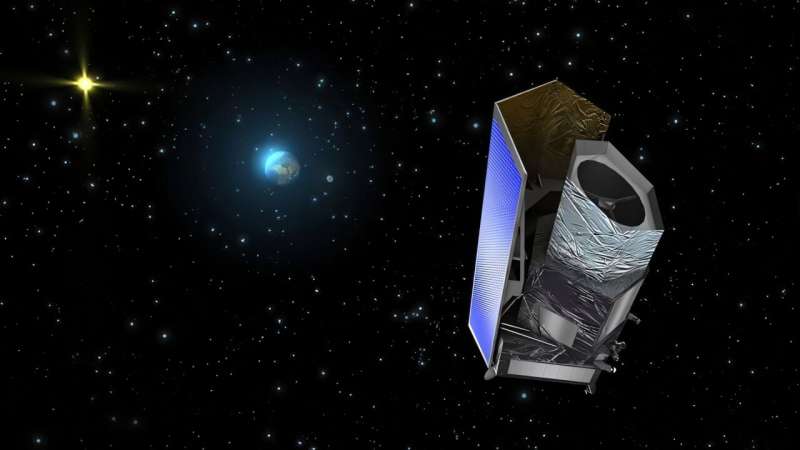
The European Space Agency’s (ESA) Euclid space telescope may have the potential for an extended mission lasting an additional eight years. According to a recent study by scientist Luigi “Rolly” Bedin from the Astronomical Institute of Padua, this extension could transform Euclid into the most powerful astrometric telescope ever developed.
Scheduled to conclude its primary mission in 2030, Euclid is currently tasked with mapping the elusive realms of dark energy and dark matter. The craft, which has additional fuel reserves, could effectively double its original mission duration of six years, providing a unique opportunity to gather more data on celestial movements.
Bedin’s proposal suggests that during this extended period, Euclid should replicate the observations made during its initial mission. This approach may initially seem redundant, but obtaining a second data point would allow astronomers to calculate the “proper motion” of nearby stars against the backdrop of more distant galaxies. Proper motion is vital for understanding the dynamics of our galaxy, as it measures how closer objects shift over time.
While some may point out that the Gaia mission is already conducting similar work, Bedin emphasizes a significant difference. Gaia, designed to create a three-dimensional map of the Milky Way, has limitations on the faintness of objects it can detect. In contrast, Euclid possesses the capability to observe objects significantly fainter—up to six magnitudes more than Gaia—allowing for the discovery of billions of additional celestial sources.
As the missions of both telescopes overlap, Gaia’s datasets assist Euclid in calibrating its observations. This collaboration could enhance the accuracy of measurements for objects already identified by Gaia by a factor of ten. Nevertheless, Bedin argues that Euclid’s potential extends beyond just complementing Gaia’s findings.
He proposes a novel idea for utilizing Euclid’s remaining fuel: conducting a third set of observations aimed at measuring “parallax.” This technique involves capturing images of specific stars six months apart, leveraging the telescope’s position on opposite sides of the sun. Such observations would enhance distance estimations of these stars, akin to how human depth perception operates.
Bedin acknowledges that several engineering challenges exist for this advanced method, as Euclid was not originally designed for parallax measurements. However, he believes these challenges are manageable. He asserts that merely repeating the initial observational campaign to gather data on proper motion presents no major obstacles.
With ample time remaining in Euclid’s primary mission, project managers at ESA should seriously consider Bedin’s recommendations. His ideas represent a pragmatic and innovative use of resources that could yield significant scientific discoveries.
More information on this proposal can be found in Bedin’s paper, titled “The case for an Astrometric Mission Extension of Euclid,” available on the arXiv preprint server.








Revolutionary Photonic Ski-Jump Could Miniaturize LiDAR Systems

Couples Detox from Plastics in New Netflix Doc: Can It Boost Fertility?

Aventon Launches Affordable Full-Suspension Electric Mountain Bike

Discover Eight Must-Try Restaurants This Spring Season

UC Irvine Team Unveils Innovative Ion Pump for Water Treatment

One-Third of Americans Trim Daily Expenses for Healthcare Needs

Apple Secures First Oscar in Three Years with F1: The Movie

Fourth Graders Celebrate St. Patrick’s Day with Creative Weather Drawings

Kim Kardashian Dazzles at Vanity Fair Oscars Party 2026

Nostradamus’ 2026 Predictions: Star Death and Dark Events Loom

Breakthroughs and Challenges Await Science in 2026

Electric Moto Influencer Surronster Arrested in Tijuana

OpenAI to Implement Age Verification for ChatGPT by December 2025

Discover the Top 10 Calorie Counting Apps of 2025

Recovering a Suspended TikTok Account: A Step-by-Step Guide

Bella Hadid Shares Health Update After Treatment for Lyme Disease

Backpack Drives Equip Students with Supplies for New School Year

Analysts Project Stronger Growth for Apple’s iPhone 17 Lineup
-
 Science7 months ago
Nostradamus’ 2026 Predictions: Star Death and Dark Events Loom
-
 Science7 months ago
Breakthroughs and Challenges Await Science in 2026
-
 Technology11 months ago
Electric Moto Influencer Surronster Arrested in Tijuana
-
 Technology8 months ago
OpenAI to Implement Age Verification for ChatGPT by December 2025
-
 Technology1 year ago
Discover the Top 10 Calorie Counting Apps of 2025
-
 Technology1 year ago
Recovering a Suspended TikTok Account: A Step-by-Step Guide
-
 Health11 months ago
Bella Hadid Shares Health Update After Treatment for Lyme Disease
-
 Education1 year ago
Backpack Drives Equip Students with Supplies for New School Year
-
 Health11 months ago
Analysts Project Stronger Growth for Apple’s iPhone 17 Lineup
-

 Technology7 months ago
Top 10 Penny Stocks to Watch in 2026 for Strong Returns
-

 Health11 months ago
Japanese Study Finds Rose Oil Can Increase Brain Gray Matter
-

 Science10 months ago
Starship V3 Set for 2026 Launch After Successful Final Test of Version 2