
Science
Astronomers Discover Rare ‘Superkilonova’ from Cosmic Collision

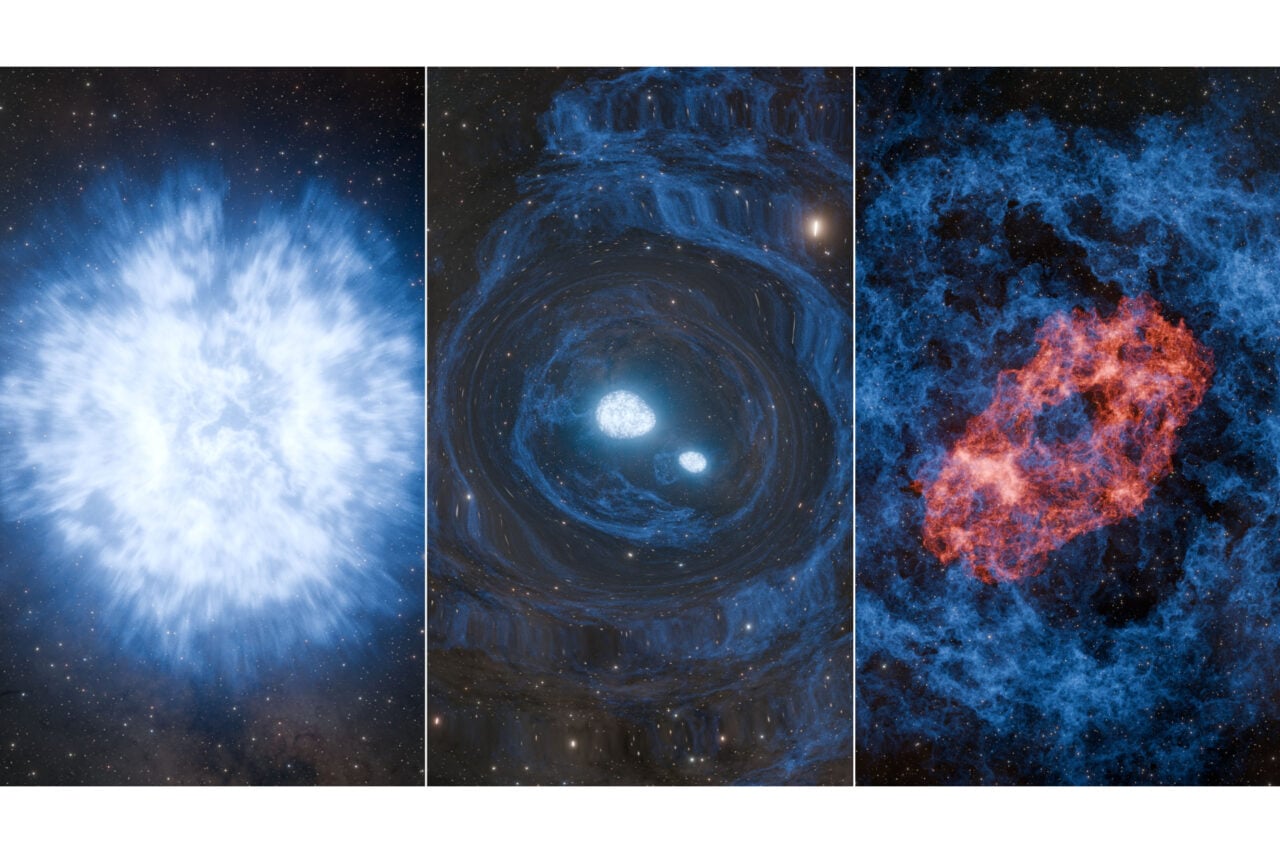
A recent astronomical discovery has unveiled a rare cosmic phenomenon, referred to as a “superkilonova,” resulting from the collision of two neutron stars. Researchers from the California Institute of Technology published their findings in The Astrophysical Journal Letters, detailing a stellar explosion that combines characteristics of both a supernova and a kilonova. The event, designated AT2025ulz, could provide new insights into the lifecycle of massive stars.
When massive stars reach the end of their lives, they typically explode in brilliant displays known as supernovas. In some cases, two dying stars collide, leading to the formation of kilonovas—less luminous but equally significant explosions that produce heavy elements. The discovery of AT2025ulz marks an extraordinary instance where a supernova has birthed two neutron stars that subsequently merged, resulting in a kilonova.
The significance of this discovery extends beyond mere observation. Stellar explosions like supernovas contribute to the formation of elements such as carbon and iron, while kilonovas are responsible for even denser elements like gold and uranium. Such events create ripples in spacetime that are detectable by instruments like LIGO.
In August 2023, LIGO detected a signal reminiscent of the first kilonova recorded in 2017. The alert prompted astronomers to investigate, and soon after, survey cameras confirmed the presence of rapidly fading red lights, indicating heavy element production consistent with kilonovas. Just days later, the source exhibited a blue flare, akin to a supernova.
Mansi Kasliwal, lead author of the study and an astrophysicist at Caltech, expressed excitement over the initial observations. “At first, for about three days, the eruption looked just like the first kilonova in 2017,” Kasliwal stated. “Everybody was intensely trying to observe and analyze it, but then it started to look more like a supernova, and some astronomers lost interest. Not us.”
For Kasliwal and her team, the data surrounding AT2025ulz presented too many anomalies to simply categorize it as a supernova. It diverged significantly from typical supernova behavior and also from the kilonova recorded in 2017. The gravitational wave readings suggested a merger involving two objects, with at least one exhibiting an unusually low mass.
According to Brian Metzger, co-author of the study and a theoretical physicist at Columbia University, the existence of a neutron star with a mass less than that of the Sun was previously thought to be theoretically impossible. Yet, LIGO’s findings indicate a sub-solar neutron star involved in a cataclysmic merger.
The team theorizes that the lightweight neutron stars may have formed from a rapidly spinning massive star that split into two during a supernova. The chaotic nature of the merging process likely forced the nascent neutron stars into a spiral that led to a kilonova explosion. Despite the tantalizing nature of this explanation, the researchers acknowledge that further investigation is necessary.
Kasliwal emphasized the importance of this discovery, stating, “Future kilonovae events may not look like GW170817 and may be mistaken for supernovae. We do not know with certainty that we found a superkilonova, but the event nevertheless is eye-opening.” If confirmed, AT2025ulz would represent only the second kilonova ever detected, highlighting the complexity of stellar phenomena and the ongoing quest for understanding the universe.








Revolutionary Photonic Ski-Jump Could Miniaturize LiDAR Systems

Couples Detox from Plastics in New Netflix Doc: Can It Boost Fertility?

Aventon Launches Affordable Full-Suspension Electric Mountain Bike

Discover Eight Must-Try Restaurants This Spring Season

UC Irvine Team Unveils Innovative Ion Pump for Water Treatment

One-Third of Americans Trim Daily Expenses for Healthcare Needs

Apple Secures First Oscar in Three Years with F1: The Movie

Fourth Graders Celebrate St. Patrick’s Day with Creative Weather Drawings

Kim Kardashian Dazzles at Vanity Fair Oscars Party 2026

Nostradamus’ 2026 Predictions: Star Death and Dark Events Loom

Breakthroughs and Challenges Await Science in 2026

Electric Moto Influencer Surronster Arrested in Tijuana

OpenAI to Implement Age Verification for ChatGPT by December 2025

Discover the Top 10 Calorie Counting Apps of 2025

Recovering a Suspended TikTok Account: A Step-by-Step Guide

Bella Hadid Shares Health Update After Treatment for Lyme Disease

Backpack Drives Equip Students with Supplies for New School Year

Analysts Project Stronger Growth for Apple’s iPhone 17 Lineup
-
 Science8 months ago
Nostradamus’ 2026 Predictions: Star Death and Dark Events Loom
-
 Science8 months ago
Breakthroughs and Challenges Await Science in 2026
-
 Technology11 months ago
Electric Moto Influencer Surronster Arrested in Tijuana
-
 Technology9 months ago
OpenAI to Implement Age Verification for ChatGPT by December 2025
-
 Technology1 year ago
Discover the Top 10 Calorie Counting Apps of 2025
-
 Technology1 year ago
Recovering a Suspended TikTok Account: A Step-by-Step Guide
-
 Health11 months ago
Bella Hadid Shares Health Update After Treatment for Lyme Disease
-
 Education1 year ago
Backpack Drives Equip Students with Supplies for New School Year
-
 Health12 months ago
Analysts Project Stronger Growth for Apple’s iPhone 17 Lineup
-

 Health12 months ago
Japanese Study Finds Rose Oil Can Increase Brain Gray Matter
-

 Technology8 months ago
Top 10 Penny Stocks to Watch in 2026 for Strong Returns
-

 Science10 months ago
Starship V3 Set for 2026 Launch After Successful Final Test of Version 2