
Science
New Research Links Plasma Rings to Planetary Habitability Around M Dwarfs

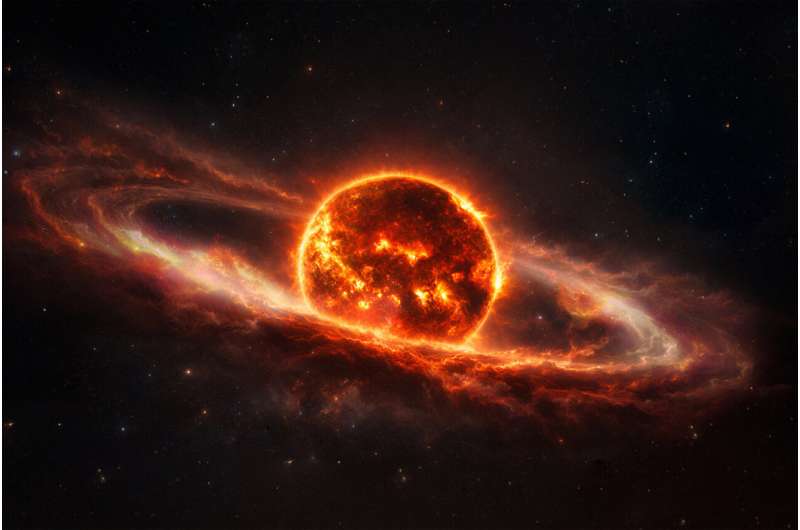
A recent study led by Luke Bouma from the Carnegie Institution for Science has uncovered significant insights into how stars, particularly M dwarf stars, influence the habitability of their orbiting planets. Bouma’s research, presented at the 247th American Astronomical Society meeting and published in The Astrophysical Journal Letters, investigates the role of plasma rings around these stars, which may serve as natural space weather stations.
Understanding M Dwarf Stars and Their Influence
M dwarf stars are smaller, cooler, and dimmer than the Sun, yet they are known to host at least one Earth-sized rocky planet in many cases. However, many of these planets are deemed inhospitable due to extreme conditions, such as excessive heat that prevents liquid water from existing or frequent stellar flares that bombard them with intense radiation. Despite these challenges, Bouma suggests that studying these stars can provide valuable insights into how stellar activity shapes planetary environments.
“Stars influence their planets. That’s obvious,” Bouma stated. “They do so both through light, which we’re great at observing, and through particles—or space weather—like solar winds and magnetic storms, which are more challenging to study at great distances.” This interplay between solar phenomena and planetary conditions poses a crucial question: How do these factors affect the possibility of life beyond Earth?
Discoveries in Plasma Dynamics
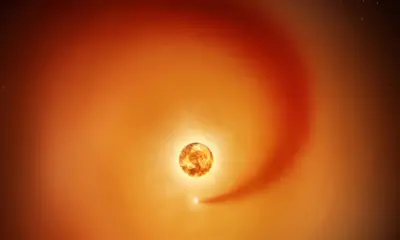
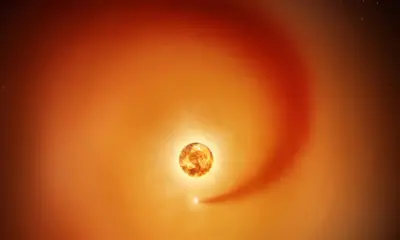
Working alongside Moira Jardine of the University of St. Andrews, Bouma focused on a unique class of M dwarf stars known as complex periodic variables. These rapidly rotating stars exhibit recurring dips in brightness, which had puzzled astronomers. Through their research, Bouma and Jardine demonstrated that these brightness fluctuations are caused by large clumps of cool plasma trapped in the star’s magnetosphere, forming a toroidal shape.
“Once we understood this, the blips in dimming stopped being weird little mysteries and became a space weather station,” Bouma explained.
This plasma torus provides a new means to assess conditions around M dwarf stars, offering insights into the dynamics of stellar material. Bouma and Jardine estimate that at least 10% of M dwarf stars could exhibit similar plasma features early in their life cycles, indicating the potential for extensive research into how these phenomena influence surrounding planetary bodies.
Future research will focus on determining the origin of the material in these plasma rings—whether it comes from the star itself or an external source. Bouma emphasizes the significance of this discovery, stating, “This is a great example of a serendipitous discovery, something we didn’t expect to find but that will give us a new window into understanding planet-star relationships.”
While the habitability of planets around M dwarfs remains uncertain, Bouma is optimistic that understanding space weather will play a crucial role in answering this question. The study paves the way for further exploration into the intricate relationships between stars and their planets, potentially reshaping our understanding of where life could exist beyond our solar system.
More information can be found in the study titled “A Plasma Torus around a Young Low-mass Star,” published in The Astrophysical Journal Letters.







Revolutionary Photonic Ski-Jump Could Miniaturize LiDAR Systems

Couples Detox from Plastics in New Netflix Doc: Can It Boost Fertility?

Aventon Launches Affordable Full-Suspension Electric Mountain Bike

Discover Eight Must-Try Restaurants This Spring Season

UC Irvine Team Unveils Innovative Ion Pump for Water Treatment

One-Third of Americans Trim Daily Expenses for Healthcare Needs

Apple Secures First Oscar in Three Years with F1: The Movie

Fourth Graders Celebrate St. Patrick’s Day with Creative Weather Drawings

Kim Kardashian Dazzles at Vanity Fair Oscars Party 2026

Nostradamus’ 2026 Predictions: Star Death and Dark Events Loom

Breakthroughs and Challenges Await Science in 2026

Electric Moto Influencer Surronster Arrested in Tijuana

OpenAI to Implement Age Verification for ChatGPT by December 2025

Discover the Top 10 Calorie Counting Apps of 2025

Recovering a Suspended TikTok Account: A Step-by-Step Guide

Bella Hadid Shares Health Update After Treatment for Lyme Disease

Backpack Drives Equip Students with Supplies for New School Year

Analysts Project Stronger Growth for Apple’s iPhone 17 Lineup
-
 Science7 months ago
Nostradamus’ 2026 Predictions: Star Death and Dark Events Loom
-
 Science8 months ago
Breakthroughs and Challenges Await Science in 2026
-
 Technology11 months ago
Electric Moto Influencer Surronster Arrested in Tijuana
-
 Technology8 months ago
OpenAI to Implement Age Verification for ChatGPT by December 2025
-
 Technology1 year ago
Discover the Top 10 Calorie Counting Apps of 2025
-
 Technology1 year ago
Recovering a Suspended TikTok Account: A Step-by-Step Guide
-
 Health11 months ago
Bella Hadid Shares Health Update After Treatment for Lyme Disease
-
 Education1 year ago
Backpack Drives Equip Students with Supplies for New School Year
-
 Health11 months ago
Analysts Project Stronger Growth for Apple’s iPhone 17 Lineup
-

 Health11 months ago
Japanese Study Finds Rose Oil Can Increase Brain Gray Matter
-

 Technology8 months ago
Top 10 Penny Stocks to Watch in 2026 for Strong Returns
-

 Science10 months ago
Starship V3 Set for 2026 Launch After Successful Final Test of Version 2