
Science
SpaceX Launches First ‘Twilight’ Rideshare Mission with NASA Payloads

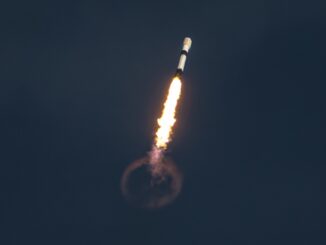
SpaceX successfully launched its inaugural ‘Twilight’ rideshare mission on January 14, 2024, from Vandenberg Space Force Base in California. The Falcon 9 rocket lifted off at 5:20 a.m. PST (8:20 a.m. EST / 1320 UTC) and is set to deploy multiple payloads, including three NASA spacecraft designed for astronomical research.
The ‘Twilight’ mission is notable for its flight to a “dawn-dusk Sun-synchronous orbit.” This new class of rideshare mission will see payloads jettisoned from the Falcon 9 rocket’s upper stage starting approximately one hour after liftoff, continuing for more than 2.5 hours. As of Saturday, SpaceX had confirmed 40 deployment events slated for this launch.
Payloads and Research Objectives
Among the payloads is the **Pandora** spacecraft, developed by NASA’s Goddard Space Flight Center. This mission aims to enhance our understanding of exoplanets by observing the atmospheres of these distant worlds. Equipped with a 17-inch-wide (45 cm) telescope, Pandora will conduct observations in both visible and infrared light, analyzing 20 stars and 39 exoplanets over a five-year timeline. With a budget cap of **$20 million**, Pandora represents a significant step forward in exoplanet exploration.
Daniel Apai, a professor of astronomy and planetary science at the University of Arizona, noted, “The Pandora mission is a bold new chapter in exoplanet exploration. It is the first space telescope built specifically to study, in detail, starlight filtered through exoplanet atmospheres.” The data collected will aid in interpreting findings from previous missions, including NASA’s Kepler and Webb space telescopes.
The mission also includes two other NASA-backed payloads, **BlackCat** and **SPARCS** (Star-Planet Activity Research CubeSat). BlackCat, funded with **$5.8 million**, is a wide-field x-ray telescope developed by Pennsylvania State University, focusing on cosmic phenomena such as gamma-ray bursts. Meanwhile, SPARCS will investigate stellar flares and sunspots, which may impact the habitability of nearby exoplanets.
Significant Milestones and Collaborations
The Falcon 9 rocket utilized for the Twilight mission is designated B1097, marking its fifth flight. This booster previously supported three launches of Starlink V2 Mini Optimized satellites and the Sentinel-6B spacecraft. Approximately **7.5 minutes** after liftoff, B1097 is expected to land at Landing Zone 4 (LZ-4), aiming for a successful recovery that would contribute to SpaceX’s growing tally of booster landings, currently at 556.
The mission also highlights a collaborative effort with **Exolaunch**, which is responsible for managing over half of the 40 payloads. One of the first deployments will be the Connecta Internet of Things CubeSats from Plan-S Satellite and Space Technologies based in Türkiye. This launch will add to Plan-S’s fleet, bringing their total to 16 IoT satellites in low Earth orbit.
Jeanne Allarie, Chief Investor Relations Officer at Exolaunch, stated, “The Twilight mission builds directly on a record-breaking year for Exolaunch. In 2025 alone, we completed 11 launches and deployed 196 satellites, the highest annual launch cadence in our history.”
Another noteworthy payload is the Araqys-D1/Dcubed-1 satellite from Germany, which aims to manufacture a **60-cm boom** in space. If successful, this project would represent a significant advancement in in-space manufacturing, paving the way for constructing larger structures in orbit.
In addition to the scientific instruments and satellites, **Kepler Communications** plans to deploy ten Aether satellites during the Twilight mission. These communications satellites feature advanced optical terminals designed for high-throughput, low-latency laser links, enhancing real-time data transmission capabilities in space.
As the mission unfolds, it promises to not only enrich our understanding of the universe but also demonstrate the capabilities of new technologies and international collaborations in space exploration. With its diverse range of payloads and innovative objectives, the Twilight mission stands as a testament to the evolving landscape of space research and satellite deployment.







Revolutionary Photonic Ski-Jump Could Miniaturize LiDAR Systems

Couples Detox from Plastics in New Netflix Doc: Can It Boost Fertility?

Aventon Launches Affordable Full-Suspension Electric Mountain Bike

Discover Eight Must-Try Restaurants This Spring Season

UC Irvine Team Unveils Innovative Ion Pump for Water Treatment

One-Third of Americans Trim Daily Expenses for Healthcare Needs

Apple Secures First Oscar in Three Years with F1: The Movie

Fourth Graders Celebrate St. Patrick’s Day with Creative Weather Drawings

Kim Kardashian Dazzles at Vanity Fair Oscars Party 2026

Nostradamus’ 2026 Predictions: Star Death and Dark Events Loom

Breakthroughs and Challenges Await Science in 2026

Electric Moto Influencer Surronster Arrested in Tijuana

OpenAI to Implement Age Verification for ChatGPT by December 2025

Discover the Top 10 Calorie Counting Apps of 2025

Recovering a Suspended TikTok Account: A Step-by-Step Guide

Bella Hadid Shares Health Update After Treatment for Lyme Disease

Backpack Drives Equip Students with Supplies for New School Year

Analysts Project Stronger Growth for Apple’s iPhone 17 Lineup
-
 Science8 months ago
Nostradamus’ 2026 Predictions: Star Death and Dark Events Loom
-
 Science8 months ago
Breakthroughs and Challenges Await Science in 2026
-
 Technology11 months ago
Electric Moto Influencer Surronster Arrested in Tijuana
-
 Technology9 months ago
OpenAI to Implement Age Verification for ChatGPT by December 2025
-
 Technology1 year ago
Discover the Top 10 Calorie Counting Apps of 2025
-
 Technology1 year ago
Recovering a Suspended TikTok Account: A Step-by-Step Guide
-
 Health11 months ago
Bella Hadid Shares Health Update After Treatment for Lyme Disease
-
 Education1 year ago
Backpack Drives Equip Students with Supplies for New School Year
-
 Health12 months ago
Analysts Project Stronger Growth for Apple’s iPhone 17 Lineup
-

 Health12 months ago
Japanese Study Finds Rose Oil Can Increase Brain Gray Matter
-

 Technology8 months ago
Top 10 Penny Stocks to Watch in 2026 for Strong Returns
-

 Science10 months ago
Starship V3 Set for 2026 Launch After Successful Final Test of Version 2