
Science
Researchers Unveil Eco-Friendly Silicon Ultrasound Patch

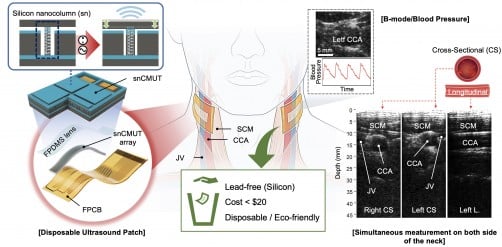
A team of researchers has developed a groundbreaking silicon-based ultrasound patch that promises to enhance medical imaging while eliminating harmful lead components. This innovative device, created under the leadership of Dr. Byung Chul Lee at the Korea Institute of Science and Technology (KIST), represents a significant advancement in wearable ultrasound technology.
Traditional ultrasound devices primarily utilize lead (Pb)-based piezoelectric ceramics, which pose risks to both human health and the environment. The new silicon patch, in collaboration with experts from KAIST, Seoul National University Hospital, and Stanford University, aims to replace these materials without compromising performance.
Innovative Design and Performance
The research team achieved a remarkable feat by fabricating an ultrathin patch, measuring just a few hundred micrometers thick, using advanced semiconductor technology. By avoiding the conventional matching and backing layers typically found in ultrasound transducers, the team created a flexible, lightweight device that maintains stable performance.
Tests conducted on the patch revealed its superiority. Compared to existing commercial transducers, it demonstrated an impressive over 30% increase in output pressure, leading to enhanced image quality. Additionally, the device proved capable of accurately measuring blood flow velocity and vessel diameter in dynamic areas, such as the neck, with a remarkable accuracy rate of over 96% when compared to standard clinical blood pressure monitors.
Wide-ranging Applications and Economic Benefits
The potential applications for this silicon-based ultrasound technology are extensive, especially in telemedicine and personalized healthcare. With production costs estimated to be approximately 1/20 that of conventional lead-based devices, the new patch is positioned to be both economical and environmentally friendly.
The research received support from the Ministry of Science and ICT and was published in the esteemed journal Nature Communications. The team at KIST is optimistic that this technology will dominate the market for disposable ultrasound patches, with plans to further validate its safety and reliability across various clinical settings.
Dr. Byung Chul Lee emphasized the significance of this development by stating, “This research is highly meaningful in that we successfully developed an ultrasound patch that anyone can use safely by replacing harmful lead with silicon.” Meanwhile, Prof. Whal Lee highlighted the versatility of silicon-based devices, noting their flexibility and potential to expand the applications of ultrasound imaging.
As the healthcare industry continues to evolve, this innovation signals a promising shift towards safer, more efficient medical technologies. The collaborative efforts of these leading institutions underscore the importance of advancing medical devices that prioritize both performance and environmental sustainability.










Revolutionary Photonic Ski-Jump Could Miniaturize LiDAR Systems

Couples Detox from Plastics in New Netflix Doc: Can It Boost Fertility?

Aventon Launches Affordable Full-Suspension Electric Mountain Bike

Discover Eight Must-Try Restaurants This Spring Season

UC Irvine Team Unveils Innovative Ion Pump for Water Treatment

One-Third of Americans Trim Daily Expenses for Healthcare Needs

Apple Secures First Oscar in Three Years with F1: The Movie

Fourth Graders Celebrate St. Patrick’s Day with Creative Weather Drawings

Kim Kardashian Dazzles at Vanity Fair Oscars Party 2026

Nostradamus’ 2026 Predictions: Star Death and Dark Events Loom

Breakthroughs and Challenges Await Science in 2026

Electric Moto Influencer Surronster Arrested in Tijuana

OpenAI to Implement Age Verification for ChatGPT by December 2025

Discover the Top 10 Calorie Counting Apps of 2025

Bella Hadid Shares Health Update After Treatment for Lyme Disease

Analysts Project Stronger Growth for Apple’s iPhone 17 Lineup

Japanese Study Finds Rose Oil Can Increase Brain Gray Matter

Top 10 Penny Stocks to Watch in 2026 for Strong Returns
-
 Science6 months ago
Nostradamus’ 2026 Predictions: Star Death and Dark Events Loom
-
 Science7 months ago
Breakthroughs and Challenges Await Science in 2026
-
 Technology10 months ago
Electric Moto Influencer Surronster Arrested in Tijuana
-
 Technology7 months ago
OpenAI to Implement Age Verification for ChatGPT by December 2025
-
 Technology12 months ago
Discover the Top 10 Calorie Counting Apps of 2025
-
 Health10 months ago
Bella Hadid Shares Health Update After Treatment for Lyme Disease
-
 Health10 months ago
Analysts Project Stronger Growth for Apple’s iPhone 17 Lineup
-
 Health10 months ago
Japanese Study Finds Rose Oil Can Increase Brain Gray Matter
-
 Technology7 months ago
Top 10 Penny Stocks to Watch in 2026 for Strong Returns
-

 Science9 months ago
Starship V3 Set for 2026 Launch After Successful Final Test of Version 2
-

 Technology9 months ago
InMotion Unveils P6 Electric Unicycle with 93 MPH Top Speed
-

 Technology4 months ago
Nvidia GTC 2026: Major Announcements Expected for AI and Hardware