
Science
Researchers Unlock New Insights into Charge Storage in Supercapacitors

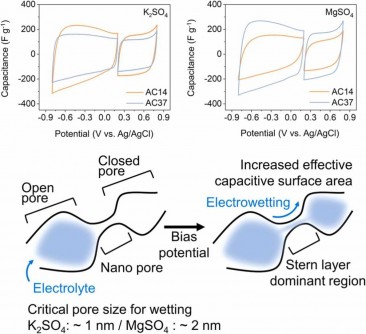
Research from a collaborative team including scientists from Korea University and KAIST has shed light on the complex mechanisms governing charge storage in supercapacitors. Published in March 2025 in the journal eScience Energy, the study focuses on how electrowetting influences ion transport within carbon nanopores, offering a potential pathway to enhance the performance of energy storage devices.
Supercapacitors are increasingly recognized for their rapid charge and discharge capabilities. However, they typically fall short of batteries in terms of energy density, largely due to limitations in charge storage within nanoporous materials. Activated carbon remains the primary choice for electrode materials, but its microporous structure poses challenges for ion accessibility. This research addresses critical gaps in understanding the effects of pore size, ion types, and double-layer structures on capacitance.
The investigation highlights how existing studies have predominantly focused on monovalent ions in sub-nanometer pores, leaving a considerable knowledge gap regarding multivalent electrolytes and mesopore environments. The research team systematically compared ion transport and electrowetting behavior across various pore sizes and charge carriers, aiming to clarify these interactions.
To conduct their experiments, researchers engineered carbon electrodes with pore sizes of 1.4 nm and 3.7 nm. They compared the electrochemical behavior of these electrodes in solutions containing monovalent ions such as K+ and Na+, alongside multivalent ions like Mg2+ and Zn2+. Their findings underscored the significance of electrowetting-induced dual-ion adsorption as a critical factor in enhancing capacitance.
The study produced two distinct activated carbons: AC14, characterized by its microporous structure, and AC37, which features a mesoporous architecture. Structural characterizations conducted using techniques such as field-emission scanning electron microscopy (FE-SEM), transmission electron microscopy (TEM), and X-ray photoelectron spectroscopy (XPS) confirmed that pore size was the main variable influencing electrochemical performance.
Results showed that monovalent ions preferred the micropores, while multivalent ions thrived in larger pore geometries. The capacitance of AC37 with Mg2+ ions reached approximately 237 F g−1, significantly outperforming other tested combinations. Additional experiments, including inductively coupled plasma optical emission spectrometry (ICP-OES) and electrochemical quartz crystal microbalance (EQCM), indicated strong dual-ion adsorption and notable mass increases in configurations optimized for performance.
The study’s molecular dynamics simulations revealed how applied voltage facilitates the penetration of water and ions into hydrophobic nanopores. This process reduces ion desolvation barriers and promotes the formation of a Stern-layer-dominant electric double layer, crucial for improving charge storage capacity.
The authors emphasized a paradigm shift in supercapacitor design. Instead of merely increasing surface area, they suggest that understanding ion behavior under confinement is vital. They noted, “Matching pore size with suitable electrolyte ions allows the electric double layer to compress into a high-density Stern layer, unlocking capacitance far beyond conventional assumptions.”
These insights advocate for optimizing electrowetting as a new design principle for future supercapacitors. The research suggests that materials should focus on engineering pore-ion compatibility rather than solely expanding pore volume. Leveraging mesopores with multivalent electrolytes could significantly enhance charge density, potentially accelerating the development of compact, high-power energy storage solutions.
The implications of this research extend beyond academic interest. By refining nanopore architecture and electrolyte chemistry, the team provides a roadmap for overcoming traditional performance limits, paving the way for advancements in applications such as wearables, grid buffering, and fast-charging electronics.
This work received funding from the Korea Institute of Science and Technology (KIST), supporting innovative research that seeks to advance energy storage technologies.


Revolutionary Photonic Ski-Jump Could Miniaturize LiDAR Systems

Couples Detox from Plastics in New Netflix Doc: Can It Boost Fertility?

Aventon Launches Affordable Full-Suspension Electric Mountain Bike

Discover Eight Must-Try Restaurants This Spring Season

UC Irvine Team Unveils Innovative Ion Pump for Water Treatment

One-Third of Americans Trim Daily Expenses for Healthcare Needs

Apple Secures First Oscar in Three Years with F1: The Movie

Fourth Graders Celebrate St. Patrick’s Day with Creative Weather Drawings

Kim Kardashian Dazzles at Vanity Fair Oscars Party 2026

Nostradamus’ 2026 Predictions: Star Death and Dark Events Loom

Breakthroughs and Challenges Await Science in 2026

Electric Moto Influencer Surronster Arrested in Tijuana

OpenAI to Implement Age Verification for ChatGPT by December 2025

Discover the Top 10 Calorie Counting Apps of 2025

Recovering a Suspended TikTok Account: A Step-by-Step Guide

Bella Hadid Shares Health Update After Treatment for Lyme Disease

Backpack Drives Equip Students with Supplies for New School Year

Analysts Project Stronger Growth for Apple’s iPhone 17 Lineup
-
 Science8 months ago
Nostradamus’ 2026 Predictions: Star Death and Dark Events Loom
-
 Science8 months ago
Breakthroughs and Challenges Await Science in 2026
-
 Technology11 months ago
Electric Moto Influencer Surronster Arrested in Tijuana
-
 Technology9 months ago
OpenAI to Implement Age Verification for ChatGPT by December 2025
-
 Technology1 year ago
Discover the Top 10 Calorie Counting Apps of 2025
-
 Technology1 year ago
Recovering a Suspended TikTok Account: A Step-by-Step Guide
-
 Health11 months ago
Bella Hadid Shares Health Update After Treatment for Lyme Disease
-
 Education1 year ago
Backpack Drives Equip Students with Supplies for New School Year
-
 Health12 months ago
Analysts Project Stronger Growth for Apple’s iPhone 17 Lineup
-

 Health12 months ago
Japanese Study Finds Rose Oil Can Increase Brain Gray Matter
-

 Technology8 months ago
Top 10 Penny Stocks to Watch in 2026 for Strong Returns
-

 Science10 months ago
Starship V3 Set for 2026 Launch After Successful Final Test of Version 2