
Science
Researchers Develop Carbon-Free Heating Tech for Steel Industry

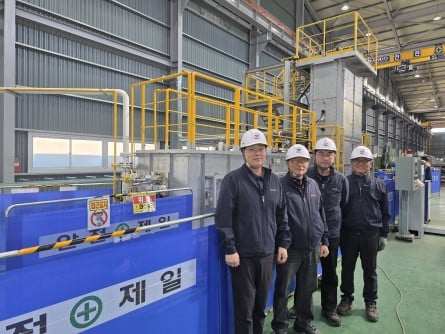
Researchers at the Korea Institute of Energy Research (KIER), led by Dr. Hookyung Lee, have unveiled a groundbreaking electrification technology that transforms the high-emission metal heat treatment process into a carbon-free operation. This innovation replaces fossil fuels with electricity in the production of galvanized steel strips, commonly used in automobiles and household appliances. The technology is poised to significantly impact energy-intensive industries, particularly steelmaking, by supporting global decarbonization efforts.
The South Korean government has intensified its commitment to decarbonizing industrial processes, aiming for a substantial reduction in greenhouse gas emissions by 2035. Under this initiative, industries like steel are increasingly urged to adopt electrified heating technologies to meet national targets. The industrial sector aims to achieve up to a 31% reduction in emissions from 2018 levels through various strategies, including process electrification and the production of low-carbon products.
The conventional method of producing galvanized steel strips involves a continuous galvanizing line (CGL) process, where steel plates pass through a molten zinc bath. During this process, the steel undergoes annealing, a critical heat treatment step that enhances its ductility and formability. Traditionally, this thermal treatment relies on fossil fuels such as natural gas, resulting in significant emissions of greenhouse gases, including carbon dioxide and nitrogen oxides. In fact, emissions from the steel industry contribute approximately 15% of South Korea’s total national emissions.
To combat these challenges, the research team has developed a “carbon-free annealing system.” This innovative system utilizes electric heating elements instead of conventional burners found in combustion-based annealing furnaces. Under testing conditions closely mirroring commercial production, the new technology achieved a remarkable reduction of over 98% in carbon dioxide and nitrogen oxides in exhaust gases.
The success of this system is attributed to its advanced furnace design. The research team maintained the existing refractory structure and steel-strip conveying mechanism while integrating electric heating elements located on both the upper and lower sections of the furnace. By optimizing the distance between these elements and the steel strips, the system enables rapid and uniform heating while minimizing heat loss to the furnace walls.
When applied to anneal steel strips measuring 0.49 millimeters thick at temperatures of 750°C, the results demonstrated that the color, microstructure, and mechanical properties of the strips matched those achieved with traditional methods. This breakthrough confirms that substantial reductions in carbon emissions can be achieved without compromising productivity or product quality. Moreover, the electric annealing furnace eliminates the need for fuel and air supply systems, burners, and exhaust systems, leading to a reduction in capital investment costs and installation footprint by approximately 40%.
The potential for this technology to operate using renewable energy sources such as wind and solar further enhances its appeal. This capability can facilitate a truly carbon-free heat treatment process, aligning with global environmental regulations, including the Carbon Border Adjustment Mechanism (CBAM). CBAM imposes additional carbon pricing on imported products produced outside the EU, ensuring a level playing field for domestic and international markets.
Dr. Hookyung Lee emphasized the significance of this development, stating, “This demonstration is the world’s first case to show that carbon-free heating can be achieved simply by replacing burners with electric heating elements.” He further noted plans to enhance the technology into an AI-based design and operation system. This system will automatically recommend optimal configurations for heating elements based on parameters such as steel strip width, thickness, and conveying speed, ultimately aiming to create an export-ready carbon-free heating solution linked to commercial-scale demonstrations with domestic steelmakers and international markets.
The research findings were published in September 2025 in the journal Applied Thermal Engineering, a respected publication in the fields of energy and thermal engineering. This study received support from the Ministry of Trade, Industry and Energy of South Korea, with the demonstration and testing conducted in collaboration with Samwoo Eco Co., Ltd.
This innovative electrification technology represents a significant step forward in the pursuit of sustainable industrial practices and may serve as a model for other countries looking to reduce their carbon footprints in energy-intensive sectors.










Revolutionary Photonic Ski-Jump Could Miniaturize LiDAR Systems

Couples Detox from Plastics in New Netflix Doc: Can It Boost Fertility?

Aventon Launches Affordable Full-Suspension Electric Mountain Bike

Discover Eight Must-Try Restaurants This Spring Season

UC Irvine Team Unveils Innovative Ion Pump for Water Treatment

One-Third of Americans Trim Daily Expenses for Healthcare Needs

Apple Secures First Oscar in Three Years with F1: The Movie

Fourth Graders Celebrate St. Patrick’s Day with Creative Weather Drawings

Kim Kardashian Dazzles at Vanity Fair Oscars Party 2026

Nostradamus’ 2026 Predictions: Star Death and Dark Events Loom

Breakthroughs and Challenges Await Science in 2026

Electric Moto Influencer Surronster Arrested in Tijuana

OpenAI to Implement Age Verification for ChatGPT by December 2025

Discover the Top 10 Calorie Counting Apps of 2025

Recovering a Suspended TikTok Account: A Step-by-Step Guide

Bella Hadid Shares Health Update After Treatment for Lyme Disease

Backpack Drives Equip Students with Supplies for New School Year

Analysts Project Stronger Growth for Apple’s iPhone 17 Lineup
-
 Science8 months ago
Nostradamus’ 2026 Predictions: Star Death and Dark Events Loom
-
 Science8 months ago
Breakthroughs and Challenges Await Science in 2026
-
 Technology11 months ago
Electric Moto Influencer Surronster Arrested in Tijuana
-
 Technology9 months ago
OpenAI to Implement Age Verification for ChatGPT by December 2025
-
 Technology1 year ago
Discover the Top 10 Calorie Counting Apps of 2025
-
 Technology1 year ago
Recovering a Suspended TikTok Account: A Step-by-Step Guide
-
 Health11 months ago
Bella Hadid Shares Health Update After Treatment for Lyme Disease
-
 Education1 year ago
Backpack Drives Equip Students with Supplies for New School Year
-
 Health11 months ago
Analysts Project Stronger Growth for Apple’s iPhone 17 Lineup
-

 Health12 months ago
Japanese Study Finds Rose Oil Can Increase Brain Gray Matter
-

 Technology8 months ago
Top 10 Penny Stocks to Watch in 2026 for Strong Returns
-

 Science10 months ago
Starship V3 Set for 2026 Launch After Successful Final Test of Version 2