
Science
New Mechanosensor Unveiled in Venus Flytrap’s Rapid Response

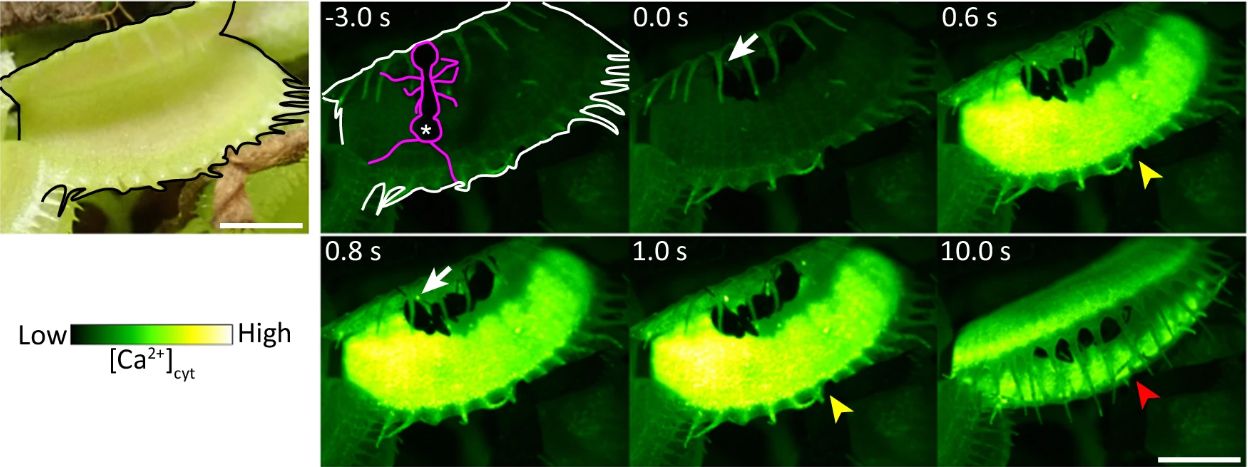
Research has identified a new mechanosensor that plays a crucial role in the rapid response of the Venus flytrap (Dionaea muscipula) to prey. In a study published in Nature Communications, lead researcher Hiraku Suda and colleagues reveal the significance of a specific protein, named DmMSL10, in the plant’s ability to detect and respond to stimuli.
The Venus flytrap, renowned for its spring-loaded trap, relies on sensory hairs lining its leaves to trigger a response when they detect movement. Previous studies had established that the plant utilizes calcium threshold signals to facilitate this rapid reaction, but the underlying mechanism remained unclear.
Researchers bred a variant of the Venus flytrap lacking the DmMSL10 protein, a stretch-activated chloride ion (Cl–) channel. The results showed that while both the wild-type and knockout plants experienced calcium ion release from mechanical stimulation, the rate of action potential generation was significantly lower in the knockout variant. The wild-type plants continued to generate action potentials even after the initial stimulation ceased, demonstrating the essential role of DmMSL10 in prey detection.
In a follow-up experiment, the team observed the behavior of ants on both the wild-type and knockout plants. The wild-type plant successfully captured the first ant that wandered onto its leaf, while the knockout variant remained unresponsive as multiple ants failed to trigger sufficient calcium signals to close the trap.
This research provides valuable insight into the mechanisms that allow the Venus flytrap to effectively capture prey, which are rich in protein and nitrogen. The findings also suggest potential evolutionary parallels between the mechanisms of plant and animal sensory responses.
The study enhances our understanding of plant biology and opens avenues for further exploration into how such rapid response systems evolved. The implications of this research stretch beyond the Venus flytrap, potentially impacting our understanding of similar mechanisms in other plant species, such as the waterwheel plant (Aldrovanda vesiculosa), and even in the animal kingdom.










Revolutionary Photonic Ski-Jump Could Miniaturize LiDAR Systems

Couples Detox from Plastics in New Netflix Doc: Can It Boost Fertility?

Aventon Launches Affordable Full-Suspension Electric Mountain Bike

Discover Eight Must-Try Restaurants This Spring Season

UC Irvine Team Unveils Innovative Ion Pump for Water Treatment

One-Third of Americans Trim Daily Expenses for Healthcare Needs

Apple Secures First Oscar in Three Years with F1: The Movie

Fourth Graders Celebrate St. Patrick’s Day with Creative Weather Drawings

Kim Kardashian Dazzles at Vanity Fair Oscars Party 2026

Nostradamus’ 2026 Predictions: Star Death and Dark Events Loom

Breakthroughs and Challenges Await Science in 2026

Electric Moto Influencer Surronster Arrested in Tijuana

OpenAI to Implement Age Verification for ChatGPT by December 2025

Discover the Top 10 Calorie Counting Apps of 2025

Recovering a Suspended TikTok Account: A Step-by-Step Guide

Bella Hadid Shares Health Update After Treatment for Lyme Disease

Backpack Drives Equip Students with Supplies for New School Year

Analysts Project Stronger Growth for Apple’s iPhone 17 Lineup
-
 Science8 months ago
Nostradamus’ 2026 Predictions: Star Death and Dark Events Loom
-
 Science8 months ago
Breakthroughs and Challenges Await Science in 2026
-
 Technology11 months ago
Electric Moto Influencer Surronster Arrested in Tijuana
-
 Technology9 months ago
OpenAI to Implement Age Verification for ChatGPT by December 2025
-
 Technology1 year ago
Discover the Top 10 Calorie Counting Apps of 2025
-
 Technology1 year ago
Recovering a Suspended TikTok Account: A Step-by-Step Guide
-
 Health11 months ago
Bella Hadid Shares Health Update After Treatment for Lyme Disease
-
 Education1 year ago
Backpack Drives Equip Students with Supplies for New School Year
-
 Health12 months ago
Analysts Project Stronger Growth for Apple’s iPhone 17 Lineup
-

 Health12 months ago
Japanese Study Finds Rose Oil Can Increase Brain Gray Matter
-

 Technology8 months ago
Top 10 Penny Stocks to Watch in 2026 for Strong Returns
-

 Science10 months ago
Starship V3 Set for 2026 Launch After Successful Final Test of Version 2