
Science
New Jersey Researchers Uncover Source of Solar Gamma Rays

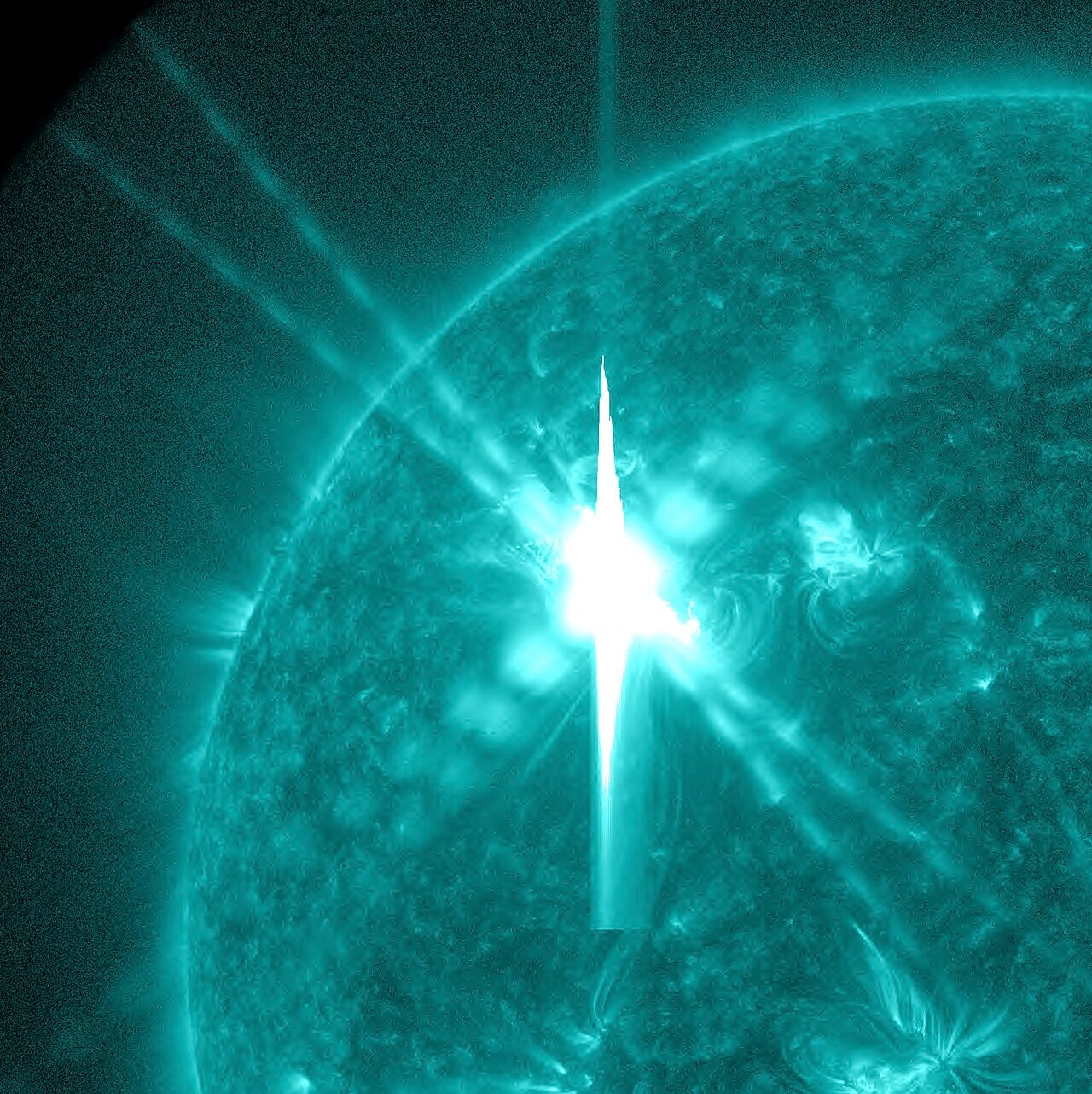
Intense solar flares not only release plasma and particles into space, but they also generate powerful bursts of gamma radiation. This radiation represents the universe’s most energetic light, and for decades, solar physicists have sought to understand its origins. Researchers at the New Jersey Institute of Technology have made significant progress in this area, pinpointing the source of gamma rays produced during major solar flare events. Their findings were published in the esteemed journal Nature Astronomy.
The breakthrough stems from the analysis of an X8.2-class solar flare that erupted on September 10, 2017. By leveraging gamma-ray observations from NASA’s Fermi Space Telescope alongside microwave imaging from NJIT’s Expanded Owens Valley Solar Array in California, the research team was able to identify the precise location of the gamma rays in the solar atmosphere. Their investigation uncovered a previously unknown class of particles that were accelerated to extraordinary energies during these major flare events.
The particles detected were measured at several million electron volts, which is hundreds to thousands of times more energetic than typical flare particles, moving at speeds approaching that of light. The team traced the gamma rays to a process called bremsstrahlung. This occurs when lightweight charged particles emit high-energy light upon colliding with material in the Sun’s atmosphere.
What sets this particle population apart is its energy distribution. Typically, flare electrons diminish in number as their energy increases. In contrast, this newly discovered group shows a concentration of particles at very high energies, with significantly fewer lower-energy electrons present. This finding offers crucial insights into the mechanisms of solar flares and how they accelerate particles.
The high-energy particle region identified by the researchers is located near areas where magnetic fields decay rapidly, coinciding with intense acceleration. This observation supports long-standing theories suggesting that the release of magnetic energy plays a critical role in driving these extreme acceleration events.
Understanding these phenomena fills critical gaps in solar flare physics and enhances the potential for improved space weather forecasting. Given that major solar eruptions can disrupt satellites, communication systems, and power grids on Earth, developing better predictive models becomes increasingly important as global technological infrastructure grows more vulnerable to space weather events.
Despite this breakthrough, several key questions remain unanswered. Researchers are still uncertain whether the accelerated particles are electrons or their antimatter counterparts, positrons. Future observations from NJIT’s telescope array, which is currently being upgraded with fifteen new antennas and advanced instrumentation, may help clarify these uncertainties by measuring the polarization of microwave emissions from similar solar events.
The ongoing research underscores the dynamic interplay between solar activity and the conditions experienced on Earth, highlighting the importance of continued exploration in solar physics.







Revolutionary Photonic Ski-Jump Could Miniaturize LiDAR Systems

Couples Detox from Plastics in New Netflix Doc: Can It Boost Fertility?

Aventon Launches Affordable Full-Suspension Electric Mountain Bike

Discover Eight Must-Try Restaurants This Spring Season

UC Irvine Team Unveils Innovative Ion Pump for Water Treatment

One-Third of Americans Trim Daily Expenses for Healthcare Needs

Apple Secures First Oscar in Three Years with F1: The Movie

Fourth Graders Celebrate St. Patrick’s Day with Creative Weather Drawings

Kim Kardashian Dazzles at Vanity Fair Oscars Party 2026

Nostradamus’ 2026 Predictions: Star Death and Dark Events Loom

Breakthroughs and Challenges Await Science in 2026

Electric Moto Influencer Surronster Arrested in Tijuana

OpenAI to Implement Age Verification for ChatGPT by December 2025

Discover the Top 10 Calorie Counting Apps of 2025

Recovering a Suspended TikTok Account: A Step-by-Step Guide

Bella Hadid Shares Health Update After Treatment for Lyme Disease

Backpack Drives Equip Students with Supplies for New School Year

Analysts Project Stronger Growth for Apple’s iPhone 17 Lineup
-
 Science7 months ago
Nostradamus’ 2026 Predictions: Star Death and Dark Events Loom
-
 Science7 months ago
Breakthroughs and Challenges Await Science in 2026
-
 Technology10 months ago
Electric Moto Influencer Surronster Arrested in Tijuana
-
 Technology8 months ago
OpenAI to Implement Age Verification for ChatGPT by December 2025
-
 Technology1 year ago
Discover the Top 10 Calorie Counting Apps of 2025
-
 Technology1 year ago
Recovering a Suspended TikTok Account: A Step-by-Step Guide
-
 Health10 months ago
Bella Hadid Shares Health Update After Treatment for Lyme Disease
-
 Education12 months ago
Backpack Drives Equip Students with Supplies for New School Year
-
 Health11 months ago
Analysts Project Stronger Growth for Apple’s iPhone 17 Lineup
-

 Technology7 months ago
Top 10 Penny Stocks to Watch in 2026 for Strong Returns
-

 Health11 months ago
Japanese Study Finds Rose Oil Can Increase Brain Gray Matter
-

 Science9 months ago
Starship V3 Set for 2026 Launch After Successful Final Test of Version 2