
Science
New Findings from LHC Illuminate Quark-Gluon Plasma Dynamics

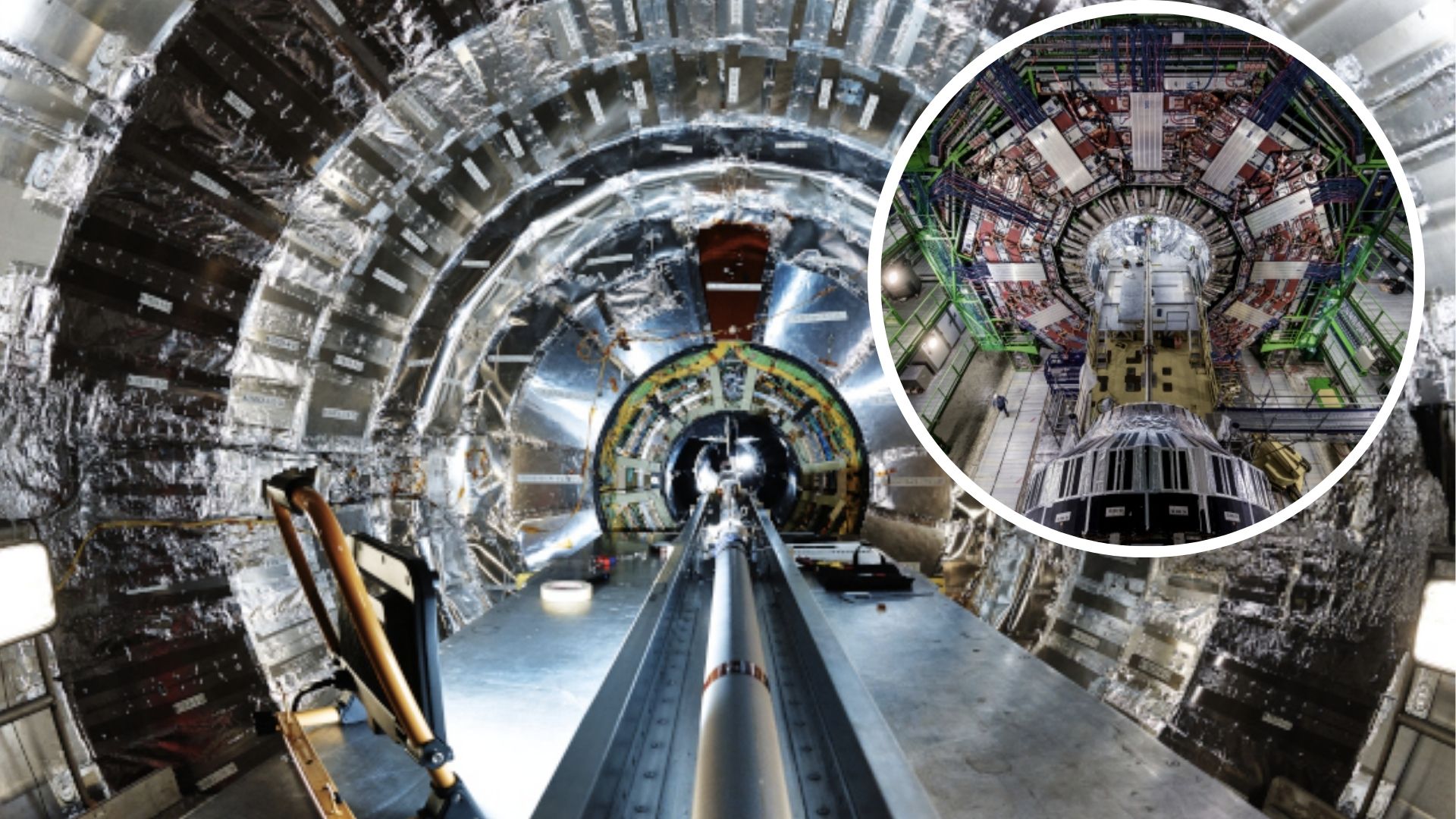
Scientists have made significant advancements in understanding the behavior of quark-gluon plasma (QGP) by examining particle flows from heavy ion collisions at the Large Hadron Collider (LHC). New measurements indicate that the observed “flow” of particles is a reflection of their collective behavior, driven by pressure gradients created under extreme collision conditions that replicate the universe’s state shortly after the Big Bang.
The findings were highlighted by physicist Jiangyong Jia from Stony Brook University and Brookhaven National Laboratory, where the Relativistic Heavy Ion Collider operates as a user facility for nuclear physics research. Jia, who leads the new analysis under the ATLAS collaboration, emphasized the importance of these results. “The new results from ATLAS, while confirming the fluid-like nature of the QGP, also reveal something new because the type of flow we studied, ‘radial’ flow, has a different geometric origin from the ‘elliptic’ flow studied previously,” he stated.
Insights from ATLAS and ALICE Collaborations
The ATLAS findings are further substantiated by measurements from the ALICE experiment, another detector at the LHC. Both teams analyzed the same type of collisions, providing complementary insights. ALICE’s results were published concurrently in the same issue of Physical Review Letters. Peter Steinberg, a physicist at Brookhaven Lab and co-author of the ATLAS paper, remarked, “In some ways, these radial flow measurements are completing a story that started the minute RHIC turned on.”
The initial data from RHIC, released in 2001, revealed notable directional differences in particle flow patterns during collisions of gold ions. Scientists observed an elliptical pattern, with more particles emerging along the reaction plane defined by the colliding ions’ direction rather than transversely. This was traced back to the unusual shape of the overlap region between the spherical gold ions during off-center collisions. The resulting asymmetric pressure gradients in this oblong fireball pushed more particles outward along the “waistband” of the football-like shape than toward its pointed ends.
This collective behavior surprised physicists because it indicated that quarks and gluons continue to interact strongly even after being liberated from their usual confines within protons and neutrons. The extreme elliptic flow led to the conclusion that the QGP behaves like a nearly frictionless liquid with very low shear viscosity.
Significance of Radial Flow Measurements
The recent radial flow measurements not only confirm the previously established fluid-like characteristics of QGP but also introduce a new angle to the understanding of viscosity in this unique state of matter. The research presents a more comprehensive picture of the QGP’s dynamics and its implications for understanding fundamental physics.
The study underscores the collaborative effort between scientists at Brookhaven National Laboratory and Stony Brook University and their ongoing commitment to exploring the fundamental properties of matter in extreme conditions. The findings contribute to a growing body of knowledge about the early universe and the fundamental forces that govern it.
As research continues at the LHC and RHIC, these discoveries pave the way for deeper insights into the universe’s origins and the behavior of matter under extreme conditions.









Revolutionary Photonic Ski-Jump Could Miniaturize LiDAR Systems

Couples Detox from Plastics in New Netflix Doc: Can It Boost Fertility?

Aventon Launches Affordable Full-Suspension Electric Mountain Bike

Discover Eight Must-Try Restaurants This Spring Season

UC Irvine Team Unveils Innovative Ion Pump for Water Treatment

One-Third of Americans Trim Daily Expenses for Healthcare Needs

Apple Secures First Oscar in Three Years with F1: The Movie

Fourth Graders Celebrate St. Patrick’s Day with Creative Weather Drawings

Kim Kardashian Dazzles at Vanity Fair Oscars Party 2026

Nostradamus’ 2026 Predictions: Star Death and Dark Events Loom

Breakthroughs and Challenges Await Science in 2026

Electric Moto Influencer Surronster Arrested in Tijuana

OpenAI to Implement Age Verification for ChatGPT by December 2025

Discover the Top 10 Calorie Counting Apps of 2025

Bella Hadid Shares Health Update After Treatment for Lyme Disease

Analysts Project Stronger Growth for Apple’s iPhone 17 Lineup

Japanese Study Finds Rose Oil Can Increase Brain Gray Matter

Top 10 Penny Stocks to Watch in 2026 for Strong Returns
-
 Science3 months ago
Nostradamus’ 2026 Predictions: Star Death and Dark Events Loom
-
 Science4 months ago
Breakthroughs and Challenges Await Science in 2026
-
 Technology7 months ago
Electric Moto Influencer Surronster Arrested in Tijuana
-
 Technology4 months ago
OpenAI to Implement Age Verification for ChatGPT by December 2025
-
 Technology9 months ago
Discover the Top 10 Calorie Counting Apps of 2025
-
 Health7 months ago
Bella Hadid Shares Health Update After Treatment for Lyme Disease
-
 Health7 months ago
Analysts Project Stronger Growth for Apple’s iPhone 17 Lineup
-
 Health7 months ago
Japanese Study Finds Rose Oil Can Increase Brain Gray Matter
-
 Technology4 months ago
Top 10 Penny Stocks to Watch in 2026 for Strong Returns
-

 Science6 months ago
Starship V3 Set for 2026 Launch After Successful Final Test of Version 2
-

 Technology1 month ago
Nvidia GTC 2026: Major Announcements Expected for AI and Hardware
-

 Education7 months ago
Harvard Secures Court Victory Over Federal Funding Cuts