
Science
NASA’s James Webb Telescope Uncovers New Moon Orbiting Uranus

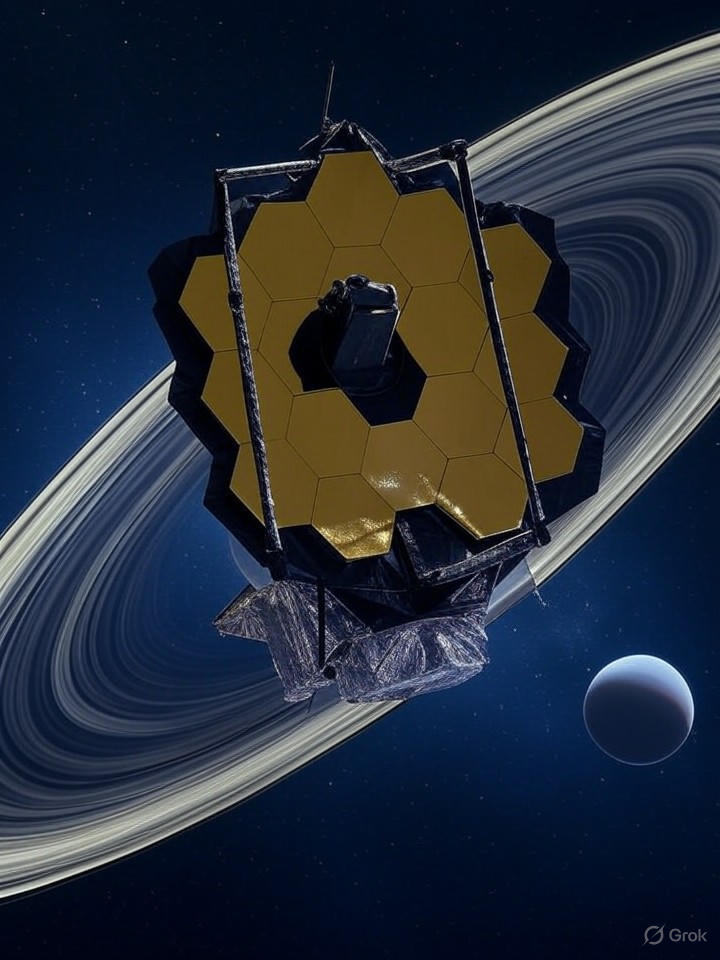
NASA’s James Webb Space Telescope (JWST) has made a groundbreaking discovery by identifying a new moon orbiting Uranus, designated as S/2025 U1. This significant finding, reported in March 2024, showcases the telescope’s enhanced capabilities, particularly through its integration of artificial intelligence (AI) in data processing. The moon, measuring approximately 6 miles in diameter, was previously undetectable by earlier missions like Voyager 2.
The ability of JWST to detect S/2025 U1 highlights the advancements in its data pipeline. By employing AI-driven algorithms, scientists can now analyze vast datasets more efficiently. This leap in technology not only aids in spotting new celestial bodies but also significantly improves the tracking of supermoons. JWST’s Near-Infrared Camera plays a crucial role in this process, utilizing high-resolution infrared imaging to identify faint signals that other telescopes might miss.
AI Enhances Celestial Observations
At the heart of this technological evolution is JWST’s sophisticated data pipeline, positioned at the second Lagrange point, roughly 1 million miles from Earth. Here, AI models trained on neural networks sift through incoming data streams, detecting anomalies that indicate potential new moons or other celestial objects. This system adjusts dynamically to various astronomical phenomena, including supermoon phases, when the Earth’s moon appears larger and brighter.
Engineers at NASA’s Ames Intelligent Systems Division have developed these tools not only for moon observation but also for other missions, such as the Volatiles Investigating Polar Exploration Rover (VIPER). This rover uses AI to enhance navigation on the lunar surface by identifying key landmarks. The impact of this technology extends to supermoon tracking, enabling JWST to correlate lunar positions with solar system dynamics, thus predicting visibility and atmospheric effects with remarkable accuracy.
Publications like The Economic Times have noted that this AI-enhanced approach has successfully identified moons previously invisible to ground-based telescopes, shedding light on Uranus’ 29 known satellites and their interactions with the planet’s unique axial tilt.
Future Implications for Space Missions
The implications of these technological advancements reach far beyond moon discovery. For NASA’s upcoming Artemis missions, which aim to return humans to the Moon, AI-driven detection methods promise to enhance safety by providing real-time mapping of hazardous terrains. Research published in the MDPI journal on neural network-aided optical navigation supports this, demonstrating how crater detection from imaging data refines spacecraft trajectories.
Moreover, the economic stakes are high. Companies like Intuitive Machines, selected by NASA for lunar terrain vehicles, are incorporating similar AI technologies to improve mobility on the Moon. This collaboration between public and private sectors could accelerate developments in space exploration, ranging from resource extraction to satellite deployment.
Despite these advancements, challenges persist. The sheer volume of data generated by JWST necessitates constant refinement of AI algorithms to minimize false positives, as early detections often required human verification. Sources from Space.com emphasize the importance of robust validation protocols to ensure accuracy, particularly when AI interprets faint infrared signals amid cosmic noise.
Additionally, as AI takes on a larger role in space data analysis, ethical considerations arise regarding transparency and potential biases in algorithmic decisions. NASA’s commitment to developing open-source tools, as outlined in Wikipedia’s entry on JWST, is aimed at fostering collaboration, though concerns remain that proprietary advancements could widen gaps between nations engaged in space exploration.
As JWST continues to evolve, its AI capabilities are set to transform supermoon observations into predictive models for future solar eclipses and meteor showers. The recent identification of S/2025 U1 signifies just the beginning of what may be undiscovered worlds within our solar system, potentially reshaping our understanding of planetary formation.
In summary, NASA’s integration of AI with the James Webb Space Telescope positions the agency at the forefront of a new era in space exploration. Each discovery not only expands our knowledge of the cosmos but also guides humanity’s next steps into the unknown, ensuring that every supermoon brings opportunities for scientific breakthroughs.






Revolutionary Photonic Ski-Jump Could Miniaturize LiDAR Systems

Couples Detox from Plastics in New Netflix Doc: Can It Boost Fertility?

Aventon Launches Affordable Full-Suspension Electric Mountain Bike

Discover Eight Must-Try Restaurants This Spring Season

UC Irvine Team Unveils Innovative Ion Pump for Water Treatment

One-Third of Americans Trim Daily Expenses for Healthcare Needs

Apple Secures First Oscar in Three Years with F1: The Movie

Fourth Graders Celebrate St. Patrick’s Day with Creative Weather Drawings

Kim Kardashian Dazzles at Vanity Fair Oscars Party 2026

Nostradamus’ 2026 Predictions: Star Death and Dark Events Loom

Breakthroughs and Challenges Await Science in 2026

Electric Moto Influencer Surronster Arrested in Tijuana

OpenAI to Implement Age Verification for ChatGPT by December 2025

Discover the Top 10 Calorie Counting Apps of 2025

Recovering a Suspended TikTok Account: A Step-by-Step Guide

Bella Hadid Shares Health Update After Treatment for Lyme Disease

Backpack Drives Equip Students with Supplies for New School Year

Analysts Project Stronger Growth for Apple’s iPhone 17 Lineup
-
 Science8 months ago
Nostradamus’ 2026 Predictions: Star Death and Dark Events Loom
-
 Science8 months ago
Breakthroughs and Challenges Await Science in 2026
-
 Technology11 months ago
Electric Moto Influencer Surronster Arrested in Tijuana
-
 Technology9 months ago
OpenAI to Implement Age Verification for ChatGPT by December 2025
-
 Technology1 year ago
Discover the Top 10 Calorie Counting Apps of 2025
-
 Technology1 year ago
Recovering a Suspended TikTok Account: A Step-by-Step Guide
-
 Health11 months ago
Bella Hadid Shares Health Update After Treatment for Lyme Disease
-
 Education1 year ago
Backpack Drives Equip Students with Supplies for New School Year
-
 Health11 months ago
Analysts Project Stronger Growth for Apple’s iPhone 17 Lineup
-

 Health12 months ago
Japanese Study Finds Rose Oil Can Increase Brain Gray Matter
-

 Technology8 months ago
Top 10 Penny Stocks to Watch in 2026 for Strong Returns
-

 Science10 months ago
Starship V3 Set for 2026 Launch After Successful Final Test of Version 2