
Science
NASA Set to Launch Historic ESCAPADE Mission to Mars in November

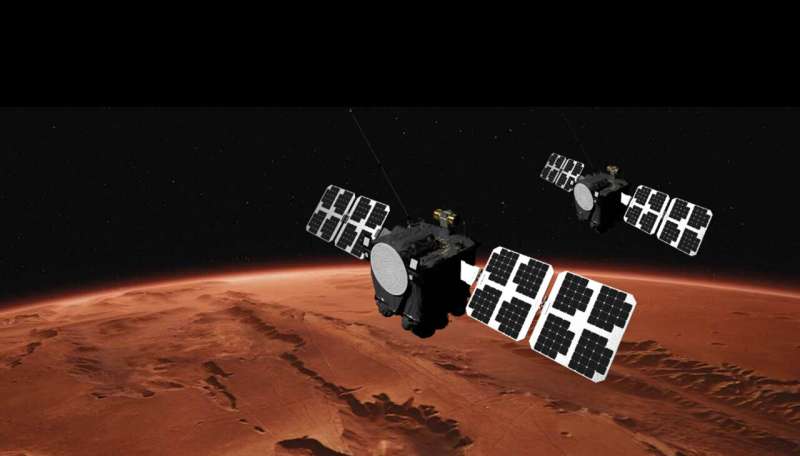
NASA is preparing for the launch of its ESCAPADE mission, marking the first dual-satellite endeavor aimed at exploring Mars. The two identical satellites, named Blue and Gold, are scheduled to launch no earlier than November 9, 2025, from Cape Canaveral, Florida. Managed by the University of California, Berkeley, the mission aims to provide a 3D map of Mars’ magnetic fields, upper atmosphere, and ionosphere, offering crucial insights into the planet’s environmental conditions.
The ESCAPADE mission will help scientists understand the processes that led to Mars losing its atmosphere over billions of years. This information is vital for future human exploration, as it will inform potential colonization efforts. Principal investigator Robert Lillis of UC Berkeley’s Space Sciences Laboratory emphasized the importance of understanding ionospheric variations for accurate communication and navigation on Mars.
The twin satellites are expected to arrive at Mars in 2027. They will be operated from the Space Sciences Laboratory’s mission operations center in Berkeley. The scientific instruments and data processing systems were developed by UC Berkeley and its partners, while the spacecraft were constructed by Rocket Lab U.S. in Long Beach, California. The launch will be executed using a New Glenn rocket developed by Blue Origin.
Significance of the Mission
Mapping Mars’ magnetic fields and their interaction with space weather is essential, given that the planet lacks a global magnetic field and a thick atmosphere. This deficiency exposes the Martian surface to harmful solar radiation, which poses a risk to any potential human inhabitants. Lillis noted that background radiation from the Milky Way is always present on Mars, but significant solar storms can dramatically increase radiation levels. For instance, NASA’s Curiosity rover recorded a solar storm last year that delivered radiation equivalent to that of 100 days of normal background exposure in just one day.
As ESCAPADE embarks on its journey, it will also explore a new trajectory to Mars. Traditionally, Mars missions are launched during a narrow window every 26 months, adhering to an energy-efficient Hohmann Transfer orbit. In contrast, ESCAPADE will utilize a trajectory that first leads to a Lagrange point—a location where the gravitational forces of the Earth and Sun are balanced—before looping back toward Earth and then heading to Mars in November 2026. This innovative approach allows for greater flexibility in launch timing, which could be crucial for future missions.
Broader Implications and Scientific Goals
The dual-satellite configuration allows ESCAPADE to provide a stereo perspective of the Martian atmosphere, enabling scientists to monitor changes in real time. “This dual approach will help us characterize how the Martian atmosphere responds to solar wind on short timescales,” Lillis explained. Understanding this interaction is vital for comprehending Mars’ climatic evolution and the potential for water, which once existed in abundance on the planet.
ESCAPADE builds on nearly six decades of research conducted by UC Berkeley scientists on Mars. Previous missions, including NASA’s MAVEN, have demonstrated that Mars possesses localized magnetic fields created by its magnetized crust, remnants of a once global magnetic field. The data from ESCAPADE is expected to shed light on how solar activity influences atmospheric escape, contributing to a better understanding of the planet’s history.
While the mission is ambitious, Lillis recognizes the challenges of human settlement on Mars. The planet’s low atmospheric pressure and exposure to cosmic radiation present significant obstacles. Yet, he remains optimistic about humanity’s tenacity in overcoming these challenges.
In summary, NASA’s ESCAPADE mission represents a significant leap forward in our understanding of Mars and its environment. With its innovative trajectory and dual-satellite design, the mission is poised to revolutionize our knowledge of the Red Planet, paving the way for future exploration and eventual colonization efforts.










Revolutionary Photonic Ski-Jump Could Miniaturize LiDAR Systems

Couples Detox from Plastics in New Netflix Doc: Can It Boost Fertility?

Aventon Launches Affordable Full-Suspension Electric Mountain Bike

Discover Eight Must-Try Restaurants This Spring Season

UC Irvine Team Unveils Innovative Ion Pump for Water Treatment

One-Third of Americans Trim Daily Expenses for Healthcare Needs

Apple Secures First Oscar in Three Years with F1: The Movie

Fourth Graders Celebrate St. Patrick’s Day with Creative Weather Drawings

Kim Kardashian Dazzles at Vanity Fair Oscars Party 2026

Nostradamus’ 2026 Predictions: Star Death and Dark Events Loom

Breakthroughs and Challenges Await Science in 2026

Electric Moto Influencer Surronster Arrested in Tijuana

OpenAI to Implement Age Verification for ChatGPT by December 2025

Discover the Top 10 Calorie Counting Apps of 2025

Recovering a Suspended TikTok Account: A Step-by-Step Guide

Bella Hadid Shares Health Update After Treatment for Lyme Disease

Backpack Drives Equip Students with Supplies for New School Year

Analysts Project Stronger Growth for Apple’s iPhone 17 Lineup
-
 Science8 months ago
Nostradamus’ 2026 Predictions: Star Death and Dark Events Loom
-
 Science8 months ago
Breakthroughs and Challenges Await Science in 2026
-
 Technology11 months ago
Electric Moto Influencer Surronster Arrested in Tijuana
-
 Technology9 months ago
OpenAI to Implement Age Verification for ChatGPT by December 2025
-
 Technology1 year ago
Discover the Top 10 Calorie Counting Apps of 2025
-
 Technology1 year ago
Recovering a Suspended TikTok Account: A Step-by-Step Guide
-
 Health11 months ago
Bella Hadid Shares Health Update After Treatment for Lyme Disease
-
 Education1 year ago
Backpack Drives Equip Students with Supplies for New School Year
-
 Health12 months ago
Analysts Project Stronger Growth for Apple’s iPhone 17 Lineup
-

 Health12 months ago
Japanese Study Finds Rose Oil Can Increase Brain Gray Matter
-

 Technology8 months ago
Top 10 Penny Stocks to Watch in 2026 for Strong Returns
-

 Science10 months ago
Starship V3 Set for 2026 Launch After Successful Final Test of Version 2