
Science
NASA Releases Decades-Long Video of Kepler’s Supernova Remnant

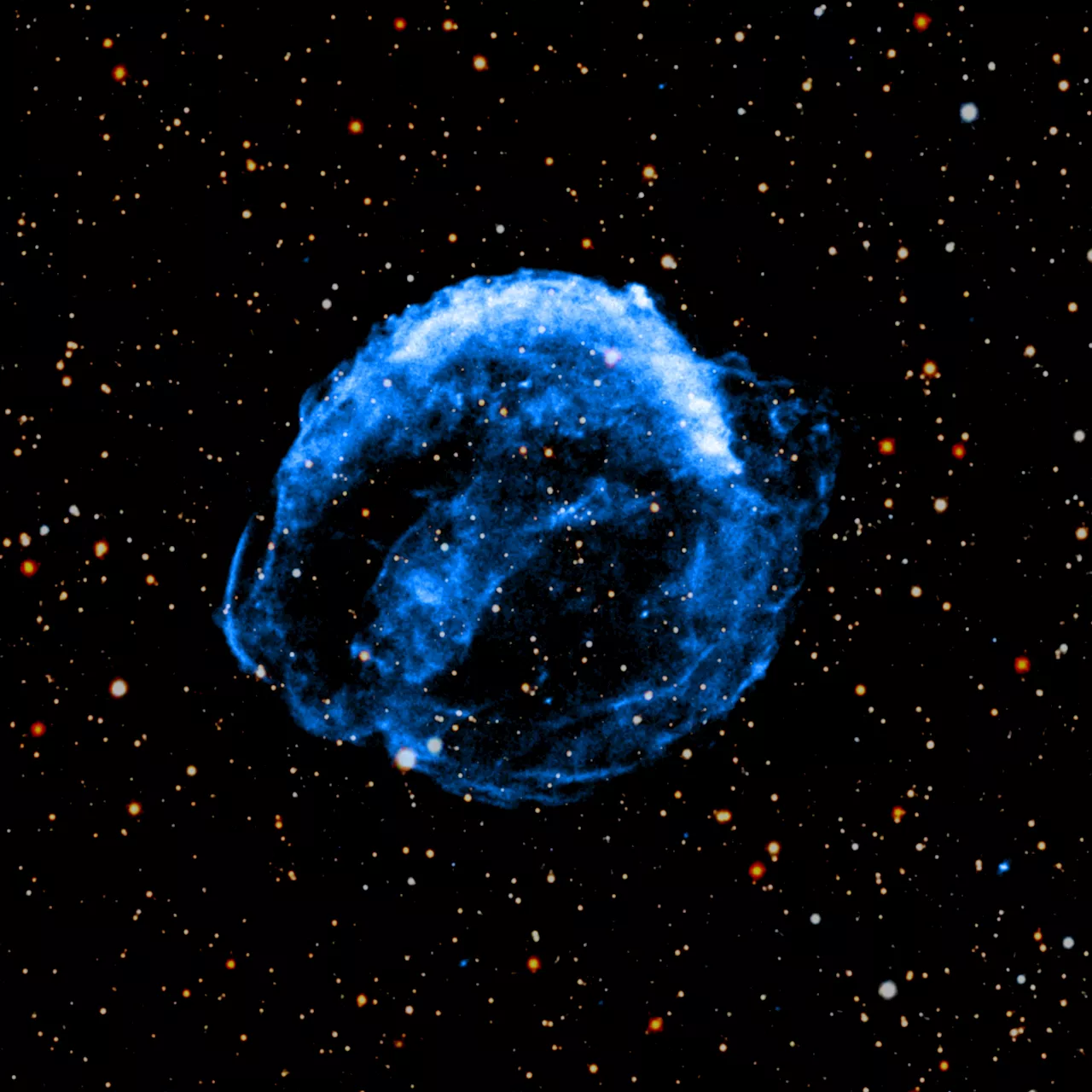
A new video illustrating the evolution of Kepler’s Supernova Remnant has been released by NASA, based on data collected over more than two and a half decades. This video, which showcases changes in the remnant, incorporates observations from the Chandra X-ray Observatory taken in the years 2000, 2004, 2006, 2014, and 2025, marking it as the longest-spanning video ever produced by Chandra.
Insights from the Timelapse Video
Kepler’s Supernova Remnant, named after the German astronomer Johannes Kepler, was first identified in 1604. The remnant is the result of a white dwarf star exploding after accumulating material from a companion star or merging with another white dwarf. This type of supernova is classified as Type Ia and is vital for measuring the expansion of the universe. The remnant is located approximately 17,000 light-years from Earth, allowing Chandra to capture detailed images of the debris and its evolution over time.
The new video merges Chandra’s X-ray data with optical imagery from Pan-STARRS, creating a stunning visual representation of the remnant. The animation illustrates a cloud-like, neon blue ring with a diagonal cross, expanding slowly like an inflating balloon throughout the showcased time periods.
Jessye Gassel, a graduate student at George Mason University in Virginia who led the project, remarked, “The plot of Kepler’s story is just now beginning to unfold. It’s remarkable that we can watch as these remains from this shattered star crash into material already thrown out into space.” Gassel presented the video and associated findings at the 247th meeting of the American Astronomical Society in Phoenix.
Understanding Supernova Dynamics
The research team has determined that various parts of the remnant are expanding at significantly different speeds. The fastest regions are traveling at approximately 13.8 million miles per hour (about 22.2 million kilometers per hour4 million miles per hour (approximately 6.4 million kilometers per hour). This disparity in speed can be attributed to the density of the gas that the remnant encounters; the denser gas is located at the top of the image.
Brian Williams, a principal investigator of the new Chandra observations at NASA’s Goddard Space Flight Center in Maryland, emphasized the significance of supernova explosions. He stated, “Supernova explosions and the elements they hurl into space are the lifeblood of new stars and planets. Understanding exactly how they behave is crucial to knowing our cosmic history.”
Researchers also focused on the blast wave’s width forming at the leading edge of the explosion. By measuring the wave’s dimensions and speed, scientists can glean further insights into both the explosion dynamics and the surrounding environment.
The Chandra program is managed by NASA’s Marshall Space Flight Center in Huntsville, Alabama, with science operations overseen by the Smithsonian Astrophysical Observatory’s Chandra X-ray Center in Cambridge, Massachusetts.
This release features a ten-second silent video of Kepler’s expanding Supernova Remnant, highlighting its impressive evolution over the past decades. The video serves not only as a scientific tool but also as a visual testament to the enduring legacy of Kepler’s Supernova, providing a captivating glimpse into the life cycle of stars and their remnants.





Revolutionary Photonic Ski-Jump Could Miniaturize LiDAR Systems

Couples Detox from Plastics in New Netflix Doc: Can It Boost Fertility?

Aventon Launches Affordable Full-Suspension Electric Mountain Bike

Discover Eight Must-Try Restaurants This Spring Season

UC Irvine Team Unveils Innovative Ion Pump for Water Treatment

One-Third of Americans Trim Daily Expenses for Healthcare Needs

Apple Secures First Oscar in Three Years with F1: The Movie

Fourth Graders Celebrate St. Patrick’s Day with Creative Weather Drawings

Kim Kardashian Dazzles at Vanity Fair Oscars Party 2026

Nostradamus’ 2026 Predictions: Star Death and Dark Events Loom

Breakthroughs and Challenges Await Science in 2026

Electric Moto Influencer Surronster Arrested in Tijuana

OpenAI to Implement Age Verification for ChatGPT by December 2025

Discover the Top 10 Calorie Counting Apps of 2025

Recovering a Suspended TikTok Account: A Step-by-Step Guide

Bella Hadid Shares Health Update After Treatment for Lyme Disease

Analysts Project Stronger Growth for Apple’s iPhone 17 Lineup

Japanese Study Finds Rose Oil Can Increase Brain Gray Matter
-
 Science7 months ago
Nostradamus’ 2026 Predictions: Star Death and Dark Events Loom
-
 Science7 months ago
Breakthroughs and Challenges Await Science in 2026
-
 Technology10 months ago
Electric Moto Influencer Surronster Arrested in Tijuana
-
 Technology8 months ago
OpenAI to Implement Age Verification for ChatGPT by December 2025
-
 Technology12 months ago
Discover the Top 10 Calorie Counting Apps of 2025
-
 Technology1 year ago
Recovering a Suspended TikTok Account: A Step-by-Step Guide
-
 Health10 months ago
Bella Hadid Shares Health Update After Treatment for Lyme Disease
-
 Health10 months ago
Analysts Project Stronger Growth for Apple’s iPhone 17 Lineup
-
 Health11 months ago
Japanese Study Finds Rose Oil Can Increase Brain Gray Matter
-

 Technology7 months ago
Top 10 Penny Stocks to Watch in 2026 for Strong Returns
-

 Science9 months ago
Starship V3 Set for 2026 Launch After Successful Final Test of Version 2
-

 Technology9 months ago
InMotion Unveils P6 Electric Unicycle with 93 MPH Top Speed