
Science
How Manifolds Revolutionized Our Understanding of Space

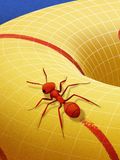
Mathematicians have fundamentally changed their understanding of space thanks to the concept of manifolds, first introduced by Bernhard Riemann in the mid-19th century. This mathematical innovation allows for the exploration of complex geometries beyond the traditional flat spaces we perceive in everyday life. Riemann’s work laid the foundation for modern topology, a field that investigates properties of space that remain invariant under continuous transformations.
Before Riemann, geometry primarily dealt with objects in Euclidean space, where principles like straight lines representing the shortest distance between points held true. These concepts were intuitive, but by the early 1800s, some mathematicians began to explore non-Euclidean geometries, where shapes could curve and behave unpredictably. This shift posed challenges for the mathematical community, which struggled to accept these new ideas.
Riemann, originally drawn to theology before pivoting to mathematics, studied under renowned mathematician Carl Friedrich Gauss. In 1854, he delivered a pivotal lecture on the foundations of geometry at the University of Göttingen. This lecture introduced a groundbreaking theory that generalized Gauss’s ideas to multiple dimensions. Despite its profound implications, Riemann’s work was initially met with skepticism and largely ignored until the late 19th century, when mathematicians such as Henri Poincaré began to recognize its significance.
Defining Manifolds and Their Importance
The term “manifold,” derived from Riemann’s German word Mannigfaltigkeit, meaning “variety” or “multiplicity,” describes a space that appears Euclidean when examined closely. For example, a circle is a one-dimensional manifold; anywhere on it, it looks like a straight line. In contrast, a figure eight, which has a crossing point, is not a manifold because it does not maintain this property.
Manifolds provide a framework for mathematicians to examine shapes whose properties could vary depending on their spatial context. For instance, if one takes a piece of string and loops it, it forms a one-dimensional manifold. However, if the string is twisted in three-dimensional space before connecting its ends, it can create complex knots, demonstrating how dimensionality affects properties of shapes.
To work with manifolds, mathematicians divide them into overlapping regions called “charts.” Each chart includes a set of coordinates that describe a specific area within the manifold. Collectively, these charts form an “atlas,” which allows mathematicians to apply familiar Euclidean techniques to study the manifold’s properties. This approach is essential for calculating areas, volumes, and understanding movements within these complex spaces.
Applications Across Disciplines
The implications of manifolds extend far beyond theoretical mathematics; they are crucial in physics, particularly in our understanding of the universe. Albert Einstein utilized concepts of manifolds in his general theory of relativity, describing space-time as a four-dimensional manifold whose curvature defines gravity. This integration of abstract mathematics into the real world exemplifies the transformative power of Riemann’s ideas.
Manifolds also provide valuable insights into various scientific fields. For example, in studying a double pendulum, a system that exhibits chaotic behavior, researchers represent its configurations on a toroidal manifold. This geometric interpretation simplifies the analysis of complex trajectories, allowing for a more intuitive understanding of the pendulum’s dynamics.
Furthermore, the study of high-dimensional data, such as the activity of numerous neurons in the brain, often employs manifold analysis to uncover patterns that might not be apparent in higher-dimensional spaces. As theoretical physicist Jonathan Sorce from Princeton University notes, “So much of physics comes down to understanding geometry. And often in surprising ways.”
In summary, the concept of manifolds has revolutionized mathematical thought and has become integral to various scientific disciplines. As mathematicians continue to apply this framework, the understanding of complex geometries and their applications is expected to expand, offering new insights into both mathematics and the physical universe. The legacy of Bernhard Riemann endures, as his ideas continue to shape the foundations of modern science.


Revolutionary Photonic Ski-Jump Could Miniaturize LiDAR Systems

Couples Detox from Plastics in New Netflix Doc: Can It Boost Fertility?

Aventon Launches Affordable Full-Suspension Electric Mountain Bike

Discover Eight Must-Try Restaurants This Spring Season

UC Irvine Team Unveils Innovative Ion Pump for Water Treatment

One-Third of Americans Trim Daily Expenses for Healthcare Needs

Apple Secures First Oscar in Three Years with F1: The Movie

Fourth Graders Celebrate St. Patrick’s Day with Creative Weather Drawings

Kim Kardashian Dazzles at Vanity Fair Oscars Party 2026

Nostradamus’ 2026 Predictions: Star Death and Dark Events Loom

Breakthroughs and Challenges Await Science in 2026

Electric Moto Influencer Surronster Arrested in Tijuana

OpenAI to Implement Age Verification for ChatGPT by December 2025

Discover the Top 10 Calorie Counting Apps of 2025

Recovering a Suspended TikTok Account: A Step-by-Step Guide

Bella Hadid Shares Health Update After Treatment for Lyme Disease

Backpack Drives Equip Students with Supplies for New School Year

Analysts Project Stronger Growth for Apple’s iPhone 17 Lineup
-
 Science7 months ago
Nostradamus’ 2026 Predictions: Star Death and Dark Events Loom
-
 Science7 months ago
Breakthroughs and Challenges Await Science in 2026
-
 Technology10 months ago
Electric Moto Influencer Surronster Arrested in Tijuana
-
 Technology8 months ago
OpenAI to Implement Age Verification for ChatGPT by December 2025
-
 Technology1 year ago
Discover the Top 10 Calorie Counting Apps of 2025
-
 Technology1 year ago
Recovering a Suspended TikTok Account: A Step-by-Step Guide
-
 Health10 months ago
Bella Hadid Shares Health Update After Treatment for Lyme Disease
-
 Education1 year ago
Backpack Drives Equip Students with Supplies for New School Year
-
 Health11 months ago
Analysts Project Stronger Growth for Apple’s iPhone 17 Lineup
-

 Technology7 months ago
Top 10 Penny Stocks to Watch in 2026 for Strong Returns
-

 Health11 months ago
Japanese Study Finds Rose Oil Can Increase Brain Gray Matter
-

 Science9 months ago
Starship V3 Set for 2026 Launch After Successful Final Test of Version 2