
Science
CHIME Telescope Discovers Brightest Fast Radio Burst Ever Recorded

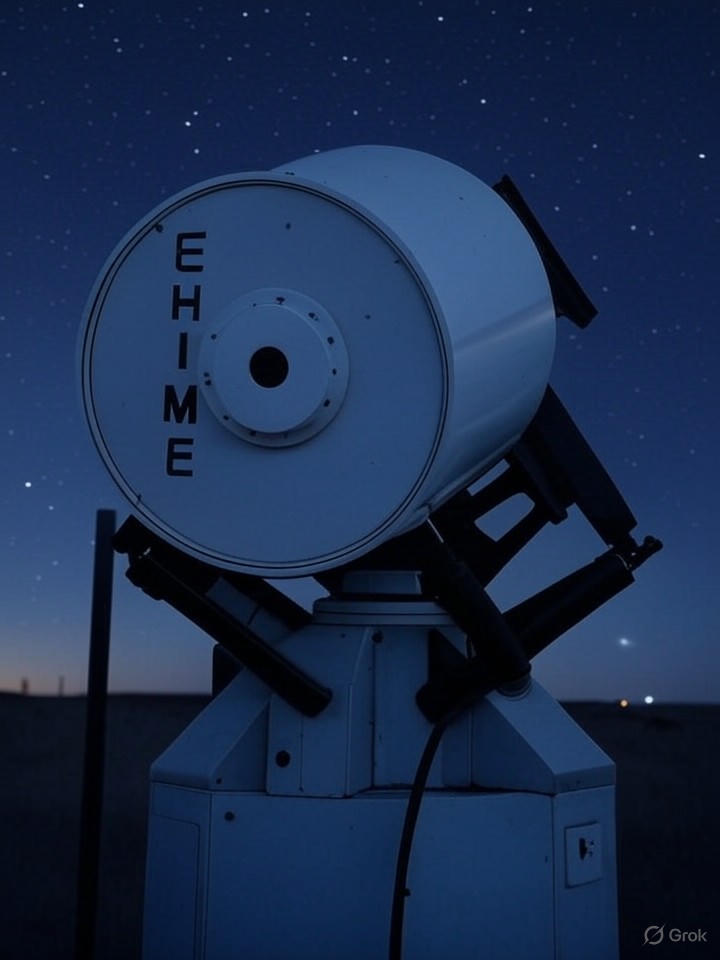
Recent advancements in astronomy have led to the discovery of the brightest fast radio burst (FRB) ever recorded, a phenomenon that continues to challenge existing theories about its origins. The Canadian Hydrogen Intensity Mapping Experiment (CHIME) telescope, operational since 2018 and located in British Columbia, detected this remarkable burst, designated FRB 20250316A, in March 2025.
The event, informally named “RBFLOAT,” or “Radio Brightest Flash of All Time,” originates from the nearby spiral galaxy NGC 4141, situated approximately 130 million light-years away in the constellation Ursa Major. This proximity allows astronomers to study the burst in unprecedented detail, contrasting sharply with most FRBs that are traced back to ancient, distant galaxies.
Unprecedented Localization and Implications
Using CHIME’s upgraded outrigger stations, researchers achieved an impressive localization accuracy of within 13 parsecs, a significant feat for a non-repeating event. As outlined in a study published in The Astrophysical Journal Letters and highlighted by the Dunlap Institute, the burst’s source lies in the galaxy’s outer regions, far from typical star-forming areas linked to such energetic outbursts.
The implications of this finding are considerable. While magnetars—highly magnetized neutron stars—were previously considered the primary candidates for FRBs, RBFLOAT’s location in a relatively older stellar population raises questions about this theory. Magnetars are typically formed in the aftermath of recent supernova explosions, leading researchers to consider alternative explanations, such as colliding neutron stars or exotic white dwarf phenomena.
A researcher from Berkeley News commented, “This burst is in a surprising location,” highlighting the need for further investigation into the origins of FRBs. The one-off nature of RBFLOAT also diverges from the behavior of repeating bursts, which some theories attribute to different underlying processes.
The Role of Technological Advancements
CHIME’s success is the result of extensive international collaboration, involving institutions like the University of Toronto and McGill University. Recent enhancements to the telescope, including outriggers positioned in California and West Virginia, have enabled greater triangulation accuracy, as detailed in reports from the Green Bank Observatory. This technological progress not only localized RBFLOAT but also promises to map more FRBs, potentially revealing their energy sources.
Looking forward, the integration of data from observatories like the James Webb Space Telescope could soon provide optical counterparts to these bursts, enriching our understanding of their origins. As highlighted in social media posts from researchers, this discovery could challenge established magnetar theories and necessitate a reevaluation of cosmic radio signal classifications.
The broader implications of FRBs extend beyond their origins. They serve as cosmic probes, measuring the dispersion of intergalactic plasma and assisting in models of cosmic evolution. RBFLOAT, being relatively nearby, offers a cleaner signal than more distant FRBs, which are often distorted by intervening matter. Scientists describe the energy emitted by RBFLOAT as “as energetic as the sun, but lasting only milliseconds,” providing a unique opportunity for further study.
As the CHIME team continues to observe these bursts, questions remain: What accounts for this unprecedented brightness? Is it an anomaly or a potential new subclass of FRBs? Ongoing research and collaboration among global scientific communities may soon provide answers, ultimately transforming our understanding of extreme astrophysical phenomena.
Industry experts view this discovery as a pivotal moment in the study of FRBs. With over a thousand FRBs detected, patterns are beginning to emerge—some originate from “dead” galaxies, while others exhibit repetitive behavior. The case of RBFLOAT underscores the necessity for diverse models to interpret these signals. As research progresses, FRBs could shed light on the distribution of dark matter or even point towards exotic physics. For now, this remarkable burst stands as a beacon guiding astronomers in their quest to unravel the mysteries of the universe.












Revolutionary Photonic Ski-Jump Could Miniaturize LiDAR Systems

Couples Detox from Plastics in New Netflix Doc: Can It Boost Fertility?

Aventon Launches Affordable Full-Suspension Electric Mountain Bike

Discover Eight Must-Try Restaurants This Spring Season

UC Irvine Team Unveils Innovative Ion Pump for Water Treatment

One-Third of Americans Trim Daily Expenses for Healthcare Needs

Apple Secures First Oscar in Three Years with F1: The Movie

Fourth Graders Celebrate St. Patrick’s Day with Creative Weather Drawings

Kim Kardashian Dazzles at Vanity Fair Oscars Party 2026

Nostradamus’ 2026 Predictions: Star Death and Dark Events Loom

Breakthroughs and Challenges Await Science in 2026

Electric Moto Influencer Surronster Arrested in Tijuana

OpenAI to Implement Age Verification for ChatGPT by December 2025

Discover the Top 10 Calorie Counting Apps of 2025

Recovering a Suspended TikTok Account: A Step-by-Step Guide

Bella Hadid Shares Health Update After Treatment for Lyme Disease

Backpack Drives Equip Students with Supplies for New School Year

Analysts Project Stronger Growth for Apple’s iPhone 17 Lineup
-
 Science8 months ago
Nostradamus’ 2026 Predictions: Star Death and Dark Events Loom
-
 Science8 months ago
Breakthroughs and Challenges Await Science in 2026
-
 Technology11 months ago
Electric Moto Influencer Surronster Arrested in Tijuana
-
 Technology9 months ago
OpenAI to Implement Age Verification for ChatGPT by December 2025
-
 Technology1 year ago
Discover the Top 10 Calorie Counting Apps of 2025
-
 Technology1 year ago
Recovering a Suspended TikTok Account: A Step-by-Step Guide
-
 Health11 months ago
Bella Hadid Shares Health Update After Treatment for Lyme Disease
-
 Education1 year ago
Backpack Drives Equip Students with Supplies for New School Year
-
 Health12 months ago
Analysts Project Stronger Growth for Apple’s iPhone 17 Lineup
-

 Health12 months ago
Japanese Study Finds Rose Oil Can Increase Brain Gray Matter
-

 Technology8 months ago
Top 10 Penny Stocks to Watch in 2026 for Strong Returns
-

 Science10 months ago
Starship V3 Set for 2026 Launch After Successful Final Test of Version 2