
Science
Astronomers Unveil Unprecedented Radio Image of the Milky Way

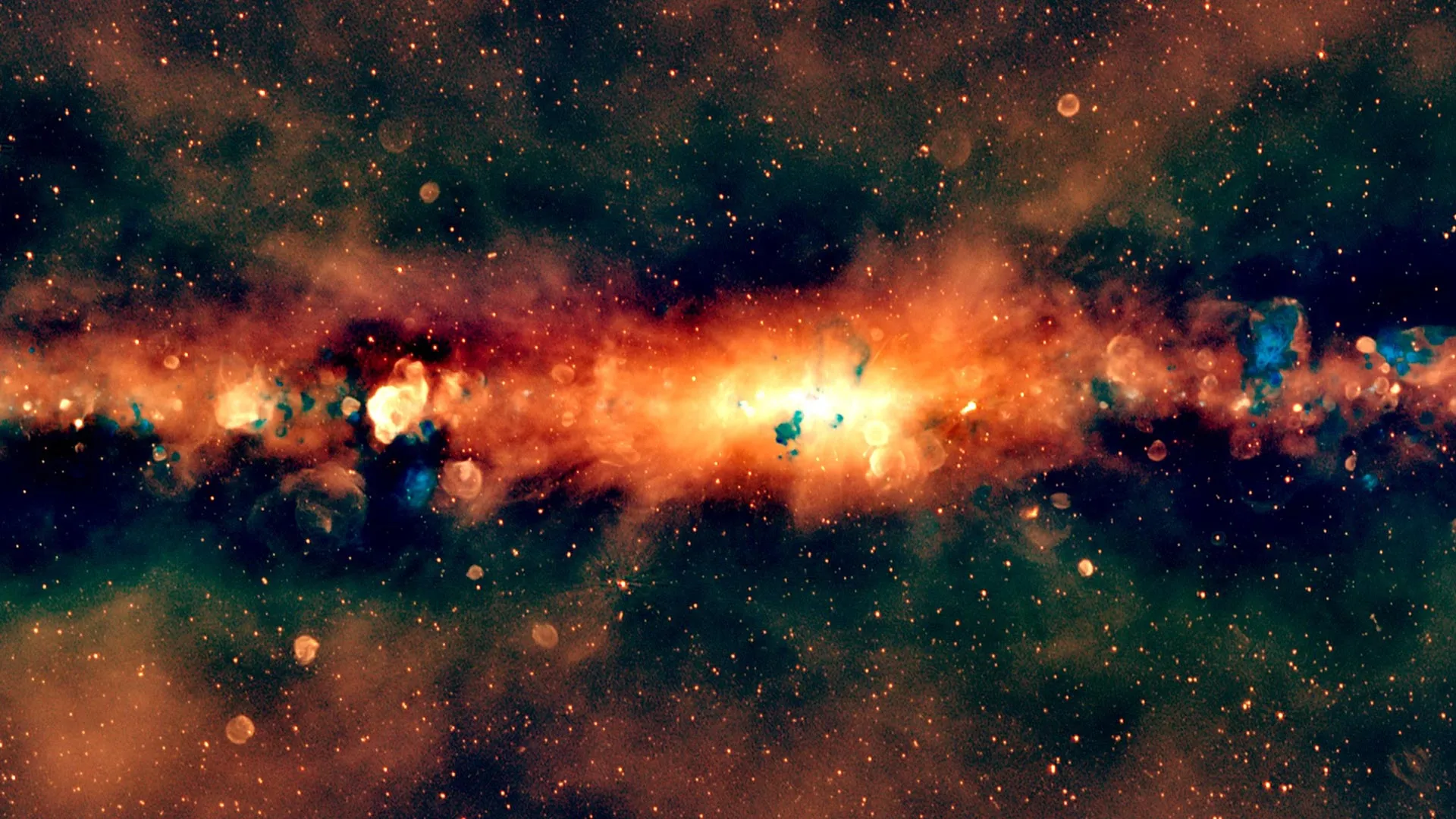
Astronomers at the International Centre for Radio Astronomy Research (ICRAR) have unveiled a groundbreaking radio image of the Milky Way, showcasing the galaxy in unprecedented detail. Released on January 24, 2026, this remarkable image utilizes low-frequency radio “colors” to reveal previously hidden structures within our galaxy, marking a significant advancement in astronomical research.
The new image, created by PhD student Silvia Mantovanini, represents the largest low-frequency radio color depiction of the Milky Way to date. Over the course of 18 months, Mantovanini dedicated approximately 1 million CPU hours on supercomputers at the Pawsey Supercomputing Research Centre to process extensive data collected from two major sky surveys. The observations were conducted using the Murchison Widefield Array (MWA) telescope, located at Inyarrimanha Ilgari Bundara in Western Australia.
A Major Leap in Astronomical Imaging
This latest image offers a sharper, deeper, and wider view of the Milky Way compared to previous releases, such as the GLEAM image from 2019. Specifically, it boasts double the resolution, ten times the sensitivity, and encompasses twice the area of the sky. These enhancements enable astronomers to explore the Milky Way with greater clarity, uncovering features that were previously elusive.
“This vibrant image delivers an unparalleled perspective of our Galaxy at low radio frequencies,” Ms. Mantovanini remarked. “It provides valuable insights into the evolution of stars, including their formation in various regions of the Galaxy, how they interact with other celestial objects, and ultimately their demise.”
The data utilized for this image came from the GaLactic and Extragalactic All-sky MWA (GLEAM) survey, which observed the sky for 28 nights in 2013 and 2014, and its follow-up, GLEAM-X, which collected data over 113 nights from 2018 to 2020.
Revealing Stellar Dynamics
Mantovanini’s research focuses on supernova remnants, which are the expanding clouds of gas and energy resulting from stellar explosions. While astronomers have documented hundreds of these remnants, many believe that thousands remain undiscovered. The new imaging capabilities allow for clearer differentiation between the materials surrounding newly formed stars and the remnants of dead ones.
“You can clearly identify remnants of exploded stars, represented by large red circles. The smaller blue regions indicate stellar nurseries where new stars are actively forming,” Mantovanini explained.
Additionally, the new image may provide crucial insights into pulsars, the rapidly spinning remnants of massive stars. By examining how bright pulsars appear across different GLEAM-X frequencies, researchers aim to enhance their understanding of the mechanisms behind the production of radio waves and the spatial distribution of these celestial objects within the Milky Way.
Associate Professor Natasha Hurley-Walker, a key member of the ICRAR team and principal investigator of the GLEAM-X survey, emphasized the image’s significance for astrophysical studies. “This low-frequency image allows us to unveil large astrophysical structures in our Galaxy that are difficult to image at higher frequencies,” she stated.
As of now, no low-frequency radio image of the entire Southern Galactic Plane has been published, making this achievement a pivotal moment in the field of astronomy. Looking ahead, Hurley-Walker noted that only the upcoming SKA Observatory’s SKA-Low telescope, set to be completed in the next decade on Wajarri Yamaji Country, will possess the capability to surpass this image in terms of sensitivity and resolution.
The research behind this monumental image has cataloged around 98,000 radio sources across the section of the Galactic Plane visible from the Southern Hemisphere. These sources include pulsars, planetary nebulae, and compact HII regions, as well as distant galaxies located far beyond the Milky Way.
This remarkable achievement not only enhances our understanding of the Milky Way but also opens new avenues for exploring the life cycle of stars and the intricate dynamics of our galaxy.












Revolutionary Photonic Ski-Jump Could Miniaturize LiDAR Systems

Couples Detox from Plastics in New Netflix Doc: Can It Boost Fertility?

Aventon Launches Affordable Full-Suspension Electric Mountain Bike

Discover Eight Must-Try Restaurants This Spring Season

UC Irvine Team Unveils Innovative Ion Pump for Water Treatment

One-Third of Americans Trim Daily Expenses for Healthcare Needs

Apple Secures First Oscar in Three Years with F1: The Movie

Fourth Graders Celebrate St. Patrick’s Day with Creative Weather Drawings

Kim Kardashian Dazzles at Vanity Fair Oscars Party 2026

Nostradamus’ 2026 Predictions: Star Death and Dark Events Loom

Breakthroughs and Challenges Await Science in 2026

Electric Moto Influencer Surronster Arrested in Tijuana

OpenAI to Implement Age Verification for ChatGPT by December 2025

Discover the Top 10 Calorie Counting Apps of 2025

Bella Hadid Shares Health Update After Treatment for Lyme Disease

Analysts Project Stronger Growth for Apple’s iPhone 17 Lineup

Japanese Study Finds Rose Oil Can Increase Brain Gray Matter

Top 10 Penny Stocks to Watch in 2026 for Strong Returns
-
 Science4 months ago
Nostradamus’ 2026 Predictions: Star Death and Dark Events Loom
-
 Science4 months ago
Breakthroughs and Challenges Await Science in 2026
-
 Technology7 months ago
Electric Moto Influencer Surronster Arrested in Tijuana
-
 Technology4 months ago
OpenAI to Implement Age Verification for ChatGPT by December 2025
-
 Technology9 months ago
Discover the Top 10 Calorie Counting Apps of 2025
-
 Health7 months ago
Bella Hadid Shares Health Update After Treatment for Lyme Disease
-
 Health7 months ago
Analysts Project Stronger Growth for Apple’s iPhone 17 Lineup
-
 Health7 months ago
Japanese Study Finds Rose Oil Can Increase Brain Gray Matter
-
 Technology4 months ago
Top 10 Penny Stocks to Watch in 2026 for Strong Returns
-

 Science6 months ago
Starship V3 Set for 2026 Launch After Successful Final Test of Version 2
-

 Technology1 month ago
Nvidia GTC 2026: Major Announcements Expected for AI and Hardware
-

 Education7 months ago
Harvard Secures Court Victory Over Federal Funding Cuts