
Science
Astronomers Unveil TOI-5734 b, a New Hot Sub-Neptune Exoplanet

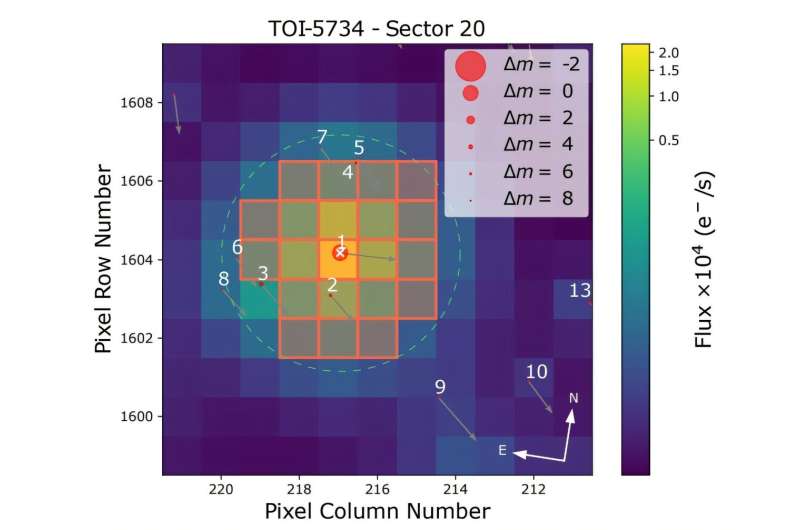
An international team of astronomers has successfully discovered a new exoplanet, designated TOI-5734 b, which is classified as a hot sub-Neptune. This planet, located approximately 106 light years from Earth, is notably about two times larger and nine times more massive than our planet. The findings were published on February 20, 2026, on the arXiv pre-print server.
Discovery and Characteristics of TOI-5734 b
The discovery was made using data from the Transiting Exoplanet Survey Satellite (TESS) and the High Accuracy Radial velocity Planet Searcher for the Northern Hemisphere (HARPS-N). The host star, known as TOI-5734 or TIC 9989136, is a relatively young K dwarf star with an effective temperature of approximately 4,750 K. Astronomers first identified a potential transit signal from this star in 2022, prompting follow-up observations led by Simone Filomeno from the Astronomical Observatory of Rome, Italy.
“In this paper, we present the detection and characterization of the transiting young planetary system TOI-5734 (TIC 9989136),” the researchers stated, highlighting their use of a combination of data from three TESS sectors and spectroscopic measurements from the HARPS-N spectrograph at the Galileo National Telescope.
Planetary Properties and Future Evolution
TOI-5734 b has a radius of about 2.1 Earth radii, with a mass measuring 9.1 Earth masses. This results in a density that is slightly less than that of Earth. The exoplanet completes an orbit around its host star every 6.18 days, situated at a distance of approximately 0.06 AU.
The estimated equilibrium temperature of TOI-5734 b is around 688 K, supporting its classification as a hot sub-Neptune with Earth-like density. The astronomers noted that its characteristics place it at the upper edge of the so-called “radius valley,” a range where there is a notable scarcity of planets with radii between 1.5 and 2.0 Earth radii.
Regarding its chemical composition, the researchers suggest that TOI-5734 b is likely a rocky planet that has significantly lost its primary atmosphere. They also propose a scenario where the planet could evolve into a “water world,” but anticipate that it will completely lose its primordial envelope within 300 million years.
The research provides insights into the past evolution of TOI-5734 b, indicating that the planet may have migrated from a region with larger radii in the mass-radius diagram to its current position near the radius gap.
The findings contribute significantly to our understanding of exoplanets, especially those classified within the sub-Neptune category. As researchers continue to explore these distant worlds, discoveries like TOI-5734 b help outline the complexities of planetary systems beyond our solar system.
This article is based on the research conducted by Filomeno et al. and is part of ongoing efforts in the field of astronomy to uncover the mysteries of the universe.









Revolutionary Photonic Ski-Jump Could Miniaturize LiDAR Systems

Couples Detox from Plastics in New Netflix Doc: Can It Boost Fertility?

Aventon Launches Affordable Full-Suspension Electric Mountain Bike

Discover Eight Must-Try Restaurants This Spring Season

UC Irvine Team Unveils Innovative Ion Pump for Water Treatment

One-Third of Americans Trim Daily Expenses for Healthcare Needs

Apple Secures First Oscar in Three Years with F1: The Movie

Fourth Graders Celebrate St. Patrick’s Day with Creative Weather Drawings

Kim Kardashian Dazzles at Vanity Fair Oscars Party 2026

Nostradamus’ 2026 Predictions: Star Death and Dark Events Loom

Breakthroughs and Challenges Await Science in 2026

Electric Moto Influencer Surronster Arrested in Tijuana

OpenAI to Implement Age Verification for ChatGPT by December 2025

Discover the Top 10 Calorie Counting Apps of 2025

Recovering a Suspended TikTok Account: A Step-by-Step Guide

Bella Hadid Shares Health Update After Treatment for Lyme Disease

Backpack Drives Equip Students with Supplies for New School Year

Analysts Project Stronger Growth for Apple’s iPhone 17 Lineup
-
 Science8 months ago
Nostradamus’ 2026 Predictions: Star Death and Dark Events Loom
-
 Science8 months ago
Breakthroughs and Challenges Await Science in 2026
-
 Technology11 months ago
Electric Moto Influencer Surronster Arrested in Tijuana
-
 Technology9 months ago
OpenAI to Implement Age Verification for ChatGPT by December 2025
-
 Technology1 year ago
Discover the Top 10 Calorie Counting Apps of 2025
-
 Technology1 year ago
Recovering a Suspended TikTok Account: A Step-by-Step Guide
-
 Health11 months ago
Bella Hadid Shares Health Update After Treatment for Lyme Disease
-
 Education1 year ago
Backpack Drives Equip Students with Supplies for New School Year
-
 Health11 months ago
Analysts Project Stronger Growth for Apple’s iPhone 17 Lineup
-

 Health12 months ago
Japanese Study Finds Rose Oil Can Increase Brain Gray Matter
-

 Technology8 months ago
Top 10 Penny Stocks to Watch in 2026 for Strong Returns
-

 Science10 months ago
Starship V3 Set for 2026 Launch After Successful Final Test of Version 2