
Science
Astronomers Explore Gamma Ray Mystery in Milky Way’s Core

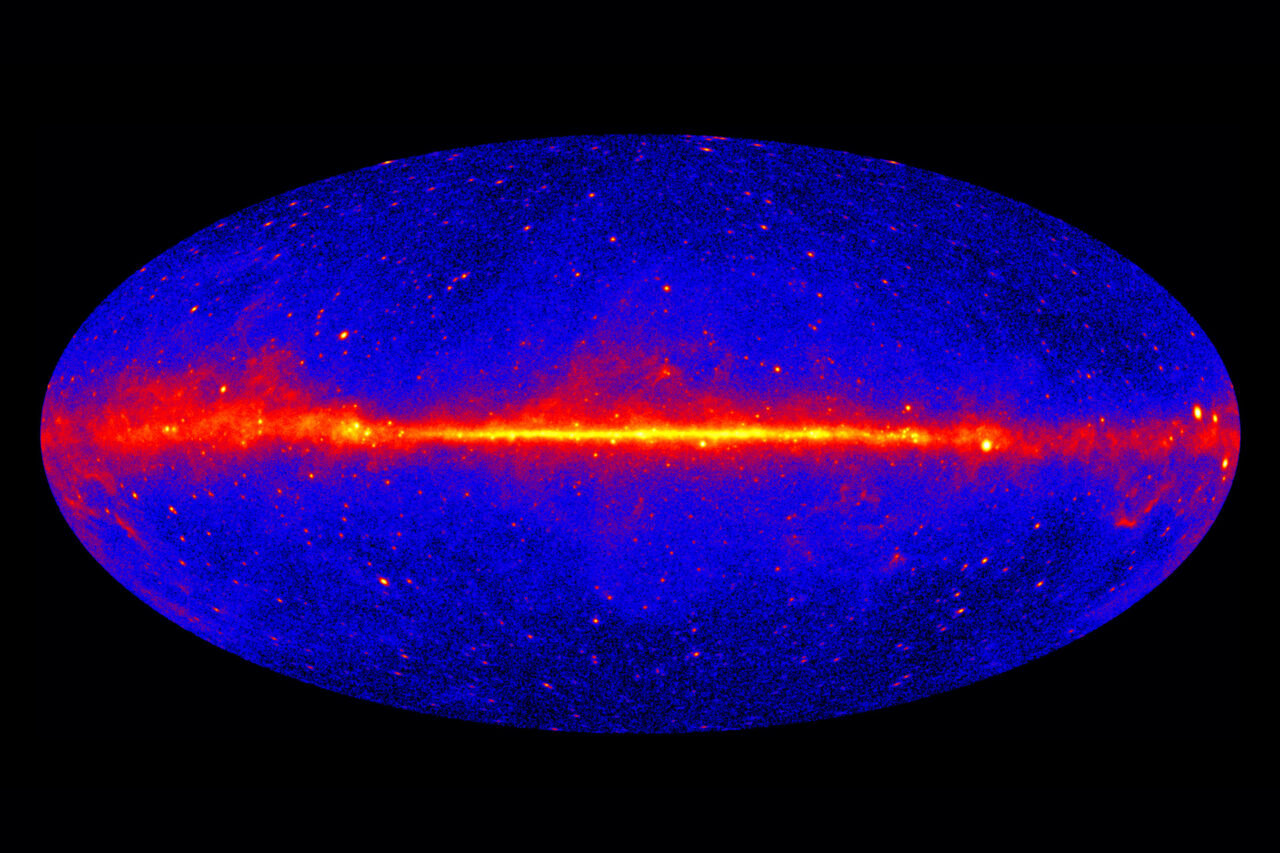
Astronomers have recently proposed a new explanation for a puzzling concentration of gamma rays emanating from the center of the Milky Way galaxy. A study published in Physical Review Letters suggests that these high-energy emissions may originate from neutron stars, rather than the previously considered sources. If this hypothesis proves accurate, it could provide the “first proof” of dark matter, a substance that constitutes approximately 85% of the universe’s mass yet remains largely undetectable.
The Fermi Gamma-ray Space Telescope first detected excess gamma rays in 2009, sparking numerous theories about their origin. While some researchers attributed the emissions to energetic stars or potential instrumental errors, the new study posits that they could stem from dark matter particle collisions. This connection is critical, as dark matter plays a fundamental role in holding galaxies together, according to Joseph Silk, an astrophysicist at Johns Hopkins University and co-author of the study.
New Insights into Dark Matter
The researchers conducted simulations tracing the evolution of the Milky Way, testing various scenarios to explain the gamma-ray phenomenon. They suggest that if the emissions are indeed linked to dark matter, it would reinforce existing theories about its existence, especially in light of the lack of direct detection in numerous underground experiments. Silk emphasized the significance of this research, stating, “Dark matter dominates the universe and holds galaxies together. It’s extremely consequential, and we’re desperately thinking all the time of ideas as to how we could detect it.”
Although previous research has hinted at a relationship between the Milky Way’s gamma rays and dark matter, the latest findings provide a more robust theoretical framework. The study highlights the importance of ongoing investigations, particularly in the context of upcoming advancements in gamma-ray observation technology.
Future Research Directions
While the new model shows promise, it is not definitive proof of dark matter. The researchers acknowledged that their simulations also produced reasonable results when accounting for fast-spinning neutron stars, known as millisecond pulsars. However, this scenario relies on assumptions regarding the number of these light sources, which may exceed current observational confirmations.
Looking ahead, the research team intends to further their studies in anticipation of the activation of the Cherenkov Telescope Array, a next-generation facility designed for gamma-ray observations. Silk expressed optimism about the potential impact of new data, stating, “It’s possible we will see the new data and confirm one theory over the other. Or maybe we’ll find nothing, in which case it’ll be an even greater mystery to resolve.”
As astronomers continue to explore the elusive nature of dark matter, each discovery brings them closer to unraveling the complexities of our galaxy and the universe at large.








Revolutionary Photonic Ski-Jump Could Miniaturize LiDAR Systems

Couples Detox from Plastics in New Netflix Doc: Can It Boost Fertility?

Aventon Launches Affordable Full-Suspension Electric Mountain Bike

Discover Eight Must-Try Restaurants This Spring Season

UC Irvine Team Unveils Innovative Ion Pump for Water Treatment

One-Third of Americans Trim Daily Expenses for Healthcare Needs

Apple Secures First Oscar in Three Years with F1: The Movie

Fourth Graders Celebrate St. Patrick’s Day with Creative Weather Drawings

Kim Kardashian Dazzles at Vanity Fair Oscars Party 2026

Nostradamus’ 2026 Predictions: Star Death and Dark Events Loom

Breakthroughs and Challenges Await Science in 2026

Electric Moto Influencer Surronster Arrested in Tijuana

OpenAI to Implement Age Verification for ChatGPT by December 2025

Discover the Top 10 Calorie Counting Apps of 2025

Recovering a Suspended TikTok Account: A Step-by-Step Guide

Bella Hadid Shares Health Update After Treatment for Lyme Disease

Backpack Drives Equip Students with Supplies for New School Year

Analysts Project Stronger Growth for Apple’s iPhone 17 Lineup
-
 Science8 months ago
Nostradamus’ 2026 Predictions: Star Death and Dark Events Loom
-
 Science8 months ago
Breakthroughs and Challenges Await Science in 2026
-
 Technology11 months ago
Electric Moto Influencer Surronster Arrested in Tijuana
-
 Technology9 months ago
OpenAI to Implement Age Verification for ChatGPT by December 2025
-
 Technology1 year ago
Discover the Top 10 Calorie Counting Apps of 2025
-
 Technology1 year ago
Recovering a Suspended TikTok Account: A Step-by-Step Guide
-
 Health11 months ago
Bella Hadid Shares Health Update After Treatment for Lyme Disease
-
 Education1 year ago
Backpack Drives Equip Students with Supplies for New School Year
-
 Health11 months ago
Analysts Project Stronger Growth for Apple’s iPhone 17 Lineup
-

 Health12 months ago
Japanese Study Finds Rose Oil Can Increase Brain Gray Matter
-

 Technology8 months ago
Top 10 Penny Stocks to Watch in 2026 for Strong Returns
-

 Science10 months ago
Starship V3 Set for 2026 Launch After Successful Final Test of Version 2