
Science
Ancient Meteorite Impact Discovered at Miralga Structure in Australia

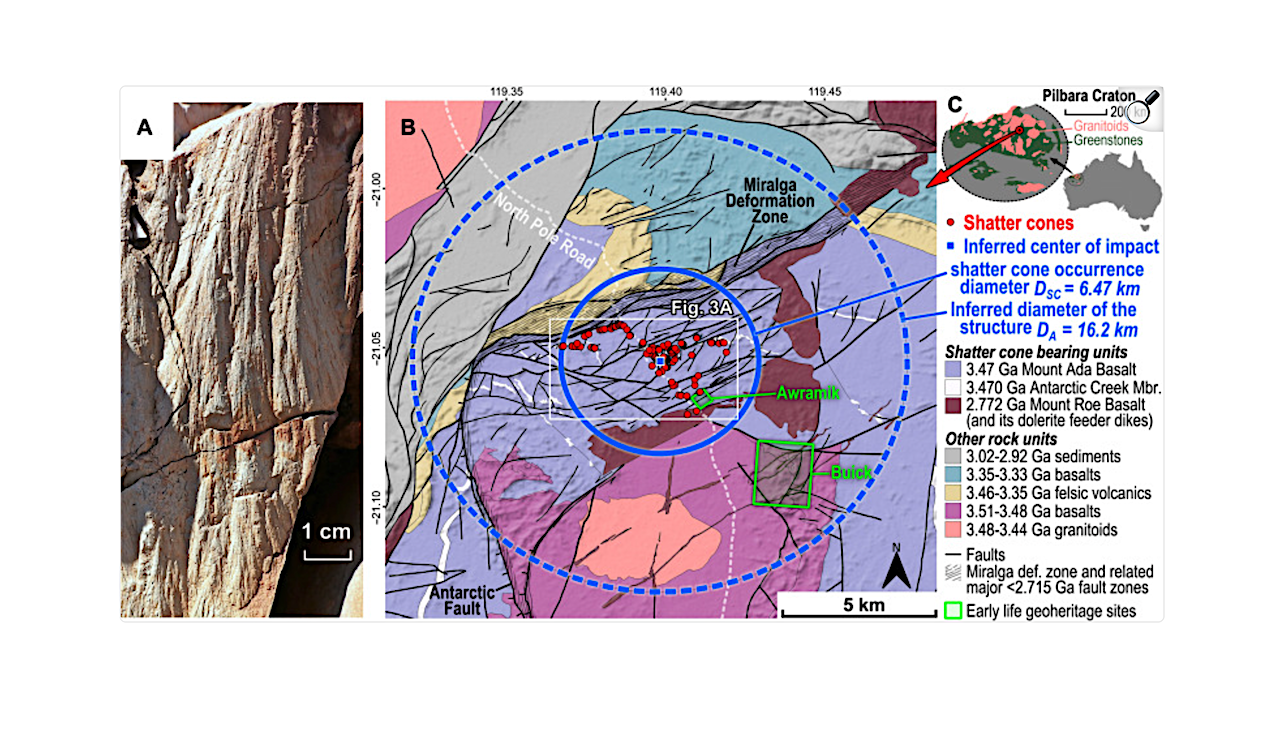
New findings at the North Pole Dome in the Pilbara Craton of Western Australia reveal a significant geological discovery. Researchers have identified evidence of an ancient meteorite impact, which has implications for understanding early Earth and Mars. The site contains shatter cones within rocks that date back approximately 3.47 billion years, indicating a history of impact events.
Initial reports suggested that the impact created a crater with a diameter of over 100 kilometers and occurred at 3.47 billion years. However, further analysis demonstrates inaccuracies in these age and size estimates. The shatter cones, which are geological features formed under extreme pressure, are spread over an area with a diameter of 6.5 kilometers. They define a larger impact structure, estimated to be 16 kilometers wide.
Researchers have also discovered the first shocked mineral at this site, identified as the high-pressure titanium dioxide polymorph, TiO2-II (srilankite). This finding has led scientists to provisionally name the site the Miralga impact structure. The presence of these shatter cones, which appear in younger overlying rocks, provides clear evidence that the impact event took place after approximately 2.7 billion years.
Geological Significance and Mars Analog Potential
The 3.47 billion-year-old hydrothermally altered basalts found at the Miralga impact structure are now recognized as the oldest known shocked terrestrial rocks. This highlights the site’s potential for providing insights into impact processes on both Earth and Mars. The research emphasizes that the geological features observed could serve as analogs for impacts into biosignature-bearing Archean greenstones, which are crucial for understanding the potential for life on Mars.
Images accompanying the study illustrate the shatter cones in various geological contexts. For instance, one image features shatter cones in weakly propylitic altered massive vesicular basalt from the 2.77 billion-year-old Mount Roe Basalt. Another shows shatter cones located within an intensely chloritized fault zone in the Mount Ada Basalt, which likely dates to less than 2.71 billion years. The occurrence of these features indicates a post-deformation date for the impact event.
Research findings were published in the renowned journal Science Advances, and the study was conducted by a team from Harvard University, among other institutions. These discoveries not only deepen our understanding of the geological history of Earth but also pave the way for future explorations into the geological history of Mars, potentially revealing clues about the planet’s past habitability.
Overall, the Miralga impact structure stands as a testament to the dynamic geological processes that have shaped both Earth and other celestial bodies. The ongoing research at this site promises to enhance our knowledge of planetary impacts and their implications for the evolution of life.










Revolutionary Photonic Ski-Jump Could Miniaturize LiDAR Systems

Couples Detox from Plastics in New Netflix Doc: Can It Boost Fertility?

Aventon Launches Affordable Full-Suspension Electric Mountain Bike

Discover Eight Must-Try Restaurants This Spring Season

UC Irvine Team Unveils Innovative Ion Pump for Water Treatment

One-Third of Americans Trim Daily Expenses for Healthcare Needs

Apple Secures First Oscar in Three Years with F1: The Movie

Fourth Graders Celebrate St. Patrick’s Day with Creative Weather Drawings

Kim Kardashian Dazzles at Vanity Fair Oscars Party 2026

Nostradamus’ 2026 Predictions: Star Death and Dark Events Loom

Breakthroughs and Challenges Await Science in 2026

Electric Moto Influencer Surronster Arrested in Tijuana

OpenAI to Implement Age Verification for ChatGPT by December 2025

Discover the Top 10 Calorie Counting Apps of 2025

Recovering a Suspended TikTok Account: A Step-by-Step Guide

Bella Hadid Shares Health Update After Treatment for Lyme Disease

Backpack Drives Equip Students with Supplies for New School Year

Analysts Project Stronger Growth for Apple’s iPhone 17 Lineup
-
 Science8 months ago
Nostradamus’ 2026 Predictions: Star Death and Dark Events Loom
-
 Science8 months ago
Breakthroughs and Challenges Await Science in 2026
-
 Technology11 months ago
Electric Moto Influencer Surronster Arrested in Tijuana
-
 Technology9 months ago
OpenAI to Implement Age Verification for ChatGPT by December 2025
-
 Technology1 year ago
Discover the Top 10 Calorie Counting Apps of 2025
-
 Technology1 year ago
Recovering a Suspended TikTok Account: A Step-by-Step Guide
-
 Health11 months ago
Bella Hadid Shares Health Update After Treatment for Lyme Disease
-
 Education1 year ago
Backpack Drives Equip Students with Supplies for New School Year
-
 Health12 months ago
Analysts Project Stronger Growth for Apple’s iPhone 17 Lineup
-

 Health12 months ago
Japanese Study Finds Rose Oil Can Increase Brain Gray Matter
-

 Technology8 months ago
Top 10 Penny Stocks to Watch in 2026 for Strong Returns
-

 Science10 months ago
Starship V3 Set for 2026 Launch After Successful Final Test of Version 2