
Top Stories
Bonobos’ Sexual Rhythm Offers New Insights into Communication Evolution

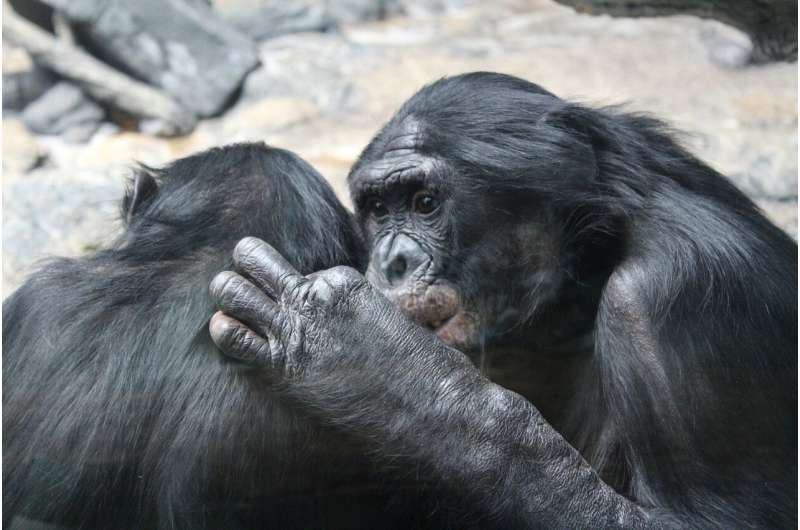
An international research team has revealed significant findings regarding the rhythmic nature of sexual behavior in bonobos, which may provide insights into the evolution of communication in humans. The study, published on February 17, 2026, in the journal Evolution and Human Behavior, highlights how analyzing the tempo of movements during mating rituals can enhance our understanding of communication’s building blocks across species.
Led by Martina Francesconi and Elisabetta Palagi from the University of Pisa, the research involves meticulous analysis of detailed video recordings of bonobos in various zoos. The study employs frame-by-frame analysis to examine repetitive movements during sexual activity and the significance of facial expressions, particularly the “silent bared-teeth display,” commonly known as a grin.
Francesconi explains the role of rapid facial mimicry, noting that bonobos can imitate each other’s expressions almost instantaneously. “This effect is only powerful enough to observe when the imitation happens immediately,” she states. The synchrony of these responses raises questions about whether they represent conscious communication or an involuntary reflex.
The findings indicate that bonobos maintain a high tempo during sexual activity, averaging around seven movements per second. Interestingly, the tempo does not noticeably increase when one animal smiles or when the partner imitates the smile. However, researchers found that the tempo drops significantly after rapid facial mimicry ceases. “This suggests that these facial expressions likely do not play a role in coordinating or accelerating the behavior,” says Yannick Jadoul from the Free University of Brussels. He further explains that the rapid decrease in tempo may correlate with physiological processes such as orgasm, although this remains an observational inference.
The researchers aim to expand their understanding of how rhythm, tempo, and vocalization have evolved in both humans and animals. “Bonobos, along with chimpanzees, are our closest living relatives,” Professor Palagi notes. Unlike chimpanzees, bonobos inhabit a matriarchal society where sexual behavior serves critical social functions. By comparing their behaviors with those of humans and other species, the team hopes to delineate which elements of communication are uniquely human and which are rooted in our evolutionary history.
Jadoul emphasizes that the study hinges on rigorous data analysis rather than artificial intelligence techniques such as large language models. “This is about pattern recognition and objective measurement of complex behaviors,” he says. This research aligns with the long-standing tradition at the Free University of Brussels focused on language, communication, and learning systems.
By systematically comparing rhythm and tempo across different species, the research team aims to gradually uncover how traits we consider “typically human,” such as music, speech, and social communication, first emerged. The study is a crucial step in understanding the intricate relationship between rhythmic behavior and communication in both bonobos and humans.
The full study, titled “SEX in bonobos: The intensity of sexual stimulation sharply drops after facial mimicry,” can be accessed in Evolution and Human Behavior. The research highlights the intricate social dynamics of bonobos and their relevance to understanding the evolution of communication in humans.

Revolutionary Photonic Ski-Jump Could Miniaturize LiDAR Systems

Couples Detox from Plastics in New Netflix Doc: Can It Boost Fertility?

Aventon Launches Affordable Full-Suspension Electric Mountain Bike

Discover Eight Must-Try Restaurants This Spring Season

UC Irvine Team Unveils Innovative Ion Pump for Water Treatment

One-Third of Americans Trim Daily Expenses for Healthcare Needs

Apple Secures First Oscar in Three Years with F1: The Movie

Fourth Graders Celebrate St. Patrick’s Day with Creative Weather Drawings

Kim Kardashian Dazzles at Vanity Fair Oscars Party 2026

Nostradamus’ 2026 Predictions: Star Death and Dark Events Loom

Breakthroughs and Challenges Await Science in 2026

Electric Moto Influencer Surronster Arrested in Tijuana

OpenAI to Implement Age Verification for ChatGPT by December 2025

Discover the Top 10 Calorie Counting Apps of 2025

Recovering a Suspended TikTok Account: A Step-by-Step Guide

Bella Hadid Shares Health Update After Treatment for Lyme Disease

Backpack Drives Equip Students with Supplies for New School Year

Analysts Project Stronger Growth for Apple’s iPhone 17 Lineup
-
 Science7 months ago
Nostradamus’ 2026 Predictions: Star Death and Dark Events Loom
-
 Science8 months ago
Breakthroughs and Challenges Await Science in 2026
-
 Technology11 months ago
Electric Moto Influencer Surronster Arrested in Tijuana
-
 Technology8 months ago
OpenAI to Implement Age Verification for ChatGPT by December 2025
-
 Technology1 year ago
Discover the Top 10 Calorie Counting Apps of 2025
-
 Technology1 year ago
Recovering a Suspended TikTok Account: A Step-by-Step Guide
-
 Health11 months ago
Bella Hadid Shares Health Update After Treatment for Lyme Disease
-
 Education1 year ago
Backpack Drives Equip Students with Supplies for New School Year
-
 Health11 months ago
Analysts Project Stronger Growth for Apple’s iPhone 17 Lineup
-

 Technology8 months ago
Top 10 Penny Stocks to Watch in 2026 for Strong Returns
-

 Health11 months ago
Japanese Study Finds Rose Oil Can Increase Brain Gray Matter
-

 Science10 months ago
Starship V3 Set for 2026 Launch After Successful Final Test of Version 2