
Technology
Researchers Develop Machine Learning Models for Geopolymer Concrete Strength

Geopolymer concrete is increasingly recognized for its impressive mechanical properties and environmental benefits, particularly due to its compressive strength. Researchers have tackled the challenges of predicting this strength, which are compounded by the complex geopolymerization process and varying mixture designs. In a recent study, a team led by Quang-Huy LE and including Duy-Hung NGUYEN, Thanh SANG-TO, Samir KHATIR, Hoang LE-MINH, Amir H. GANDOMI, and Thanh CUONG-LE developed machine learning models to effectively predict the compressive strength of geopolymer concrete.
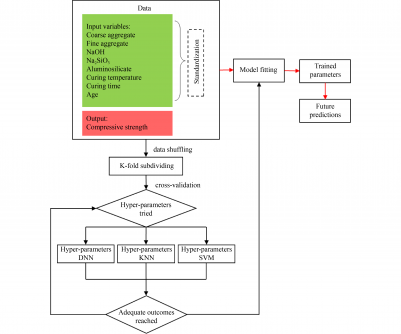
The research, titled “Machine Learning Based Models for Predicting Compressive Strength of Geopolymer Concrete,” introduces three distinct machine learning approaches: deep neural networks (DNN), K-nearest neighbors (KNN), and support vector machines (SVM). To build a robust database, the team collected a total of 375 experimental samples from existing literature. After thorough preprocessing, including the removal of 30 outliers and the standardization of input variables, 345 valid samples were used for analysis.
Key input variables for the models encompassed coarse aggregate content, fine aggregate content, NaOH and Na2SiO3 content, aluminosilicate content, curing temperature, curing time, and age. The output variable was the compressive strength of the geopolymer concrete. The researchers utilized the standard K-fold cross-validation method to evaluate model performance, which helped mitigate overfitting and enhanced generalizability.
The effectiveness of the models was gauged using various statistical metrics, including root mean squared error (RMSE), mean absolute error (MAE), correlation coefficient (R), and performance index (PI). The basic mean square error (MSE) served as the loss function during model training. The results highlighted that all three models successfully predicted the compressive strength of geopolymer concrete, demonstrating strong correlations between predicted and actual values.
Among the models tested, the DNN exhibited superior performance relative to both KNN and SVM. It achieved the highest correlation coefficient, approximately 0.96 for the training set and 0.89 for the testing set. Additionally, the DNN model had the lowest RMSE and MAE, as well as the least performance variability across cross-validation splits, indicating its enhanced stability and accuracy.
All models produced PI values significantly below the acceptable threshold of 0.2, affirming their reliability in predicting compressive strength. This study offers a valuable data-driven tool for optimizing the mixture design of geopolymer concrete, which could facilitate broader application in engineering projects.
The findings of this research are documented in the journal Frontiers in Structural and Civil Engineering, published in 2024, volume 18, pages 1028–1049. The full study can be accessed via DOI: https://doi.org/10.1007/s11709-024-1039-5.

Revolutionary Photonic Ski-Jump Could Miniaturize LiDAR Systems

Couples Detox from Plastics in New Netflix Doc: Can It Boost Fertility?

Aventon Launches Affordable Full-Suspension Electric Mountain Bike

Discover Eight Must-Try Restaurants This Spring Season

UC Irvine Team Unveils Innovative Ion Pump for Water Treatment

One-Third of Americans Trim Daily Expenses for Healthcare Needs

Apple Secures First Oscar in Three Years with F1: The Movie

Fourth Graders Celebrate St. Patrick’s Day with Creative Weather Drawings

Kim Kardashian Dazzles at Vanity Fair Oscars Party 2026

Nostradamus’ 2026 Predictions: Star Death and Dark Events Loom

Breakthroughs and Challenges Await Science in 2026

Electric Moto Influencer Surronster Arrested in Tijuana

OpenAI to Implement Age Verification for ChatGPT by December 2025

Discover the Top 10 Calorie Counting Apps of 2025

Recovering a Suspended TikTok Account: A Step-by-Step Guide

Bella Hadid Shares Health Update After Treatment for Lyme Disease

Backpack Drives Equip Students with Supplies for New School Year

Analysts Project Stronger Growth for Apple’s iPhone 17 Lineup
-
 Science7 months ago
Nostradamus’ 2026 Predictions: Star Death and Dark Events Loom
-
 Science7 months ago
Breakthroughs and Challenges Await Science in 2026
-
 Technology11 months ago
Electric Moto Influencer Surronster Arrested in Tijuana
-
 Technology8 months ago
OpenAI to Implement Age Verification for ChatGPT by December 2025
-
 Technology1 year ago
Discover the Top 10 Calorie Counting Apps of 2025
-
 Technology1 year ago
Recovering a Suspended TikTok Account: A Step-by-Step Guide
-
 Health11 months ago
Bella Hadid Shares Health Update After Treatment for Lyme Disease
-
 Education1 year ago
Backpack Drives Equip Students with Supplies for New School Year
-
 Health11 months ago
Analysts Project Stronger Growth for Apple’s iPhone 17 Lineup
-

 Technology8 months ago
Top 10 Penny Stocks to Watch in 2026 for Strong Returns
-

 Health11 months ago
Japanese Study Finds Rose Oil Can Increase Brain Gray Matter
-

 Science10 months ago
Starship V3 Set for 2026 Launch After Successful Final Test of Version 2