
Science
Welding Evolution: The Impact of Auto-Darkening Helmets

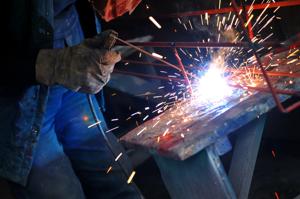
Advancements in welding technology have transformed safety and efficiency for both professionals and enthusiasts. A significant innovation is the introduction of auto-darkening welding helmets, which have greatly improved the experience of arc welding.
Gary Hanington, a Professor Emeritus of physical science at Great Basin College and chief scientist at AHV, reflects on the evolution of welding helmets and the technology behind them. He recalls his own experiences with welding, dating back to the 1970s, when safety equipment was rudimentary at best.
In the past, welders relied on simple helmets that required manual adjustment. “Using a basic welder’s helmet meant employing a poke-and-hope technique to strike the arc,” Hanington explains. Without the ability to see the weld area clearly, it was common to have mishaps, such as burning through essential parts of a vehicle. This experience highlights the importance of improved safety measures in welding.
The journey of arc welding began with a patent in 1890, but widespread adoption in the United States took time due to limited access to electricity. Significant advancements occurred during World War II, driven by the high demand for durable construction. After the war, smaller transformer-based units made welding accessible for home use, significantly impacting farm and ranch repairs.
Despite these developments, helmet technology lagged behind until the 1980s. The only notable change before then was a one-piece helmet introduced in 1937, designed to offer greater protection for welders. It wasn’t until 1981 that the Swedish company Hornell launched the first auto-darkening welding helmet, known as Speedglas. This helmet featured electronic shutters that automatically adjusted the lens to protect the welder’s eyes from harmful infrared and ultraviolet light.
The technology behind these helmets relies on liquid crystal cells. When an electric arc is detected, sensors trigger the lens to darken, ensuring the welder’s eyes are shielded from intense light. During operation, light from the welding arc first passes through a UV/IR filter, reflecting 99% of incoming infrared rays and blocking ultraviolet light. This not only protects the welder’s eyes but also safeguards the liquid crystal panels from heat damage.
In the years since the introduction of auto-darkening helmets, safety standards have improved significantly. The acquisition of Hornell by 3M in 2004 further accelerated innovation in welding safety. Today, welders can enjoy enhanced visibility and protection, allowing them to concentrate on their work without the constant need to adjust their helmets.
Reflecting on his welding journey, Hanington emphasizes the importance of skill development. Learning to weld is an art that requires practice, and modern auto-darkening helmets have made this craft more accessible and safer. “These advancements would have been invaluable during my time working on Rusty-Busty,” he notes.
The evolution of welding technology, particularly the introduction of auto-darkening helmets, has had a profound impact on both safety and efficiency in the field. As welding continues to evolve, these innovations will undoubtedly shape the future of the craft, making it safer and more approachable for new generations of welders.
For those interested in learning more about welding and the advancements in safety technology, Gary Hanington can be reached at [email protected] or [email protected].


Revolutionary Photonic Ski-Jump Could Miniaturize LiDAR Systems

Couples Detox from Plastics in New Netflix Doc: Can It Boost Fertility?

Aventon Launches Affordable Full-Suspension Electric Mountain Bike

Discover Eight Must-Try Restaurants This Spring Season

UC Irvine Team Unveils Innovative Ion Pump for Water Treatment

One-Third of Americans Trim Daily Expenses for Healthcare Needs

Apple Secures First Oscar in Three Years with F1: The Movie

Fourth Graders Celebrate St. Patrick’s Day with Creative Weather Drawings

Kim Kardashian Dazzles at Vanity Fair Oscars Party 2026

Nostradamus’ 2026 Predictions: Star Death and Dark Events Loom

Breakthroughs and Challenges Await Science in 2026

Electric Moto Influencer Surronster Arrested in Tijuana

OpenAI to Implement Age Verification for ChatGPT by December 2025

Discover the Top 10 Calorie Counting Apps of 2025

Recovering a Suspended TikTok Account: A Step-by-Step Guide

Bella Hadid Shares Health Update After Treatment for Lyme Disease

Backpack Drives Equip Students with Supplies for New School Year

Analysts Project Stronger Growth for Apple’s iPhone 17 Lineup
-
 Science8 months ago
Nostradamus’ 2026 Predictions: Star Death and Dark Events Loom
-
 Science8 months ago
Breakthroughs and Challenges Await Science in 2026
-
 Technology11 months ago
Electric Moto Influencer Surronster Arrested in Tijuana
-
 Technology9 months ago
OpenAI to Implement Age Verification for ChatGPT by December 2025
-
 Technology1 year ago
Discover the Top 10 Calorie Counting Apps of 2025
-
 Technology1 year ago
Recovering a Suspended TikTok Account: A Step-by-Step Guide
-
 Health11 months ago
Bella Hadid Shares Health Update After Treatment for Lyme Disease
-
 Education1 year ago
Backpack Drives Equip Students with Supplies for New School Year
-
 Health12 months ago
Analysts Project Stronger Growth for Apple’s iPhone 17 Lineup
-

 Health12 months ago
Japanese Study Finds Rose Oil Can Increase Brain Gray Matter
-

 Technology8 months ago
Top 10 Penny Stocks to Watch in 2026 for Strong Returns
-

 Science10 months ago
Starship V3 Set for 2026 Launch After Successful Final Test of Version 2