
Science
UK Researchers Develop Robust Perovskite Solar Cells with 95% Retention

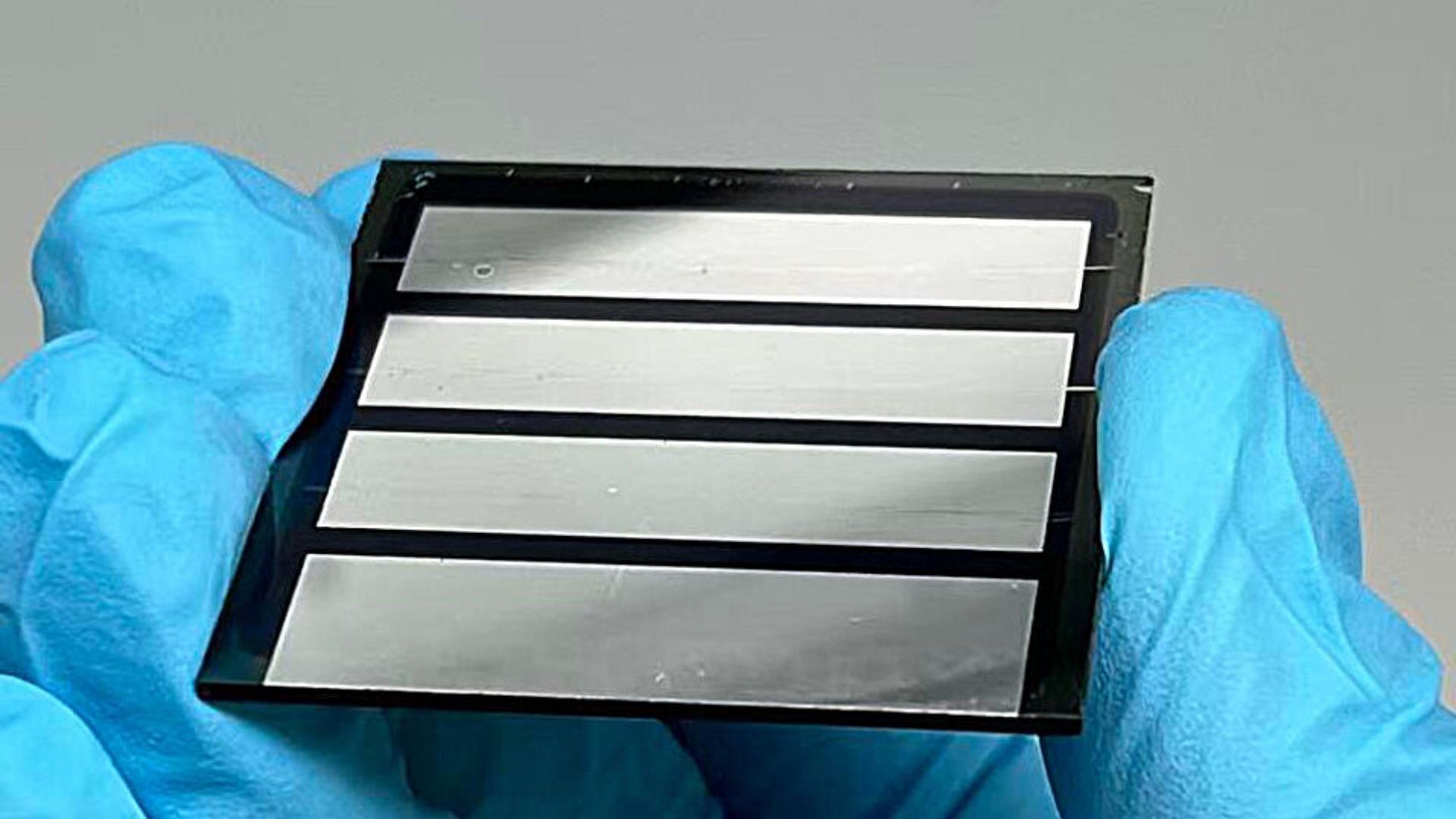
Innovative research from the University of Manchester has led to the development of new perovskite solar cells that maintain over 95% of their performance after extensive testing. Under the guidance of Professor Thomas Anthopoulos, the team has successfully stabilized these solar cells, addressing a significant barrier that has hindered their widespread adoption. This breakthrough could potentially transform the solar energy landscape by making low-cost, efficient solar technology more accessible globally.
Enhancing Stability and Efficiency
The newly designed perovskite solar cells achieved an impressive power conversion efficiency of 25.4% during testing. Central to this advancement is the introduction of a novel molecular glue that smooths the surface of the perovskite, effectively eliminating microscopic defects that have historically led to energy loss and material degradation. These improvements ensure that the solar cells can withstand extreme temperatures, maintaining functionality even at 85°C (185 degrees Fahrenheit).
Traditionally, silicon has dominated the solar market due to its reliability. However, it is heavy and expensive to produce. In contrast, perovskite solar cells are lightweight, flexible, and considerably cheaper. Despite their advantages, early iterations of perovskite technology suffered rapid degradation, often failing within days of exposure to heat and light. Professor Anthopoulos explained, “Current state-of-the-art perovskite materials are known to be unstable under heat or light, causing the cells to degrade faster.”
The research team addressed these issues by employing small-molecule ligands that act as a protective seal across the perovskite surface. This innovation not only enhances stability but also facilitates the organization of the material into low-dimensional layers, which serve as a structural shield against degradation.
Implications for Renewable Energy
The implications of this research extend beyond just efficiency. The new perovskite solar cells have shown resilience, retaining their performance even after 1,100 hours of continuous use. This durability positions them as a viable alternative to traditional silicon panels, especially in applications where flexibility and weight are critical, such as in curved windows, portable devices, and even wearable technology.
The race to commercialize perovskite technology is intensifying, with concurrent advancements being made in other regions. For instance, researchers in China recently introduced a three-dimensional electrical imaging method aimed at observing charge-carrier migration in perovskite films. This technique could further improve the understanding of internal defects and enhance the overall performance of solar cells.
The findings from the University of Manchester were published in the journal Science on January 8, 2023. As researchers continue to refine perovskite technology, the potential for a more sustainable energy future becomes increasingly feasible. By overcoming the significant challenges of stability and performance, these new solar cells may play a crucial role in the transition to renewable energy sources worldwide.





Revolutionary Photonic Ski-Jump Could Miniaturize LiDAR Systems

Couples Detox from Plastics in New Netflix Doc: Can It Boost Fertility?

Aventon Launches Affordable Full-Suspension Electric Mountain Bike

Discover Eight Must-Try Restaurants This Spring Season

UC Irvine Team Unveils Innovative Ion Pump for Water Treatment

One-Third of Americans Trim Daily Expenses for Healthcare Needs

Apple Secures First Oscar in Three Years with F1: The Movie

Fourth Graders Celebrate St. Patrick’s Day with Creative Weather Drawings

Kim Kardashian Dazzles at Vanity Fair Oscars Party 2026

Nostradamus’ 2026 Predictions: Star Death and Dark Events Loom

Breakthroughs and Challenges Await Science in 2026

Electric Moto Influencer Surronster Arrested in Tijuana

OpenAI to Implement Age Verification for ChatGPT by December 2025

Discover the Top 10 Calorie Counting Apps of 2025

Recovering a Suspended TikTok Account: A Step-by-Step Guide

Bella Hadid Shares Health Update After Treatment for Lyme Disease

Backpack Drives Equip Students with Supplies for New School Year

Analysts Project Stronger Growth for Apple’s iPhone 17 Lineup
-
 Science7 months ago
Nostradamus’ 2026 Predictions: Star Death and Dark Events Loom
-
 Science7 months ago
Breakthroughs and Challenges Await Science in 2026
-
 Technology11 months ago
Electric Moto Influencer Surronster Arrested in Tijuana
-
 Technology8 months ago
OpenAI to Implement Age Verification for ChatGPT by December 2025
-
 Technology1 year ago
Discover the Top 10 Calorie Counting Apps of 2025
-
 Technology1 year ago
Recovering a Suspended TikTok Account: A Step-by-Step Guide
-
 Health11 months ago
Bella Hadid Shares Health Update After Treatment for Lyme Disease
-
 Education1 year ago
Backpack Drives Equip Students with Supplies for New School Year
-
 Health11 months ago
Analysts Project Stronger Growth for Apple’s iPhone 17 Lineup
-

 Technology7 months ago
Top 10 Penny Stocks to Watch in 2026 for Strong Returns
-

 Health11 months ago
Japanese Study Finds Rose Oil Can Increase Brain Gray Matter
-

 Science10 months ago
Starship V3 Set for 2026 Launch After Successful Final Test of Version 2