
Science
Rethinking Climate Migration: Introducing ‘Tethered Resilience’

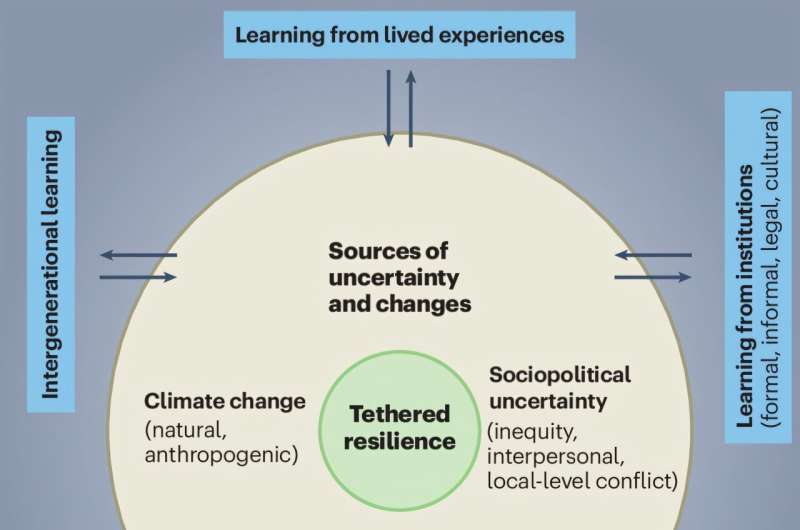
As climate change continues to affect communities worldwide, a new perspective on migration is emerging. Researchers from Yale University, led by Brianna Castro, have proposed a third framework called “tethered resilience.” This concept challenges the traditional binary of either staying or leaving vulnerable areas, suggesting that individuals and families often make nuanced decisions based on intergenerational ties and social networks.
In a commentary published on December 10, 2025, in the journal Nature Climate Change, the authors argue that many affected by climate change do not fit neatly into the categories of “movers” or “stayers.” Instead, they often engage in temporary or seasonal relocations while maintaining connections to their communities and cultural identities. This approach acknowledges the complexity of human decision-making in the face of climate risks.
Bishawjit Mallick, the lead author of the study and an associate professor at the University of Utrecht, emphasized that the narrative surrounding climate migration needs to shift. “What the world needs to know is that many people don’t just ‘move away or give up,'” he stated. “Instead, they try to adapt in mixed ways.” This perspective promotes a more dynamic understanding of resilience, blending mobility with a sense of rootedness.
Examples of Tethered Resilience in Action
The researchers highlight several case studies that illustrate the concept of tethered resilience. In Fiji, families are choosing to remain in vulnerable coastal areas while planning for future migrations inland. They envision a generational retreat, wherein future generations will build homes on higher ground.
In Guatemala, young residents are actively engaging in local economic initiatives, viewing these efforts as a way to secure their future in regions threatened by drought and crop failure. These initiatives reflect a commitment to their communities and an understanding of the value of local resources.
Similarly, in rural Bangladesh, women are participating in resilience-building activities, such as community farming and home-based enterprises. Their ties to the land, rooted in traditional gender roles, motivate them to invest in the local economy while adapting to climate challenges.
Redefining Adaptation Strategies
The research team identifies four key factors that influence decisions regarding climate-related migration. These include the availability of opportunities that combine ancestral practices with innovative solutions, cultural values that prioritize heritage preservation, governmental support for adaptation, and the structural inequalities faced by marginalized groups.
By highlighting these factors, the authors challenge the misconception that staying in place signifies a failure to adapt. Instead, they advocate for a comprehensive view of resilience that encompasses diverse strategies for future-making under risk.
Brianna Castro urged policymakers to invest in social infrastructure and networks that empower communities to stay and adapt. “People’s attachment to land, identity, and community matters,” she said, stressing the importance of a supportive environment for those navigating climate impacts.
The concept of tethered resilience offers a fresh lens through which to view climate adaptation, encouraging a more flexible and context-specific approach. As communities continue to grapple with the realities of climate change, understanding the multifaceted nature of their decisions will be crucial for developing effective policies and support systems.
This research not only broadens the discourse on climate migration but also emphasizes the need for tailored solutions that respect and enhance the connections people have to their communities and environments.











Revolutionary Photonic Ski-Jump Could Miniaturize LiDAR Systems

Couples Detox from Plastics in New Netflix Doc: Can It Boost Fertility?

Aventon Launches Affordable Full-Suspension Electric Mountain Bike

Discover Eight Must-Try Restaurants This Spring Season

UC Irvine Team Unveils Innovative Ion Pump for Water Treatment

One-Third of Americans Trim Daily Expenses for Healthcare Needs

Apple Secures First Oscar in Three Years with F1: The Movie

Fourth Graders Celebrate St. Patrick’s Day with Creative Weather Drawings

Kim Kardashian Dazzles at Vanity Fair Oscars Party 2026

Nostradamus’ 2026 Predictions: Star Death and Dark Events Loom

Breakthroughs and Challenges Await Science in 2026

Electric Moto Influencer Surronster Arrested in Tijuana

OpenAI to Implement Age Verification for ChatGPT by December 2025

Discover the Top 10 Calorie Counting Apps of 2025

Bella Hadid Shares Health Update After Treatment for Lyme Disease

Analysts Project Stronger Growth for Apple’s iPhone 17 Lineup

Japanese Study Finds Rose Oil Can Increase Brain Gray Matter

Top 10 Penny Stocks to Watch in 2026 for Strong Returns
-
 Science4 months ago
Nostradamus’ 2026 Predictions: Star Death and Dark Events Loom
-
 Science4 months ago
Breakthroughs and Challenges Await Science in 2026
-
 Technology7 months ago
Electric Moto Influencer Surronster Arrested in Tijuana
-
 Technology4 months ago
OpenAI to Implement Age Verification for ChatGPT by December 2025
-
 Technology9 months ago
Discover the Top 10 Calorie Counting Apps of 2025
-
 Health7 months ago
Bella Hadid Shares Health Update After Treatment for Lyme Disease
-
 Health7 months ago
Analysts Project Stronger Growth for Apple’s iPhone 17 Lineup
-
 Health7 months ago
Japanese Study Finds Rose Oil Can Increase Brain Gray Matter
-
 Technology4 months ago
Top 10 Penny Stocks to Watch in 2026 for Strong Returns
-

 Science6 months ago
Starship V3 Set for 2026 Launch After Successful Final Test of Version 2
-

 Technology1 month ago
Nvidia GTC 2026: Major Announcements Expected for AI and Hardware
-

 Education7 months ago
Harvard Secures Court Victory Over Federal Funding Cuts