
Science
Researchers Uncover Origins of Hot Jupiters’ Close Orbits

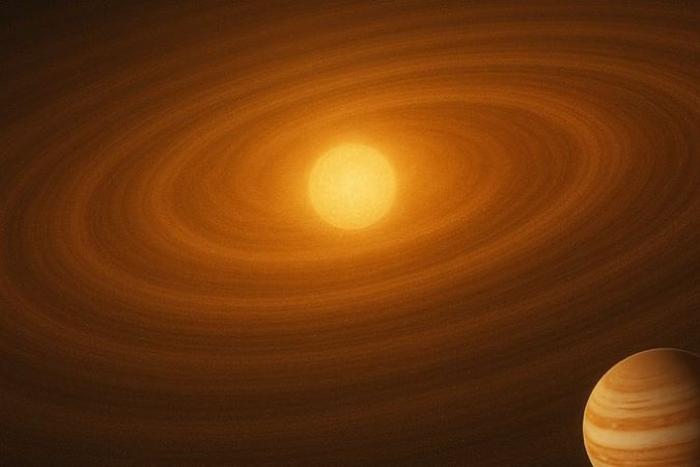
A recent study published in The Astronomical Journal sheds light on the intriguing orbits of hot Jupiters, a class of exoplanets that orbit perilously close to their host stars. Conducted by a team from The University of Tokyo, the research investigates how these planets, which do not resemble any bodies in our solar system, ended up in such tight orbits. This study enhances our understanding of planetary formation and evolution, potentially informing the search for life beyond Earth.
The researchers focused on the orbital evolution of over 500 hot Jupiters, employing mathematical equations to analyze their origins in relation to two key processes: disk migration and high-eccentricity migration (HEM). Disk migration occurs while a planet is still embedded in a protoplanetary disk surrounding its star, whereas HEM involves a planet’s orbit elongating before it stabilizes into a circular path. By examining the timescales of these orbital changes, the team aimed to discern whether the planets’ current positions correspond to their formation history.
The findings revealed that the majority of the hot Jupiters studied transitioned from highly eccentric orbits to circular ones in a time frame shorter than the age of their respective systems. However, notably, around 30 hot Jupiters exhibited orbital timescales exceeding the age of their systems. This discrepancy suggests that further research is necessary to fully understand the processes that govern the orbits of these enigmatic planets.
Moving forward, the researchers emphasize the need for a larger sample size and a deeper investigation into the obliquity, or tilt, of protoplanetary disks, as this could significantly influence disk migration. They also highlight the importance of studying archival data from NASA’s retired Kepler telescope and the ongoing Transiting Exoplanet Survey Satellite (TESS) mission.
Hot Jupiters, characterized by their rapid orbits ranging from 1 to 10 days, challenge existing models of planetary system formation. The first confirmed exoplanet, discovered in 1995, was a hot Jupiter, which sparked a reevaluation of how planetary systems develop. Since then, scientists have identified approximately 500 to 600 hot Jupiters, making up about one-tenth of all confirmed exoplanets.
Despite their extreme temperatures, which make them inhospitable to life as we know it, hot Jupiters are crucial for understanding planetary evolution. Their unique characteristics prompt ongoing debates among scientists regarding their origins—whether they formed close to their stars or migrated inward from farther out in the protoplanetary disk.
The study represents a significant step in unraveling the mysterious origins of hot Jupiters. As researchers delve deeper into this fascinating area, they may uncover even more insights into the formation and evolution of planetary systems beyond our own. The quest for knowledge continues, and the scientific community remains eager to explore the implications of these findings for our understanding of the universe.










Revolutionary Photonic Ski-Jump Could Miniaturize LiDAR Systems

Couples Detox from Plastics in New Netflix Doc: Can It Boost Fertility?

Aventon Launches Affordable Full-Suspension Electric Mountain Bike

Discover Eight Must-Try Restaurants This Spring Season

UC Irvine Team Unveils Innovative Ion Pump for Water Treatment

One-Third of Americans Trim Daily Expenses for Healthcare Needs

Apple Secures First Oscar in Three Years with F1: The Movie

Fourth Graders Celebrate St. Patrick’s Day with Creative Weather Drawings

Kim Kardashian Dazzles at Vanity Fair Oscars Party 2026

Nostradamus’ 2026 Predictions: Star Death and Dark Events Loom

Breakthroughs and Challenges Await Science in 2026

Electric Moto Influencer Surronster Arrested in Tijuana

OpenAI to Implement Age Verification for ChatGPT by December 2025

Discover the Top 10 Calorie Counting Apps of 2025

Recovering a Suspended TikTok Account: A Step-by-Step Guide

Bella Hadid Shares Health Update After Treatment for Lyme Disease

Backpack Drives Equip Students with Supplies for New School Year

Analysts Project Stronger Growth for Apple’s iPhone 17 Lineup
-
 Science8 months ago
Nostradamus’ 2026 Predictions: Star Death and Dark Events Loom
-
 Science8 months ago
Breakthroughs and Challenges Await Science in 2026
-
 Technology11 months ago
Electric Moto Influencer Surronster Arrested in Tijuana
-
 Technology9 months ago
OpenAI to Implement Age Verification for ChatGPT by December 2025
-
 Technology1 year ago
Discover the Top 10 Calorie Counting Apps of 2025
-
 Technology1 year ago
Recovering a Suspended TikTok Account: A Step-by-Step Guide
-
 Health11 months ago
Bella Hadid Shares Health Update After Treatment for Lyme Disease
-
 Education1 year ago
Backpack Drives Equip Students with Supplies for New School Year
-
 Health11 months ago
Analysts Project Stronger Growth for Apple’s iPhone 17 Lineup
-

 Health12 months ago
Japanese Study Finds Rose Oil Can Increase Brain Gray Matter
-

 Technology8 months ago
Top 10 Penny Stocks to Watch in 2026 for Strong Returns
-

 Science10 months ago
Starship V3 Set for 2026 Launch After Successful Final Test of Version 2