
Science
Researchers Uncover How Gravitational Waves Could Reveal Dark Matter

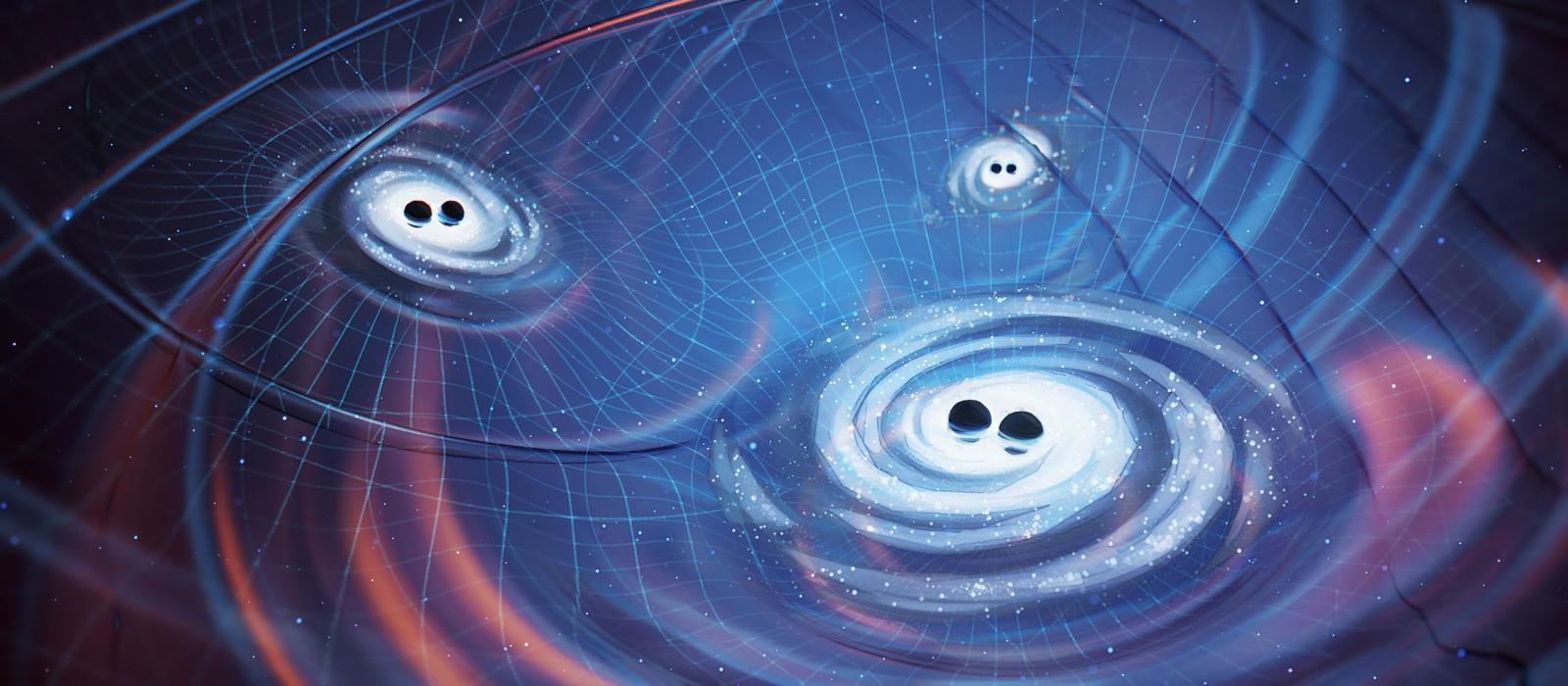
The discovery of gravitational waves (GWs) has opened new avenues in astrophysics, with recent research proposing their use in decoding one of the universe’s most elusive mysteries—dark matter. A team from the University of Amsterdam published their findings in the journal Physical Review Letters, detailing how GWs from merging black holes and neutron stars could provide insights into the existence and distribution of dark matter.
Since the first detection of GWs in 2015, a prediction of Albert Einstein‘s Theory of General Relativity, the field of astronomy has been transformed. These waves emerge from the merger of massive, compact objects, creating ripples in spacetime detectable from millions of light-years away. The research conducted by Rodrigo Vicente, Theophanes K. Karydas, and Gianfranco Bertone from the university’s Institute of Physics and the Gravitation & Astroparticle Physics Amsterdam (GRAPPA) centre marks a significant advancement in this area.
New Modeling Techniques for Gravitational Waves
The researchers focused on extreme mass-ratio inspirals (EMRIs), where black holes or neutron stars orbit each other and spiral inward to form larger black holes. This study introduces an innovative modeling approach that accounts for various environmental factors affecting EMRIs, utilizing General Relativity rather than the traditional Newtonian framework. This shift allows for a more accurate prediction of how these celestial bodies influence GWs.
By enhancing the understanding of how dark matter interacts with black holes, the research suggests that dense concentrations of dark matter could create observable “spikes” or “mounds” around these massive objects. The team anticipates that next-generation instruments will be able to detect these imprints in GW signals, potentially confirming the existence of dark matter, which comprises approximately 65% of the universe’s mass.
Future Implications and Technological Advancements
The European Space Agency (ESA) plans to launch the Laser Interferometer Space Antenna (LISA) within the next decade. This space-based observatory will be the first of its kind dedicated to studying gravitational waves, comprising three spacecraft equipped with six lasers to measure spacetime ripples. The mission is expected to detect over 10,000 GW signals, providing unprecedented data for astrophysicists.
The implications of this research extend beyond just the detection of dark matter. It contributes to a broader effort to map the distribution of dark matter throughout the universe and enhance understanding of its composition. This growing field of study could reshape current cosmological theories and offer new insights into the fundamental nature of the universe.
This groundbreaking work not only sets the stage for future discoveries with LISA and other detectors like the Laser Interferometer Gravitational Wave Observatory (LIGO), the Virgo Collaboration, and the Kamioka Gravitational-wave Detector (KAGRA), but it also reaffirms the importance of gravitational waves as a tool for exploring the cosmos. As scientists prepare for the next generation of astronomical instruments, the potential for unlocking the secrets of dark matter appears more promising than ever.










Revolutionary Photonic Ski-Jump Could Miniaturize LiDAR Systems

Couples Detox from Plastics in New Netflix Doc: Can It Boost Fertility?

Aventon Launches Affordable Full-Suspension Electric Mountain Bike

Discover Eight Must-Try Restaurants This Spring Season

UC Irvine Team Unveils Innovative Ion Pump for Water Treatment

One-Third of Americans Trim Daily Expenses for Healthcare Needs

Apple Secures First Oscar in Three Years with F1: The Movie

Fourth Graders Celebrate St. Patrick’s Day with Creative Weather Drawings

Kim Kardashian Dazzles at Vanity Fair Oscars Party 2026

Nostradamus’ 2026 Predictions: Star Death and Dark Events Loom

Breakthroughs and Challenges Await Science in 2026

Electric Moto Influencer Surronster Arrested in Tijuana

OpenAI to Implement Age Verification for ChatGPT by December 2025

Discover the Top 10 Calorie Counting Apps of 2025

Bella Hadid Shares Health Update After Treatment for Lyme Disease

Analysts Project Stronger Growth for Apple’s iPhone 17 Lineup

Japanese Study Finds Rose Oil Can Increase Brain Gray Matter

Top 10 Penny Stocks to Watch in 2026 for Strong Returns
-
 Science3 months ago
Nostradamus’ 2026 Predictions: Star Death and Dark Events Loom
-
 Science4 months ago
Breakthroughs and Challenges Await Science in 2026
-
 Technology7 months ago
Electric Moto Influencer Surronster Arrested in Tijuana
-
 Technology4 months ago
OpenAI to Implement Age Verification for ChatGPT by December 2025
-
 Technology9 months ago
Discover the Top 10 Calorie Counting Apps of 2025
-
 Health7 months ago
Bella Hadid Shares Health Update After Treatment for Lyme Disease
-
 Health7 months ago
Analysts Project Stronger Growth for Apple’s iPhone 17 Lineup
-
 Health7 months ago
Japanese Study Finds Rose Oil Can Increase Brain Gray Matter
-
 Technology4 months ago
Top 10 Penny Stocks to Watch in 2026 for Strong Returns
-

 Science6 months ago
Starship V3 Set for 2026 Launch After Successful Final Test of Version 2
-

 Technology1 month ago
Nvidia GTC 2026: Major Announcements Expected for AI and Hardware
-

 Education7 months ago
Harvard Secures Court Victory Over Federal Funding Cuts