
Science
New Quadruple Star System Reveals Insights into Brown Dwarfs

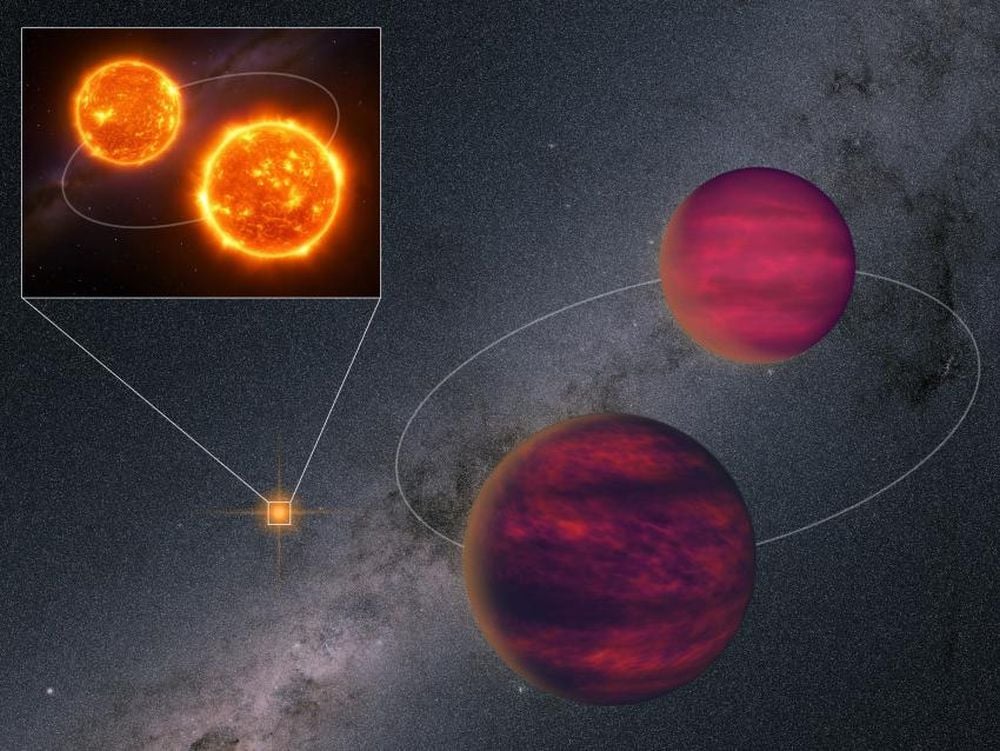
Astrophysicists have made a significant breakthrough in understanding brown dwarfs through the discovery of a rare quadruple star system located approximately 82 light-years from Earth. This new system, which includes a binary pair of M dwarfs and a binary pair of brown dwarfs, offers a fresh perspective on these enigmatic celestial bodies often described as “failed stars.”
Brown dwarfs occupy a unique position in the cosmos, forming from the same processes as stars but lacking the mass required to initiate hydrogen fusion. While they are too massive to be categorized as gas giant planets like Jupiter, they do fuse some deuterium, further complicating their classification. Their low luminosity and temperature make them challenging to study in isolation, leading researchers to seek other methods of understanding their characteristics.
Significance of the Discovery
The quadruple star system, referred to as UPM J1040–3551, is noteworthy because it presents an opportunity to navigate the “mass-degeneracy problem.” This problem arises from the fact that brown dwarfs maintain a relatively consistent radius regardless of their mass due to electron degeneracy pressure, which is also found in white dwarfs. Consequently, measuring their temperature does not effectively distinguish between older, more massive brown dwarfs and younger, less massive ones.
As detailed in a research article published in the Monthly Notices of the Royal Astronomical Society, the lead author, Professor Zenghua Zhang from Nanjing University, states that the discovery of these benchmark brown dwarfs in wide binary systems is critical for characterizing substellar objects and refining atmospheric models.
The study highlights two main components of the system: L 122–88 AB, a wide binary consisting of a mildly metal-poor M2 dwarf and a T5 dwarf, and the hierarchical quadruple nature of UPM J1040–3551, which includes pairs of M dwarfs and brown dwarfs.
Methodology and Observations
The researchers utilized data from the European Space Agency’s (ESA) Gaia mission and the NASA Wide-field Infrared Explorer to identify the system. Follow-up spectroscopic observations were conducted to confirm the nature of the brown dwarfs.
Dr. Felipe Navarete, from the Brazilian National Astrophysics Laboratory, led these spectroscopic observations. He utilized the Southern Astrophysical Research (SOAR) Telescope at the Cerro Tololo Inter-American Observatory in Chile. “These observations were challenging due to the faintness of the brown dwarfs,” Dr. Navarete noted. “However, the capabilities of SOAR allowed us to collect the crucial spectroscopic data needed to understand the nature of these objects.”
The findings indicate that the red dwarf pair has approximately 17% of the Sun’s mass and temperatures around 2,900 degrees Celsius. The brown dwarfs, categorized as T-type, have temperatures of 550 degrees Celsius and 420 degrees Celsius. These brown dwarfs are similar in size to Jupiter but possess densities between 10 and 30 times greater than that of the gas giant.
The research team emphasized that these discoveries provide a unique cosmic laboratory for studying these mysterious objects. “This is the first quadruple system ever discovered with a pair of T-type brown dwarfs orbiting two stars,” said Dr. María Cruz Gálvez-Ortiz from the Center for Astrobiology in Spain.
Implications for Future Research
The importance of these observations extends beyond immediate findings. The quadruple star system offers a dual advantage in studying brown dwarfs. According to Professor Hugh Jones from the University of Hertfordshire, this system can serve as an age benchmark, allowing researchers to calibrate low-temperature atmosphere models, while also acting as a mass benchmark to test evolutionary models.
The research indicates that UPM J1040–3551 is relatively young, with an estimated age between 300 million and 2 billion years. This age determination was made possible by measuring H-alpha emissions, which provide insights into stellar activity independent of traditional luminosity-based models.
The study’s findings suggest that the wide orbits of the brown dwarfs around the primary M dwarfs eliminate confounding factors such as tidal heating and mass transfer, which can alter cooling histories and obscure the understanding of brown dwarfs.
The researchers conclude that the newly discovered systems, L 122–88 AB and UPM J1040–3551 AB, significantly enhance the sample of benchmark brown dwarfs, particularly in the less-explored regimes of cool temperatures. This research not only furthers the understanding of brown dwarfs but also contributes to bridging the gap between brown dwarfs and giant exoplanets, providing a more comprehensive understanding of the low-mass end of the stellar-substellar-planetary continuum.











Revolutionary Photonic Ski-Jump Could Miniaturize LiDAR Systems

Couples Detox from Plastics in New Netflix Doc: Can It Boost Fertility?

Aventon Launches Affordable Full-Suspension Electric Mountain Bike

Discover Eight Must-Try Restaurants This Spring Season

UC Irvine Team Unveils Innovative Ion Pump for Water Treatment

One-Third of Americans Trim Daily Expenses for Healthcare Needs

Apple Secures First Oscar in Three Years with F1: The Movie

Fourth Graders Celebrate St. Patrick’s Day with Creative Weather Drawings

Kim Kardashian Dazzles at Vanity Fair Oscars Party 2026

Nostradamus’ 2026 Predictions: Star Death and Dark Events Loom

Breakthroughs and Challenges Await Science in 2026

Electric Moto Influencer Surronster Arrested in Tijuana

OpenAI to Implement Age Verification for ChatGPT by December 2025

Discover the Top 10 Calorie Counting Apps of 2025

Recovering a Suspended TikTok Account: A Step-by-Step Guide

Bella Hadid Shares Health Update After Treatment for Lyme Disease

Backpack Drives Equip Students with Supplies for New School Year

Analysts Project Stronger Growth for Apple’s iPhone 17 Lineup
-
 Science8 months ago
Nostradamus’ 2026 Predictions: Star Death and Dark Events Loom
-
 Science8 months ago
Breakthroughs and Challenges Await Science in 2026
-
 Technology11 months ago
Electric Moto Influencer Surronster Arrested in Tijuana
-
 Technology9 months ago
OpenAI to Implement Age Verification for ChatGPT by December 2025
-
 Technology1 year ago
Discover the Top 10 Calorie Counting Apps of 2025
-
 Technology1 year ago
Recovering a Suspended TikTok Account: A Step-by-Step Guide
-
 Health11 months ago
Bella Hadid Shares Health Update After Treatment for Lyme Disease
-
 Education1 year ago
Backpack Drives Equip Students with Supplies for New School Year
-
 Health11 months ago
Analysts Project Stronger Growth for Apple’s iPhone 17 Lineup
-

 Health12 months ago
Japanese Study Finds Rose Oil Can Increase Brain Gray Matter
-

 Technology8 months ago
Top 10 Penny Stocks to Watch in 2026 for Strong Returns
-

 Science10 months ago
Starship V3 Set for 2026 Launch After Successful Final Test of Version 2