
Science
New Method Enhances Exciton Flow in Moiré Superlattices

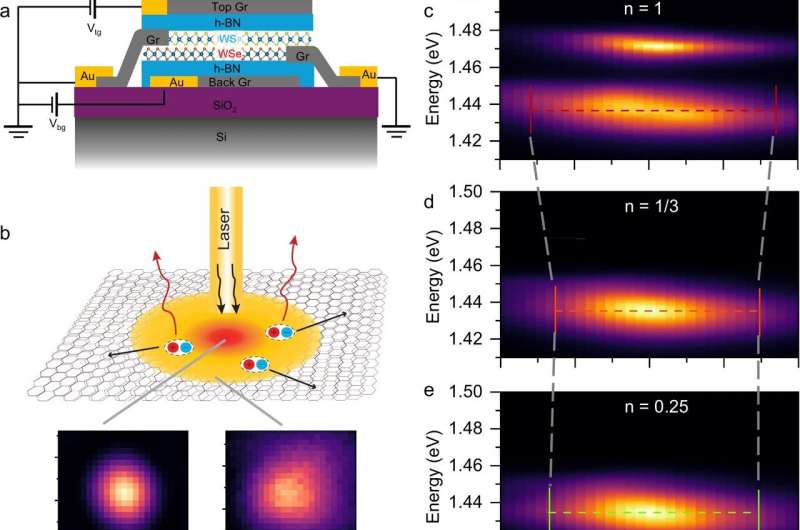
Researchers from Carnegie Mellon University and the University of California, Riverside, have developed a groundbreaking method to control the flow of excitons in moiré superlattices. This innovative technique, detailed in a study published in Nature Communications on December 21, 2025, leverages correlated electrons to enhance energy transport in electronic devices.
Excitons, which are pairs of negatively charged electrons and positively charged holes, play a crucial role in energy transport within semiconductors. These charge carriers also form in transition metal dichalcogenides, a class of materials consisting of a transition metal and two chalcogen atoms. The research team focused on structures comprising two layers of these materials, stacked with a slight rotational mismatch to create what are known as moiré superlattices.
Controlling Exciton Dynamics Through Electron Interactions
The researchers explored the effects of electron interactions within these moiré superlattices. Senior author Sufei Shi highlighted their previous work with WS2 and WSe2, which involved studying quantum many-body phenomena stemming from strong electron-electron and exciton-exciton interactions. This foundational research inspired the current study, where the team aimed to manipulate exciton dynamics through the strong interactions between electrons and excitons.
To create their moiré superlattices, the researchers fabricated layers of transition metal dichalcogenides and stacked them at a precise angle. They then employed optical techniques to induce the formation of excitons between the layers. By adjusting the density of electrons in the system using electrostatic doping, the team was able to examine how excitons spread, known as their diffusivity.
By controlling the number of electrons present, the researchers discovered significant variations in exciton flow. “We controlled the exciton diffusivity in our system by adjusting the gate voltage, which dictates the electron density in the moiré superlattices,” Shi explained. Notably, the study found that when the electron density reached levels sufficient to create a Mott insulator state, the flow of excitons increased by as much as 100 times. Conversely, exciton diffusivity decreased when electrons formed a rigid, crystal-like arrangement, referred to as Wigner crystal states.
Implications for Quantum Devices and Optoelectronics
This research opens new avenues for enhancing exciton diffusivity in transition metal dichalcogenide-based moiré superlattices, with potential applications in quantum and optoelectronic devices. Shi noted the significance of this work, stating, “With the robust exciton in 2D semiconductors, it has been proposed to use excitons as information carriers instead of electrons.” The challenge had been that excitons are charge neutral and not easily manipulated by electric fields. However, by harnessing the interaction between correlated electrons and excitons, the team achieved an electrically tunable exciton diffusivity.
Future research could build on these findings to further refine technologies based on moiré superlattices. By modulating exciton flow through these devices, researchers could induce desired physical states. Shi expressed interest in exploring additional methods to control exciton diffusivity, including the use of electric fields or nanoscale device patterns. The team also aims to investigate how exciton-exciton interactions can further manipulate diffusion processes and contribute to the development of new correlated exciton states.
The study represents a significant step forward in understanding the interplay between excitons and correlated electrons, potentially paving the way for innovative applications in advanced electronic and optoelectronic systems.








Revolutionary Photonic Ski-Jump Could Miniaturize LiDAR Systems

Couples Detox from Plastics in New Netflix Doc: Can It Boost Fertility?

Aventon Launches Affordable Full-Suspension Electric Mountain Bike

Discover Eight Must-Try Restaurants This Spring Season

UC Irvine Team Unveils Innovative Ion Pump for Water Treatment

One-Third of Americans Trim Daily Expenses for Healthcare Needs

Apple Secures First Oscar in Three Years with F1: The Movie

Fourth Graders Celebrate St. Patrick’s Day with Creative Weather Drawings

Kim Kardashian Dazzles at Vanity Fair Oscars Party 2026

Nostradamus’ 2026 Predictions: Star Death and Dark Events Loom

Breakthroughs and Challenges Await Science in 2026

Electric Moto Influencer Surronster Arrested in Tijuana

OpenAI to Implement Age Verification for ChatGPT by December 2025

Discover the Top 10 Calorie Counting Apps of 2025

Recovering a Suspended TikTok Account: A Step-by-Step Guide

Bella Hadid Shares Health Update After Treatment for Lyme Disease

Backpack Drives Equip Students with Supplies for New School Year

Analysts Project Stronger Growth for Apple’s iPhone 17 Lineup
-
 Science8 months ago
Nostradamus’ 2026 Predictions: Star Death and Dark Events Loom
-
 Science8 months ago
Breakthroughs and Challenges Await Science in 2026
-
 Technology11 months ago
Electric Moto Influencer Surronster Arrested in Tijuana
-
 Technology9 months ago
OpenAI to Implement Age Verification for ChatGPT by December 2025
-
 Technology1 year ago
Discover the Top 10 Calorie Counting Apps of 2025
-
 Technology1 year ago
Recovering a Suspended TikTok Account: A Step-by-Step Guide
-
 Health11 months ago
Bella Hadid Shares Health Update After Treatment for Lyme Disease
-
 Education1 year ago
Backpack Drives Equip Students with Supplies for New School Year
-
 Health12 months ago
Analysts Project Stronger Growth for Apple’s iPhone 17 Lineup
-

 Health12 months ago
Japanese Study Finds Rose Oil Can Increase Brain Gray Matter
-

 Technology8 months ago
Top 10 Penny Stocks to Watch in 2026 for Strong Returns
-

 Science10 months ago
Starship V3 Set for 2026 Launch After Successful Final Test of Version 2