
Science
New Method Accurately Differentiates Life and Non-Life Using Amino Acids

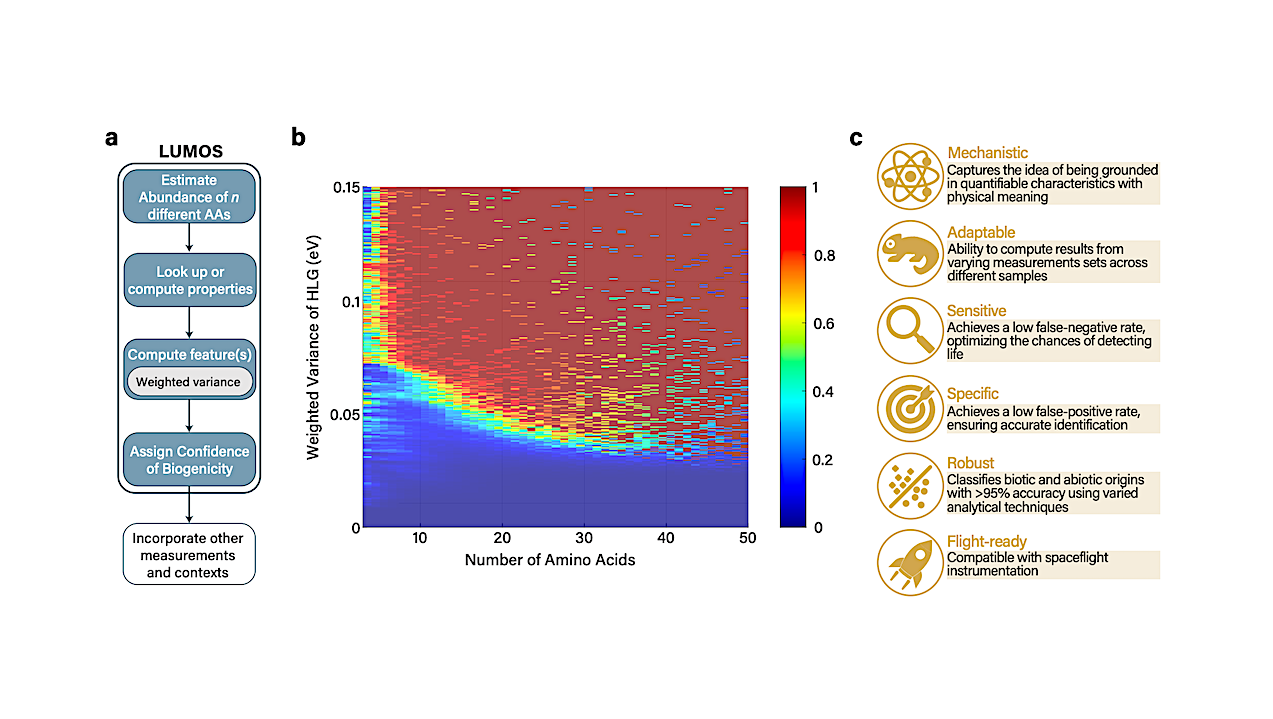
A groundbreaking statistical framework has been introduced to distinguish between life and non-life using amino acids (AAs), which are crucial to understanding the potential for life beyond Earth. Researchers José L. Ramírez-Colón, Ziqin Ni, and Christopher E. Carr have developed a method called LUMOS (Life Unveiled via Molecular Orbital Signatures) that analyzes the abundance-weighted HOMO-LUMO gap (HLG) of AAs within a sample. This advancement could significantly enhance the search for extraterrestrial life.
Amino acids are essential for all known life forms, playing a critical role in biological processes. They have been detected in various cosmic environments, including samples from asteroid Bennu, which contained 33 different AAs, 15 of which are fundamental to protein synthesis. Despite their significance, distinguishing between AAs that originate from biological processes and those that arise from abiotic means remains a challenge.
LUMOS tackles this complexity by assessing the distribution of HLG values in AAs. The research team compiled datasets from various environments and found that abiotic samples exhibited highly uniform distributions of HLGs, while biotic samples displayed greater variance, favoring AAs with lower HLG values. This pattern suggests a connection between the chemical reactivity of AAs and life’s ability to control chemical reactions.
The LUMOS framework has demonstrated over 95% accuracy in differentiating biotic from abiotic samples across diverse environmental and extraterrestrial conditions. This high level of precision indicates that varied molecular reactivity may serve as a universal biosignature, providing a pathway to identify life forms that do not necessarily share the same biochemical makeup as those known on Earth.
LUMOS is designed to be compatible with existing analytical instruments, making it suitable for both returned samples from space missions and in situ analyses. As research continues, a broader characterization of abiotic and biotic environments will help refine the distinctions between living and non-living chemical systems.
The findings were published on arXiv, an open-access repository, and represent a significant step forward in astrobiology, potentially transforming the way scientists approach the search for life beyond our planet. For further details, the code for LUMOS is available under the AGPLv3 license at https://github.com/jlramirezcolon/hlg-life-detection.
This innovative approach not only enhances our understanding of AAs in various environments but also opens up new avenues for exploring the fundamental characteristics that define life itself. As we expand our knowledge, the implications of this research could lead to breakthroughs in how we detect and understand life across the universe.




Revolutionary Photonic Ski-Jump Could Miniaturize LiDAR Systems

Couples Detox from Plastics in New Netflix Doc: Can It Boost Fertility?

Aventon Launches Affordable Full-Suspension Electric Mountain Bike

Discover Eight Must-Try Restaurants This Spring Season

UC Irvine Team Unveils Innovative Ion Pump for Water Treatment

One-Third of Americans Trim Daily Expenses for Healthcare Needs

Apple Secures First Oscar in Three Years with F1: The Movie

Fourth Graders Celebrate St. Patrick’s Day with Creative Weather Drawings

Kim Kardashian Dazzles at Vanity Fair Oscars Party 2026

Nostradamus’ 2026 Predictions: Star Death and Dark Events Loom

Breakthroughs and Challenges Await Science in 2026

Electric Moto Influencer Surronster Arrested in Tijuana

OpenAI to Implement Age Verification for ChatGPT by December 2025

Discover the Top 10 Calorie Counting Apps of 2025

Recovering a Suspended TikTok Account: A Step-by-Step Guide

Bella Hadid Shares Health Update After Treatment for Lyme Disease

Backpack Drives Equip Students with Supplies for New School Year

Analysts Project Stronger Growth for Apple’s iPhone 17 Lineup
-
 Science8 months ago
Nostradamus’ 2026 Predictions: Star Death and Dark Events Loom
-
 Science8 months ago
Breakthroughs and Challenges Await Science in 2026
-
 Technology11 months ago
Electric Moto Influencer Surronster Arrested in Tijuana
-
 Technology9 months ago
OpenAI to Implement Age Verification for ChatGPT by December 2025
-
 Technology1 year ago
Discover the Top 10 Calorie Counting Apps of 2025
-
 Technology1 year ago
Recovering a Suspended TikTok Account: A Step-by-Step Guide
-
 Health11 months ago
Bella Hadid Shares Health Update After Treatment for Lyme Disease
-
 Education1 year ago
Backpack Drives Equip Students with Supplies for New School Year
-
 Health12 months ago
Analysts Project Stronger Growth for Apple’s iPhone 17 Lineup
-

 Health12 months ago
Japanese Study Finds Rose Oil Can Increase Brain Gray Matter
-

 Technology8 months ago
Top 10 Penny Stocks to Watch in 2026 for Strong Returns
-

 Science10 months ago
Starship V3 Set for 2026 Launch After Successful Final Test of Version 2