
Science
New Gravity Theory Challenges Dark Energy Paradigm in Cosmology

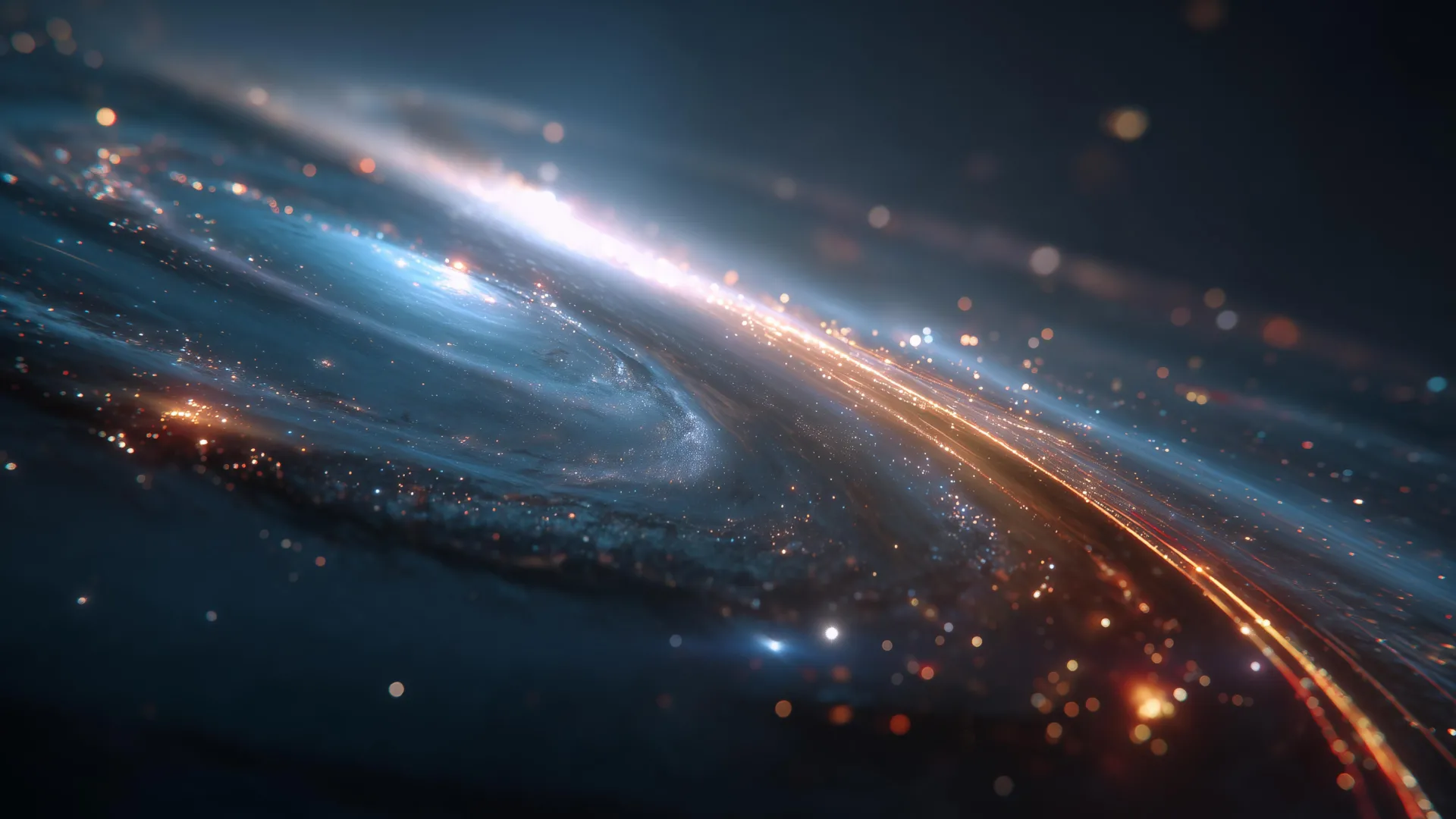
A groundbreaking study from the University of Bremen proposes an alternative explanation for the accelerating expansion of the universe, challenging the long-held reliance on dark energy. Researchers at the Center of Applied Space Technology and Microgravity (ZARM), in collaboration with colleagues from the Transylvanian University of Brașov in Romania, suggest that cosmic acceleration may be accounted for through an extended version of Einstein’s theory of gravity.
The concept of dark energy has become central to contemporary cosmology, as it is thought to drive the universe’s accelerated expansion. Despite its prominence, the nature and origins of dark energy remain elusive, making it a controversial element in scientific discourse. Current models typically incorporate dark energy to align theoretical predictions with astronomical observations. However, these models often require the addition of a “dark energy term,” which critics argue is an unsatisfactory workaround.
Rethinking Cosmic Expansion
Cosmologists traditionally use Einstein’s general theory of relativity alongside the Friedmann equations to describe the evolution of the universe. Yet, when these equations are applied to real-world observations, they frequently fall short. As a result, scientists have had to introduce dark energy into their calculations manually. This reliance on an artificial term highlights a significant gap in understanding the fundamental mechanics of cosmic expansion.
In light of these limitations, the team at ZARM explored an innovative approach utilizing a theory known as Finsler gravity. This theoretical framework has gained traction in recent years, offering a broader perspective on spacetime geometry. In contrast to traditional general relativity, Finsler gravity provides a more accurate depiction of gravitational interactions, particularly for gases, which is essential in modeling the universe’s large-scale behavior.
A New Perspective on the Universe
Upon applying Finsler gravity to the Friedmann equations, researchers uncovered a significant finding: the modified equations, termed the Finsler-Friedmann equations, naturally predict an accelerating universe, even in the absence of matter or energy. This groundbreaking revelation indicates that cosmic acceleration could be explained without invoking dark energy, eliminating the need for additional assumptions.
“This is an exciting indication that we may be able to explain the accelerated expansion of the universe, at least in parts, without dark energy, on the basis of a generalized spacetime geometry,”
said Christian Pfeifer, a physicist at ZARM and a member of the research team. He emphasized that this new geometric perspective on the dark energy problem opens up novel avenues for understanding the fundamental laws governing cosmic phenomena.
The implications of this research are profound, as they challenge a long-standing paradigm in cosmology and suggest that a more nuanced comprehension of gravity could reshape our understanding of the universe. The findings were published in the Journal of Cosmology and Astroparticle Physics on January 11, 2026, marking a significant contribution to ongoing debates in the field.
As scientists continue to unravel the mysteries of the cosmos, this study stands out as a potential turning point that may redefine the parameters of cosmological theory and our understanding of the universe’s expansion.






Revolutionary Photonic Ski-Jump Could Miniaturize LiDAR Systems

Couples Detox from Plastics in New Netflix Doc: Can It Boost Fertility?

Aventon Launches Affordable Full-Suspension Electric Mountain Bike

Discover Eight Must-Try Restaurants This Spring Season

UC Irvine Team Unveils Innovative Ion Pump for Water Treatment

One-Third of Americans Trim Daily Expenses for Healthcare Needs

Apple Secures First Oscar in Three Years with F1: The Movie

Fourth Graders Celebrate St. Patrick’s Day with Creative Weather Drawings

Kim Kardashian Dazzles at Vanity Fair Oscars Party 2026

Nostradamus’ 2026 Predictions: Star Death and Dark Events Loom

Breakthroughs and Challenges Await Science in 2026

Electric Moto Influencer Surronster Arrested in Tijuana

OpenAI to Implement Age Verification for ChatGPT by December 2025

Discover the Top 10 Calorie Counting Apps of 2025

Recovering a Suspended TikTok Account: A Step-by-Step Guide

Bella Hadid Shares Health Update After Treatment for Lyme Disease

Backpack Drives Equip Students with Supplies for New School Year

Analysts Project Stronger Growth for Apple’s iPhone 17 Lineup
-
 Science8 months ago
Nostradamus’ 2026 Predictions: Star Death and Dark Events Loom
-
 Science8 months ago
Breakthroughs and Challenges Await Science in 2026
-
 Technology11 months ago
Electric Moto Influencer Surronster Arrested in Tijuana
-
 Technology9 months ago
OpenAI to Implement Age Verification for ChatGPT by December 2025
-
 Technology1 year ago
Discover the Top 10 Calorie Counting Apps of 2025
-
 Technology1 year ago
Recovering a Suspended TikTok Account: A Step-by-Step Guide
-
 Health11 months ago
Bella Hadid Shares Health Update After Treatment for Lyme Disease
-
 Education1 year ago
Backpack Drives Equip Students with Supplies for New School Year
-
 Health11 months ago
Analysts Project Stronger Growth for Apple’s iPhone 17 Lineup
-

 Health12 months ago
Japanese Study Finds Rose Oil Can Increase Brain Gray Matter
-

 Technology8 months ago
Top 10 Penny Stocks to Watch in 2026 for Strong Returns
-

 Science10 months ago
Starship V3 Set for 2026 Launch After Successful Final Test of Version 2