
Science
Lily-Like Plants Unveil Evolution of Centromere Types

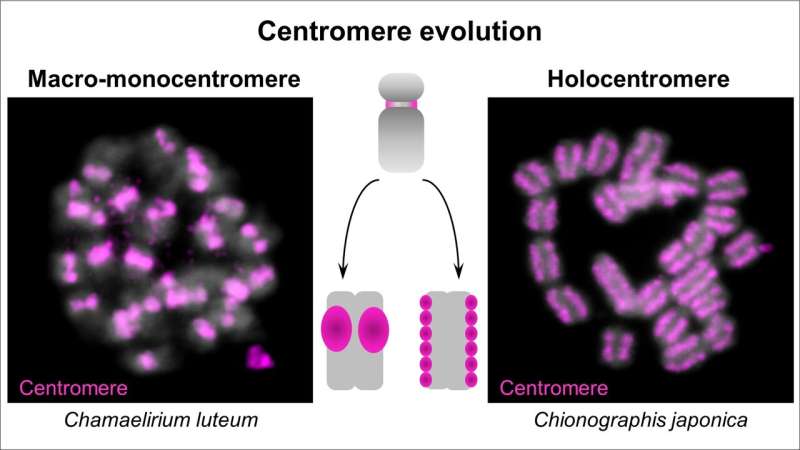
Recent research has provided significant insights into the evolution of centromeres, the essential components for chromosome transport during cell division. A team at the Leibniz Institute of Plant Genetics and Crop Plant Research (IPK) examined the genomes of two closely related lily-like plant species, revealing distinct evolutionary paths for their centromeres. Their findings, published in the journal Nature Communications on December 22, 2025, challenge previous assumptions about centromere evolution.
Most organisms, including plants and animals, typically possess a single, localized centromere per chromosome, known as a monocentromere. However, approximately 350,000 species, including nematodes and various plants, have a different type known as a holocentromere, characterized by multiple smaller centromeres distributed along the entire length of the chromosome. This configuration allows for more effective responses to chromosome breaks, reducing the risk of losing genetic material during cell division.
The IPK research team focused on comparing a species with a large monocentromere, Chamaelirium luteum, and a holocentric species, Chionographis japonica. According to Prof. Dr. Andreas Houben, the head of the research group, initial expectations were that a large centromere would evolve into an elongated form in a linear progression. Instead, the research uncovered that holocentric chromosomes developed independently from those with macromonocentric centromeres.
Dr. Yi-Tzu Kuo, the study’s first author, elaborated on the findings, stating that “the evolution of centromere types is driven by a complex interplay of gene mutations, epigenetic changes, and centromeric DNA expansion.” The research revealed that while the centromeric proportion of the overall genome is around 15% in both species, the distribution and structural characteristics are markedly different.
For the first time, the team successfully sequenced the giant monocentromere of Chamaelirium luteum, providing a clearer understanding of its structure. This extensive analysis highlighted the unique evolutionary trajectories of these plants’ centromeres, expanding the scientific community’s knowledge of centromere diversity.
Dr. Pavel Neumann, a co-author from the Academy of Sciences of the Czech Republic, emphasized the importance of studying non-model species for evolutionary comparisons. He stated, “This makes it possible to discover new features, even in structures that have been well studied, such as the centromere.”
The implications of this research extend beyond the specific species studied, offering valuable insights into the fundamental processes of genetic transmission and the evolutionary mechanisms that shape plant and animal genomes. The discoveries pave the way for further studies into centromere function and evolution, potentially informing agricultural practices and conservation efforts.
This research not only enhances our understanding of plant genetics but also underscores the intricate relationships between genetic structure and evolutionary outcomes. Further investigations will likely continue to unravel the complexities of centromere evolution and its broader implications in biology.










Revolutionary Photonic Ski-Jump Could Miniaturize LiDAR Systems

Couples Detox from Plastics in New Netflix Doc: Can It Boost Fertility?

Aventon Launches Affordable Full-Suspension Electric Mountain Bike

Discover Eight Must-Try Restaurants This Spring Season

UC Irvine Team Unveils Innovative Ion Pump for Water Treatment

One-Third of Americans Trim Daily Expenses for Healthcare Needs

Apple Secures First Oscar in Three Years with F1: The Movie

Fourth Graders Celebrate St. Patrick’s Day with Creative Weather Drawings

Kim Kardashian Dazzles at Vanity Fair Oscars Party 2026

Nostradamus’ 2026 Predictions: Star Death and Dark Events Loom

Breakthroughs and Challenges Await Science in 2026

Electric Moto Influencer Surronster Arrested in Tijuana

OpenAI to Implement Age Verification for ChatGPT by December 2025

Discover the Top 10 Calorie Counting Apps of 2025

Recovering a Suspended TikTok Account: A Step-by-Step Guide

Bella Hadid Shares Health Update After Treatment for Lyme Disease

Backpack Drives Equip Students with Supplies for New School Year

Analysts Project Stronger Growth for Apple’s iPhone 17 Lineup
-
 Science8 months ago
Nostradamus’ 2026 Predictions: Star Death and Dark Events Loom
-
 Science8 months ago
Breakthroughs and Challenges Await Science in 2026
-
 Technology11 months ago
Electric Moto Influencer Surronster Arrested in Tijuana
-
 Technology9 months ago
OpenAI to Implement Age Verification for ChatGPT by December 2025
-
 Technology1 year ago
Discover the Top 10 Calorie Counting Apps of 2025
-
 Technology1 year ago
Recovering a Suspended TikTok Account: A Step-by-Step Guide
-
 Health11 months ago
Bella Hadid Shares Health Update After Treatment for Lyme Disease
-
 Education1 year ago
Backpack Drives Equip Students with Supplies for New School Year
-
 Health12 months ago
Analysts Project Stronger Growth for Apple’s iPhone 17 Lineup
-

 Health12 months ago
Japanese Study Finds Rose Oil Can Increase Brain Gray Matter
-

 Technology8 months ago
Top 10 Penny Stocks to Watch in 2026 for Strong Returns
-

 Science10 months ago
Starship V3 Set for 2026 Launch After Successful Final Test of Version 2