
Science
Hubble Telescope Reveals Insights into Planet Formation

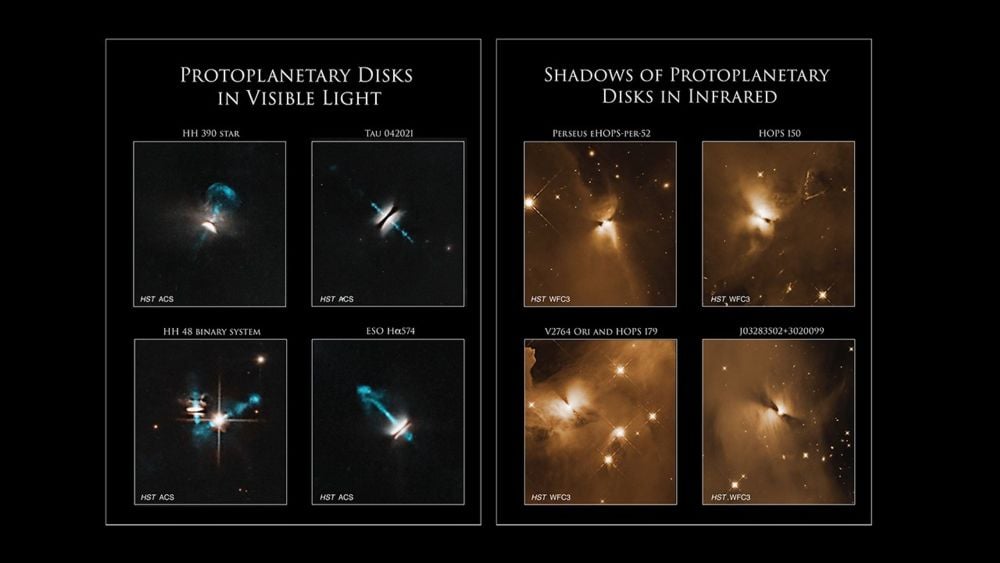
The Hubble Space Telescope continues to make significant contributions to our understanding of the cosmos, particularly regarding the formation of stars and planets. Recently, a new gallery of images showcases protoplanetary disks surrounding young stars, demonstrating Hubble’s ongoing relevance in astronomical research.
Since its launch over 35 years ago, Hubble has been instrumental in addressing critical questions in astronomy. Operating from its position in Low-Earth Orbit, the telescope has explored fundamental concepts such as the age and size of the Universe, the evolution of galaxies, and the nature of black holes. Among its key objectives has been the investigation of how stars and planets form, with observations from Hubble providing essential data that has shaped contemporary astrophysical theories.
Exploring Protoplanetary Disks
The newly released images reveal four distinct protoplanetary disks, captured in visible light using Hubble’s Advanced Camera for Surveys. These disks are dynamic environments where young stars, encased in clouds of gas, emerge. As the density within these clouds increases, pre-stellar cores form, which eventually undergo gravitational collapse to become protostars.
The disks around these protostars, initially termed circumstellar disks, are reclassified as protoplanetary disks once planets begin to form. The observations illustrate how these disks are influenced by the characteristics of the stars they encircle. For instance, the images highlight polar jets of gas and brightly lit nebulae, providing insight into the complex interactions occurring during star formation.
Among the featured objects, HH 390 is viewed at an angle, showcasing one side of its nebulosity, while Tau 042021 is captured edge-on, indicating a more advanced evolutionary stage. Meanwhile, HH 48, a binary protostar, demonstrates how the gravitational forces of the larger star impact the disk of its less massive companion. Lastly, ESO Hα574 presents a compact disk with a well-defined jet.
The dynamics within these disks are driven by angular momentum, which causes them to rotate around the forming star. This rotation facilitates the accretion of material onto the star over hundreds of thousands of years. Nevertheless, astrophysicists continue to investigate the mechanisms through which material transitions from the disk into the star, an area still lacking a comprehensive understanding.
Jets and their Effects on Surroundings
As material approaches the protostar, some of it is redirected along the star’s magnetic field lines, resulting in the formation of polar jets. These jets can reach speeds of several hundred kilometers per second. When these jets collide with interstellar medium clumps, they create bright phenomena known as Herbig-Haro Objects, which last only a few tens of thousands of years.
Despite the obscuring presence of dust around protostars, Hubble has been able to capture their infrared signatures. Using its Wide Field Camera 3, Hubble has provided detailed images of three bright protostars, including HOPS 150 and V2764 Orionis, located in the Orion Molecular Cloud Complex. The camera’s capabilities allow for observations in optical, ultraviolet, and portions of the infrared spectrum, although the jets themselves remain invisible in these infrared images.
The James Webb Space Telescope (JWST), which launched with ambitious scientific goals, has also contributed to our understanding of star and planet formation. Recent research based on JWST observations revealed complex structures within young protostars, including layered winds and jets, further enhancing our knowledge of these processes.
The collaboration between Hubble and JWST marks a pivotal moment in astrophysics, as the two telescopes complement each other’s findings. For example, data from Hubble and JWST has helped illustrate the intricate nature of protostellar winds and jets, with new insights emerging from the layered structures observed in these celestial phenomena.
As Hubble approaches a potential end, having exceeded its expected lifespan of 15 years, its contributions remain invaluable. Despite a reduction in operational efficiency due to the loss of gyroscopes—resulting in a 12% decrease in observational capacity—NASA anticipates that the telescope will continue to function into the next decade. Speculation around a possible servicing mission could extend its operational life even further.
The ongoing work of the Hubble Space Telescope not only enriches our understanding of stellar and planetary formation but also serves as a testament to human ingenuity in exploring the Universe. As researchers continue to analyze the data generated by Hubble, the insights gained will undoubtedly influence the future of astronomy for years to come.







Revolutionary Photonic Ski-Jump Could Miniaturize LiDAR Systems

Couples Detox from Plastics in New Netflix Doc: Can It Boost Fertility?

Aventon Launches Affordable Full-Suspension Electric Mountain Bike

Discover Eight Must-Try Restaurants This Spring Season

UC Irvine Team Unveils Innovative Ion Pump for Water Treatment

One-Third of Americans Trim Daily Expenses for Healthcare Needs

Apple Secures First Oscar in Three Years with F1: The Movie

Fourth Graders Celebrate St. Patrick’s Day with Creative Weather Drawings

Kim Kardashian Dazzles at Vanity Fair Oscars Party 2026

Nostradamus’ 2026 Predictions: Star Death and Dark Events Loom

Breakthroughs and Challenges Await Science in 2026

Electric Moto Influencer Surronster Arrested in Tijuana

OpenAI to Implement Age Verification for ChatGPT by December 2025

Discover the Top 10 Calorie Counting Apps of 2025

Bella Hadid Shares Health Update After Treatment for Lyme Disease

Analysts Project Stronger Growth for Apple’s iPhone 17 Lineup

Japanese Study Finds Rose Oil Can Increase Brain Gray Matter

Top 10 Penny Stocks to Watch in 2026 for Strong Returns
-
 Science3 months ago
Nostradamus’ 2026 Predictions: Star Death and Dark Events Loom
-
 Science4 months ago
Breakthroughs and Challenges Await Science in 2026
-
 Technology7 months ago
Electric Moto Influencer Surronster Arrested in Tijuana
-
 Technology4 months ago
OpenAI to Implement Age Verification for ChatGPT by December 2025
-
 Technology9 months ago
Discover the Top 10 Calorie Counting Apps of 2025
-
 Health7 months ago
Bella Hadid Shares Health Update After Treatment for Lyme Disease
-
 Health7 months ago
Analysts Project Stronger Growth for Apple’s iPhone 17 Lineup
-
 Health7 months ago
Japanese Study Finds Rose Oil Can Increase Brain Gray Matter
-
 Technology4 months ago
Top 10 Penny Stocks to Watch in 2026 for Strong Returns
-

 Science6 months ago
Starship V3 Set for 2026 Launch After Successful Final Test of Version 2
-

 Technology1 month ago
Nvidia GTC 2026: Major Announcements Expected for AI and Hardware
-

 Education7 months ago
Harvard Secures Court Victory Over Federal Funding Cuts