
Science
Antarctica’s Gravity Anomaly Sheds Light on Earth’s Interior Dynamics

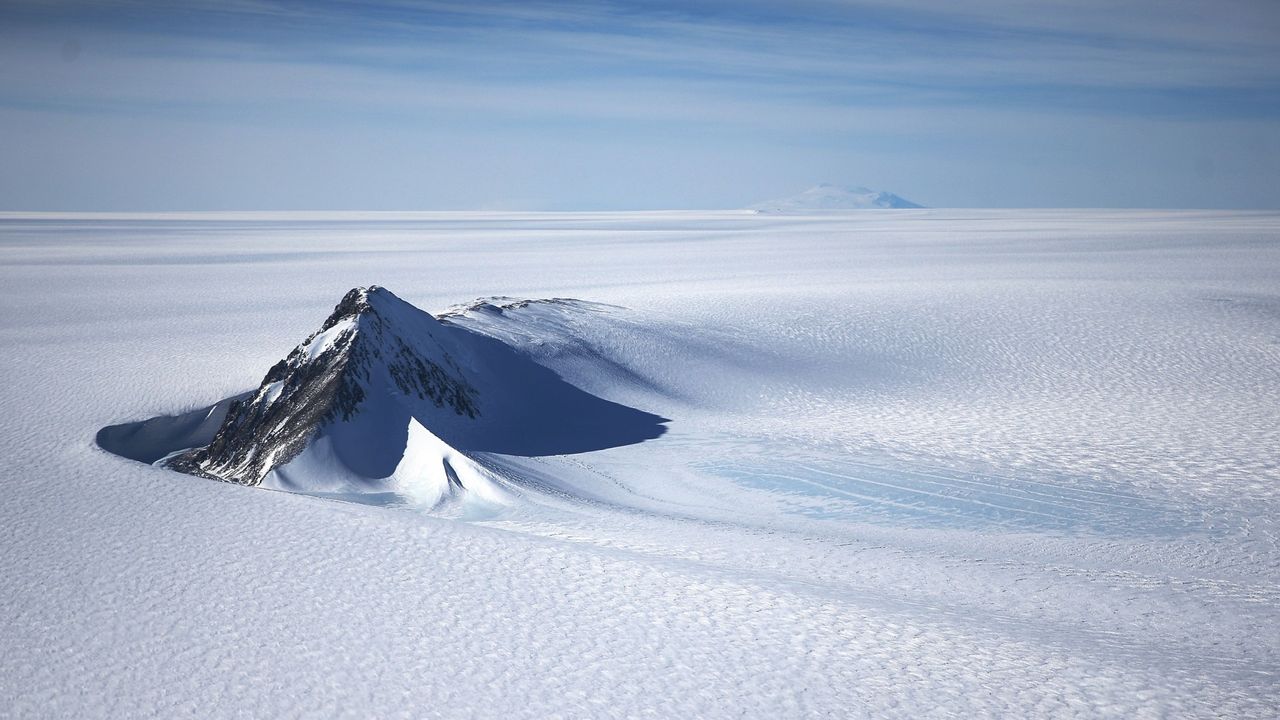
A significant study led by researchers at the University of Florida has unveiled how a “gravity hole” beneath Antarctica provides insights into the evolution of Earth’s deep interior. Known formally as the Antarctic Geoid Low, this anomaly reveals the distribution of mass deep within the planet and highlights processes that have shaped Earth over the last 70 million years.
The Antarctic Geoid Low is not a literal void but rather a gentle depression in Earth’s gravitational field, reflecting the slow, dynamic movements of rock deep beneath the Antarctic ice sheet. In a recent study published in the journal Scientific Reports, researchers reconstructed the evolution of this gravitational anomaly, showing that it is a long-standing feature influenced by powerful geological currents.
According to Alessandro Forte, Ph.D., a professor of geophysics at the University of Florida and co-author of the study, this gravity hole serves as a “window into deep Earth movements.” He explained that it demonstrates how geological processes occurring deep within the Earth can significantly alter the planet’s gravity field. “It’s a very broad, gentle low in Earth’s gravity field,” Forte stated.
The term “gravity hole” might suggest a hazardous area, but in reality, its effects on human weight are negligible. For instance, a person weighing 198 pounds (90 kilograms) would be only about 5 to 6 grams lighter in this region. The scientific implications, however, are profound, as the anomaly provides critical information about how material is arranged beneath the Earth’s surface and how that distribution has changed over geological time.
Earth’s gravitational pull varies slightly due to its non-uniform interior. Hotter, buoyant mantle rock rises while colder, denser slabs of ancient seafloor sink, redistributing mass within the planet. In areas like Antarctica, where gravity is slightly weaker, the ocean’s level surface is closer to the Earth’s center. If Earth were enveloped by a calm ocean, the water would settle into valleys and hills determined solely by gravity, with the Antarctic Geoid Low representing one of the deepest of these valleys.
The researchers utilized seismic images of today’s mantle, derived from earthquake wave data, to create high-performance computer models that simulate the mantle’s past behavior. Reconstructing the past requires testing various assumptions about rock properties, such as viscosity, which indicates how resistant mantle materials are to deformation.
“What surprised me most is how coherent the long-term story appears to be,” Forte noted. “The gravity low is not a random, short-lived feature.” Instead, it has persisted over the last 70 million years, with its strength and shape evolving in response to significant changes in the flow of rocks beneath Antarctica.
The study found that the Antarctic gravity low intensified around the time Antarctica transitioned to a permanently ice-covered continent approximately 34 million years ago. This timing raises intriguing possibilities about the interplay between gravity and regional sea levels. The gravity-defined sea surface in the Antarctic geoid low currently sits about 394 feet (120 meters) below the global average, suggesting that gradual gravitational shifts could influence measurements of regional sea levels over time.
While the research does not directly link changes in gravity to ice growth, it emphasizes an internal Earth process that coincided with significant climatic events. “Our study shows how deep Earth dynamics can reshape the gravity field over geological time,” Forte explained, acknowledging that further modeling is necessary to explore the potential impacts on climate and ice.
Antarctica’s gravity hole is unique due to its considerable size, long-wavelength amplitude, and sustained presence over millions of years. In models that isolate signals driven by mantle dynamics, it stands out as the deepest long-wavelength low on the planet. While other regions may show larger gravity lows, none match this feature’s distinct mantle-driven signature.
The study’s implications extend beyond Earth. Long-wavelength gravity anomalies can provide valuable clues about the internal dynamics of other planets, including Mars and Venus. Spacecraft tracking data on these worlds reveal gravity variations that offer insights into their structures and ancient geological activities. Earth’s ability to cross-check gravity measurements against seismic data and geological records allows scientists to reconstruct not only current conditions but also the processes that have shaped the planet over time.
The findings from this research represent nearly a decade of collaborative work, primarily led by first author Petar Glišović and in partnership with seismologists from UT Austin. The study underscores the importance of understanding Earth’s internal processes and their potential implications for our planet’s future.











Revolutionary Photonic Ski-Jump Could Miniaturize LiDAR Systems

Couples Detox from Plastics in New Netflix Doc: Can It Boost Fertility?

Aventon Launches Affordable Full-Suspension Electric Mountain Bike

Discover Eight Must-Try Restaurants This Spring Season

UC Irvine Team Unveils Innovative Ion Pump for Water Treatment

One-Third of Americans Trim Daily Expenses for Healthcare Needs

Apple Secures First Oscar in Three Years with F1: The Movie

Fourth Graders Celebrate St. Patrick’s Day with Creative Weather Drawings

Kim Kardashian Dazzles at Vanity Fair Oscars Party 2026

Nostradamus’ 2026 Predictions: Star Death and Dark Events Loom

Breakthroughs and Challenges Await Science in 2026

Electric Moto Influencer Surronster Arrested in Tijuana

OpenAI to Implement Age Verification for ChatGPT by December 2025

Discover the Top 10 Calorie Counting Apps of 2025

Recovering a Suspended TikTok Account: A Step-by-Step Guide

Bella Hadid Shares Health Update After Treatment for Lyme Disease

Backpack Drives Equip Students with Supplies for New School Year

Analysts Project Stronger Growth for Apple’s iPhone 17 Lineup
-
 Science8 months ago
Nostradamus’ 2026 Predictions: Star Death and Dark Events Loom
-
 Science8 months ago
Breakthroughs and Challenges Await Science in 2026
-
 Technology11 months ago
Electric Moto Influencer Surronster Arrested in Tijuana
-
 Technology9 months ago
OpenAI to Implement Age Verification for ChatGPT by December 2025
-
 Technology1 year ago
Discover the Top 10 Calorie Counting Apps of 2025
-
 Technology1 year ago
Recovering a Suspended TikTok Account: A Step-by-Step Guide
-
 Health11 months ago
Bella Hadid Shares Health Update After Treatment for Lyme Disease
-
 Education1 year ago
Backpack Drives Equip Students with Supplies for New School Year
-
 Health12 months ago
Analysts Project Stronger Growth for Apple’s iPhone 17 Lineup
-

 Health12 months ago
Japanese Study Finds Rose Oil Can Increase Brain Gray Matter
-

 Technology8 months ago
Top 10 Penny Stocks to Watch in 2026 for Strong Returns
-

 Science10 months ago
Starship V3 Set for 2026 Launch After Successful Final Test of Version 2