
Lifestyle
Lunar New Year Celebrations Illuminate Cultural and Spiritual Ties

On the eve of the Lunar New Year, families across Asia gather for reunion dinners that serve as cherished rituals of connection and continuity. Children return from distant cities, while migrant workers navigate long journeys home. Elders sit in anticipation, eager for the comforting sounds of familiar footsteps. This annual celebration transcends mere feasting; it embodies a profound act of restoration and togetherness.
For many Chinese Christians, the Lunar New Year is a cultural milestone rather than a religious observance. It marks the turning of the lunar calendar and provides a collective opportunity to honor family, ancestry, and shared hopes. When Chinese Catholics and other Christians come together for a special New Year Mass, the occasion gains deeper theological significance. Lanterns illuminate the pews, and traditional attire brightens the sanctuary. After the final blessing, congregants receive Mandarin oranges, a gesture rich with meaning.
This blending of cultural practices and religious faith raises an important question: how does the Gospel integrate with local culture? The concept of inculturation provides insight. This theological principle holds that the Gospel does not eliminate culture; instead, it enters, purifies, and elevates it. Christianity is not an abstract ideology but a lived reality, expressed within specific languages, traditions, and communities.
The Second Vatican Council emphasized this notion as “accommodated preaching of the revealed Word,” highlighting the need for the Church to communicate its teachings in ways that resonate with people’s lived experiences. In Asia, the Federation of Asian Bishops’ Conferences (FABC) has underscored the importance of allowing the Church to adopt an Asian identity. This approach emphasizes expressing the Gospel through local symbols, music, languages, and values without altering the core of Christian belief.
Symbolism of Reunion and Reconciliation
The reunion dinner on New Year’s Eve carries powerful echoes of Gospel themes. Families separated by distance, economic hardships, or unresolved conflicts gather at the same table. Differences are momentarily set aside, as elders bless the younger generations, and stories are shared. This gathering mirrors the parable of the Prodigal Son, where the father awaits the return of his child, leading to a joyous feast. Christianity itself is a narrative of reunion, depicting God’s reconciliation with humanity.
The Eucharist represents a sacred meal of restored communion, suggesting that the family gathering and the altar complement rather than compete with each other. In many Asian societies where filial piety remains a guiding principle, this convergence holds significant meaning. Honoring parents and elders aligns with the biblical commandment to respect one’s father and mother, transforming cultural virtues into theological affirmations.
Cultural Symbols Reinterpreted Through Faith
The act of distributing blessed oranges during the Lunar New Year Mass exemplifies this process of inculturation. In Chinese culture, oranges symbolize goodwill, abundance, and prosperity. Their vibrant color signifies fullness and blessing. Within a Catholic framework, this notion is reinterpreted to convey that true prosperity encompasses God’s providence—peace in the home, unity in relationships, and courage amid uncertainty. The fruit serves as a miniature catechism, communicating the Gospel in a culturally relevant dialect.
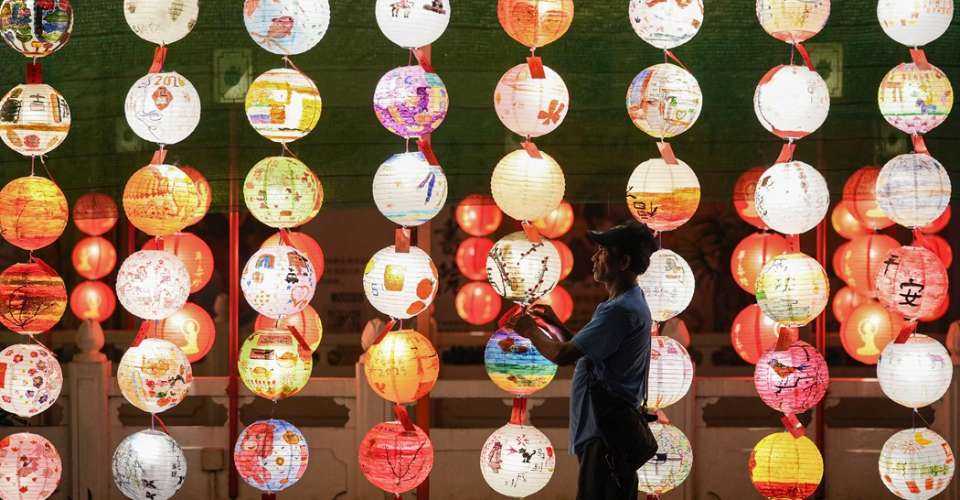
The symbolism continues with the use of lanterns, which in Chinese culture represent joy and auspiciousness. In Christian tradition, red signifies the fire of the Holy Spirit and Christ’s sacrificial love. Lanterns symbolize light, which aligns with Christ’s proclamation as the Light of the World. The Church’s celebration during this time does not focus on luck, but rather on divine providence and hope grounded in faith.
These cultural gestures carry particular weight in Asia, where Christianity can sometimes be perceived as foreign. When the Church’s sanctuary reflects local aesthetics, it sends a message that faith is not an imported concept but a vibrant presence within the fabric of Asian history.
In Malaysia, the Lunar New Year takes on additional social and political significance. The tradition of “open house” transforms private celebrations into public acts of hospitality. Chinese families welcome friends, neighbors, and colleagues—regardless of their backgrounds—into their homes, sharing food and fellowship. In a nation often scrutinized through the lens of race and religion, this practice stands as a testament to lived pluralism, where ordinary citizens demonstrate coexistence.
For Chinese Christians, this tradition aligns with the Gospel’s call for hospitality. As stated in Matthew’s Gospel, “I was a stranger, and you welcomed me.” Extending invitations during the Lunar New Year becomes a meaningful act of Christian witness. In regions where religious sensitivities can easily escalate, such cultural practices foster trust and emphasize that identity does not have to be defensive.
The Church’s involvement in Lunar New Year celebrations carries interfaith significance. It illustrates that Christianity in Malaysia is not detached from national life but intricately woven into it. The lanterns in churches and the open houses in communities convey a shared message: faith and culture can coexist harmoniously.
As the lunar year progresses, Asian Christians find themselves at the crossroads of memory and mission. They gather around family tables and altars, exchanging oranges and prayers, and hanging lanterns that symbolize the Light of Christ. The New Year embodies not just luck or superstition, but a hope anchored in divine providence and a renewed spirit of reconciliation. It highlights that light can penetrate culture, transforming it from within and affirming that Asian Christianity has a place not in conflict but in a vibrant, living tradition.











Revolutionary Photonic Ski-Jump Could Miniaturize LiDAR Systems

Couples Detox from Plastics in New Netflix Doc: Can It Boost Fertility?

Aventon Launches Affordable Full-Suspension Electric Mountain Bike

Discover Eight Must-Try Restaurants This Spring Season

UC Irvine Team Unveils Innovative Ion Pump for Water Treatment

One-Third of Americans Trim Daily Expenses for Healthcare Needs

Apple Secures First Oscar in Three Years with F1: The Movie

Fourth Graders Celebrate St. Patrick’s Day with Creative Weather Drawings

Kim Kardashian Dazzles at Vanity Fair Oscars Party 2026

Nostradamus’ 2026 Predictions: Star Death and Dark Events Loom

Breakthroughs and Challenges Await Science in 2026

Electric Moto Influencer Surronster Arrested in Tijuana

OpenAI to Implement Age Verification for ChatGPT by December 2025

Discover the Top 10 Calorie Counting Apps of 2025

Bella Hadid Shares Health Update After Treatment for Lyme Disease

Analysts Project Stronger Growth for Apple’s iPhone 17 Lineup

Japanese Study Finds Rose Oil Can Increase Brain Gray Matter

Top 10 Penny Stocks to Watch in 2026 for Strong Returns
-
 Science3 months ago
Nostradamus’ 2026 Predictions: Star Death and Dark Events Loom
-
 Science4 months ago
Breakthroughs and Challenges Await Science in 2026
-
 Technology7 months ago
Electric Moto Influencer Surronster Arrested in Tijuana
-
 Technology4 months ago
OpenAI to Implement Age Verification for ChatGPT by December 2025
-
 Technology9 months ago
Discover the Top 10 Calorie Counting Apps of 2025
-
 Health7 months ago
Bella Hadid Shares Health Update After Treatment for Lyme Disease
-
 Health7 months ago
Analysts Project Stronger Growth for Apple’s iPhone 17 Lineup
-
 Health7 months ago
Japanese Study Finds Rose Oil Can Increase Brain Gray Matter
-
 Technology4 months ago
Top 10 Penny Stocks to Watch in 2026 for Strong Returns
-

 Science6 months ago
Starship V3 Set for 2026 Launch After Successful Final Test of Version 2
-

 Technology1 month ago
Nvidia GTC 2026: Major Announcements Expected for AI and Hardware
-

 Education7 months ago
Harvard Secures Court Victory Over Federal Funding Cuts