
Education
Graduate Student Innovates Software for Fusion Power Plant Design

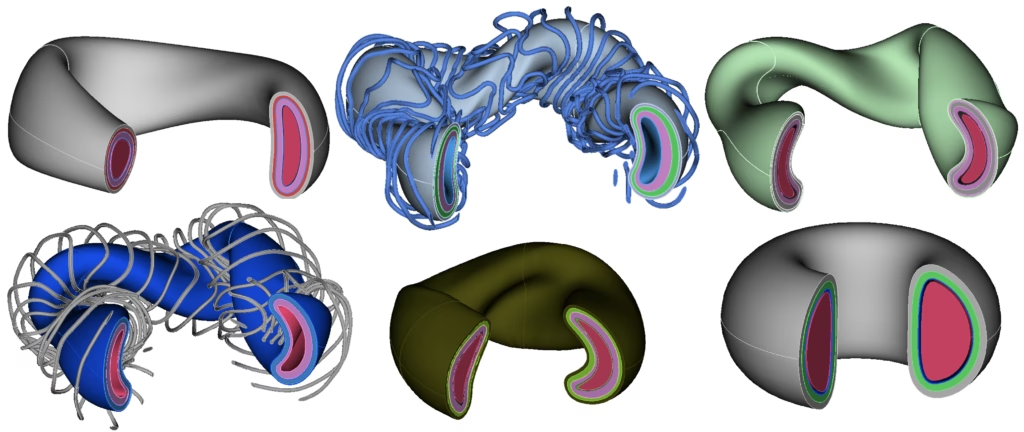
Connor Moreno, a graduate student at the University of Wisconsin–Madison, has developed innovative software tools aimed at enhancing the design processes of commercial fusion power plants. As a PhD candidate in the Department of Nuclear Engineering and Engineering Physics (NEEP), Moreno’s work focuses on addressing the challenges associated with stellarator design, a complex type of fusion reactor. His dedication stems from an early interest in fusion, sparked during his undergraduate studies, where he explored neutron physics and the pressing need for sustainable energy solutions.
Recognizing the limitations of traditional modeling techniques, Moreno created ParaStell, a software tool specifically designed to automate the parametric modeling of stellarators. This tool stands out as one of the few open-source options available and has quickly become a vital resource for private fusion startups. Companies have begun integrating ParaStell into their design workflows to enhance efficiency and productivity.
Revolutionizing Fusion Design
Moreno describes the evolution of ParaStell, stating, “I had to build it from the ground up. It started as a hodgepodge of different scripts, but now it’s a polished software package.” The software not only streamlines the creation of computer-aided design (CAD) models but also supports neutronics calculations. This capability allows researchers to optimize stellarator designs by simulating various performance metrics, including assessing potential radiation damage to reactor components.
Funding for Moreno’s research comes through a partnership known as HiFiStell, part of a multi-institutional initiative that leverages high-fidelity simulations and advanced computing for stellarator design. Professor and NEEP Department Chair Paul Wilson notes, “Our relationship with fusion energy startups that are pursuing the stellarator concept has allowed us to quickly translate the outcomes of this federal funding to influence the design process of fusion power plants.”
ParaStell is already in use by innovative companies such as Gauss Fusion and Type One Energy, a spinoff from the university co-founded by Professor Chris Hegna. Moreno has collaborated closely with two master’s students from NEEP to integrate ParaStell into Type One Energy’s neutronics design workflow, particularly for neutron and photon transport modeling.
Collaborative Efforts in Fusion Research
The integration of ParaStell has proven essential for the design of key components like the breeding blanket, a device that not only produces more fusion fuel but also protects magnetic coils from neutron radiation. Moreno emphasizes the importance of collaboration between private companies and national laboratories, stating, “It’s exciting to see my work having a real impact on these companies. It’s not just in this little box that exists only for me; it’s useful for other people.”
His ongoing research is poised to make an even greater impact. While ParaStell aids in modeling reactor designs, Moreno aims to automate the overall stellarator design process through advanced design optimization methodologies. He points out that despite the extensive use of design optimization in other industries, it remains largely underutilized within the nuclear sector, particularly in fusion research.
The challenges presented by stellarator design stem from their intricate geometries, making traditional design methods tedious and time-consuming. By applying design optimization techniques, Moreno believes that fusion companies and national laboratories can improve their design efficiency.
Looking ahead, Moreno plans to continue his contributions to the fusion energy sector after graduation, striving to advance reactor designs that could ultimately provide limitless clean energy. Wilson underscores the significance of Moreno’s expertise, stating, “The fusion energy industry is still quite young and needs people like Connor who are trained to help them answer the most challenging aspects of designing fusion power plants.”
Moreno’s work represents a crucial step in the journey toward commercializing fusion energy, highlighting the vital role of innovation and collaboration in tackling one of the most pressing challenges of our time: the quest for sustainable energy.













Revolutionary Photonic Ski-Jump Could Miniaturize LiDAR Systems

Couples Detox from Plastics in New Netflix Doc: Can It Boost Fertility?

Aventon Launches Affordable Full-Suspension Electric Mountain Bike

Discover Eight Must-Try Restaurants This Spring Season

UC Irvine Team Unveils Innovative Ion Pump for Water Treatment

One-Third of Americans Trim Daily Expenses for Healthcare Needs

Apple Secures First Oscar in Three Years with F1: The Movie

Fourth Graders Celebrate St. Patrick’s Day with Creative Weather Drawings

Kim Kardashian Dazzles at Vanity Fair Oscars Party 2026

Nostradamus’ 2026 Predictions: Star Death and Dark Events Loom

Breakthroughs and Challenges Await Science in 2026

Electric Moto Influencer Surronster Arrested in Tijuana

OpenAI to Implement Age Verification for ChatGPT by December 2025

Discover the Top 10 Calorie Counting Apps of 2025

Recovering a Suspended TikTok Account: A Step-by-Step Guide

Bella Hadid Shares Health Update After Treatment for Lyme Disease

Backpack Drives Equip Students with Supplies for New School Year

Analysts Project Stronger Growth for Apple’s iPhone 17 Lineup
-
 Science8 months ago
Nostradamus’ 2026 Predictions: Star Death and Dark Events Loom
-
 Science8 months ago
Breakthroughs and Challenges Await Science in 2026
-
 Technology11 months ago
Electric Moto Influencer Surronster Arrested in Tijuana
-
 Technology9 months ago
OpenAI to Implement Age Verification for ChatGPT by December 2025
-
 Technology1 year ago
Discover the Top 10 Calorie Counting Apps of 2025
-
 Technology1 year ago
Recovering a Suspended TikTok Account: A Step-by-Step Guide
-
 Health11 months ago
Bella Hadid Shares Health Update After Treatment for Lyme Disease
-
 Education1 year ago
Backpack Drives Equip Students with Supplies for New School Year
-
 Health12 months ago
Analysts Project Stronger Growth for Apple’s iPhone 17 Lineup
-

 Health12 months ago
Japanese Study Finds Rose Oil Can Increase Brain Gray Matter
-

 Technology8 months ago
Top 10 Penny Stocks to Watch in 2026 for Strong Returns
-

 Science10 months ago
Starship V3 Set for 2026 Launch After Successful Final Test of Version 2