
Education
Arizona Confronts Teacher Retention Crisis Amid Ongoing Shortage

The struggle to retain teachers in Arizona has reached alarming levels, as recent data from the Arizona Department of Education (ADE) reveals that nearly 14.4% of educators who began teaching in the 2024-25 school year are no longer in the classroom. This statistic highlights the challenges facing the state’s education system amid a persistent teacher shortage. Although the percentage of teachers leaving within their first four years has decreased from nearly 18% in the previous year, the overall turnover remains concerning.
The data indicates that among the teachers who did not return for the current school year, 42.8% had four or fewer years of experience. Of the educators who left, 20.9% had between five to nine years of experience, 19.2% had ten to nineteen years, and 17.1% had twenty or more years in the profession. These figures underscore the need for effective retention strategies to support teachers throughout their careers.
In an effort to understand the reasons behind this turnover, the ADE conducts surveys targeting educators who leave the profession. The most recent survey, the Teachers Who Left the Classroom Survey, was distributed in March 2025 to 8,046 teachers who exited after the 2023-24 school year. With a response rate of 31.5%, the survey revealed that the top five reasons for leaving included burnout, lack of respect, student behavior issues, interruptions during teaching, and the pursuit of higher salaries.
At a recent state Board of Education meeting, Jamie Wilber, ADE’s deputy associate superintendent for educator preparation, certification, and recruitment and retention, outlined three strategies developed by a task force aimed at improving teacher retention: enhancing teacher voice, providing robust mentoring, and implementing retention plans. Newly inducted board member Todd Haynie, president of Eastern Arizona College, raised questions about the factors contributing to early departures, particularly whether burnout or unrealistic expectations play a role.
Wilber acknowledged that many educators feel unprepared for the challenges of the profession. She emphasized the importance of connecting new teachers with effective mentorship that goes beyond mere buddy systems. “One size does not fit all,” she explained, pointing out the need for tailored support systems that align with new teacher induction standards.
Arizona Superintendent of Public Instruction Tom Horne highlighted that improving educator preparation programs is a priority for the department. Efforts are underway to collaborate with Arizona’s three public universities to review and enhance teacher preparation curricula. This initiative aims to ensure that teachers are better equipped for the realities of classroom instruction.
The discussion also touched on the impact of certification on retention rates. Board member Jason Catanese raised concerns about whether teachers without formal education training or those who were emergency-certified are more likely to leave the profession. According to Wilber, teachers who are appropriately certified exhibit a retention rate of 85%, compared to 75% for those without proper certification.
Advocacy for higher salaries across all school-related positions was another key point raised during the meeting. Catanese stressed the need for the board to represent the interests of not only teachers but also paraprofessionals, bus drivers, and cafeteria workers, urging them to be vocal in legislative discussions.
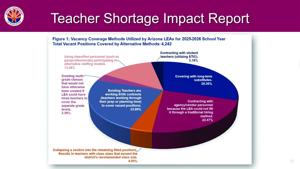
As Arizona continues to experience a teacher shortage, the ADE’s 2025 Teacher Shortage Impact Report found 4,242 vacancies out of 57,567 planned positions within school districts and charter schools as of September 2025. Long-term substitutes fill the largest share of these vacancies, accounting for 29.56%, while existing teachers working additional hours cover 23.88%. The report also identified various alternative staffing methods, including contracting with agency personnel and employing classified staff.
Middle schools emerged as a critical area for staffing, with the lowest teacher retention rate of 79% compared to 83% for elementary and high school teachers. Special education and Structured English Immersion classrooms also face significant challenges, with up to 15% of educators leaving their positions.
Wilber remarked, “Retention is the new recruitment.” She emphasized that focusing on retaining current educators is essential for effective recruitment strategies to succeed. The ADE’s commitment to addressing these challenges will play a crucial role in shaping the future of education in Arizona, as the state seeks to build a more stable teaching workforce.













Paul Mohror Announces Candidacy for Fargo School Board Election

28 Yotes Earn All-Summit League Team Honors After Strong Championships

New Method Accurately Differentiates Life and Non-Life Using Amino Acids

Texas Health Plans New Hospital in McKinney to Open by 2028

Kalamata Airport to Launch 31 Routes to 22 Destinations in 2026

Pope’s Words Inspire Local Council Actions and Community Engagement

Boston’s February 26, 2026, Edition Highlights Local and Global Trends

NASA Astronaut Captures Stunning Space Photo from ISS

Advocates Push for Disability Services Expansion in California

Nostradamus’ 2026 Predictions: Star Death and Dark Events Loom

OpenAI to Implement Age Verification for ChatGPT by December 2025

Discover the Top 10 Calorie Counting Apps of 2025

Electric Moto Influencer Surronster Arrested in Tijuana

Bella Hadid Shares Health Update After Treatment for Lyme Disease

Breakthroughs and Challenges Await Science in 2026

Analysts Project Stronger Growth for Apple’s iPhone 17 Lineup

Top 10 Penny Stocks to Watch in 2026 for Strong Returns

Harvard Secures Court Victory Over Federal Funding Cuts
-
 Science2 months ago
Nostradamus’ 2026 Predictions: Star Death and Dark Events Loom
-
 Technology3 months ago
OpenAI to Implement Age Verification for ChatGPT by December 2025
-
 Technology7 months ago
Discover the Top 10 Calorie Counting Apps of 2025
-
 Technology5 months ago
Electric Moto Influencer Surronster Arrested in Tijuana
-
 Health5 months ago
Bella Hadid Shares Health Update After Treatment for Lyme Disease
-
 Science2 months ago
Breakthroughs and Challenges Await Science in 2026
-
 Health6 months ago
Analysts Project Stronger Growth for Apple’s iPhone 17 Lineup
-
 Technology2 months ago
Top 10 Penny Stocks to Watch in 2026 for Strong Returns
-
 Education6 months ago
Harvard Secures Court Victory Over Federal Funding Cuts
-

 Science4 months ago
Starship V3 Set for 2026 Launch After Successful Final Test of Version 2
-

 Health6 months ago
Erin Bates Shares Recovery Update Following Sepsis Complications
-

 Technology8 months ago
Meta Initiates $60B AI Data Center Expansion, Starting in Ohio